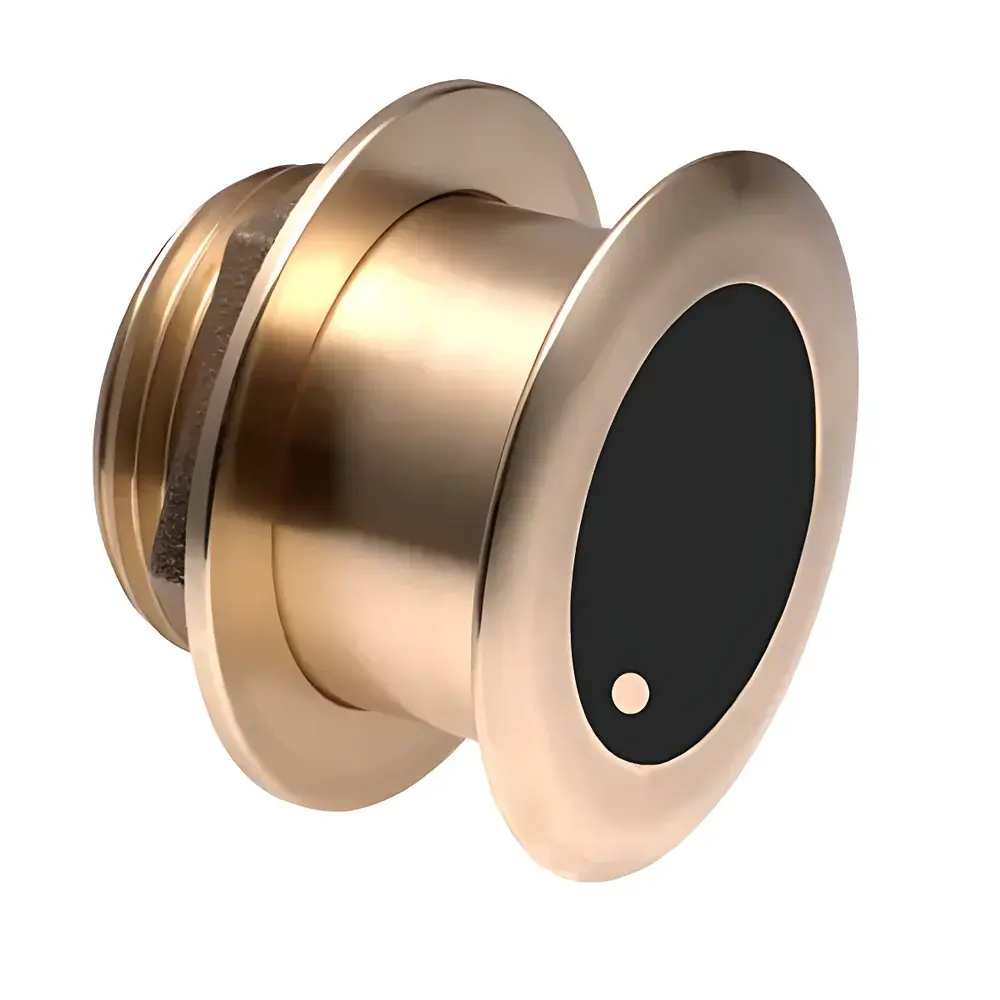
Airmar B164 Low-Profile Through-Hull Depth Sounder Transducer
| Brand | Airmar |
|---|---|
| Origin | USA |
| Model | B164 |
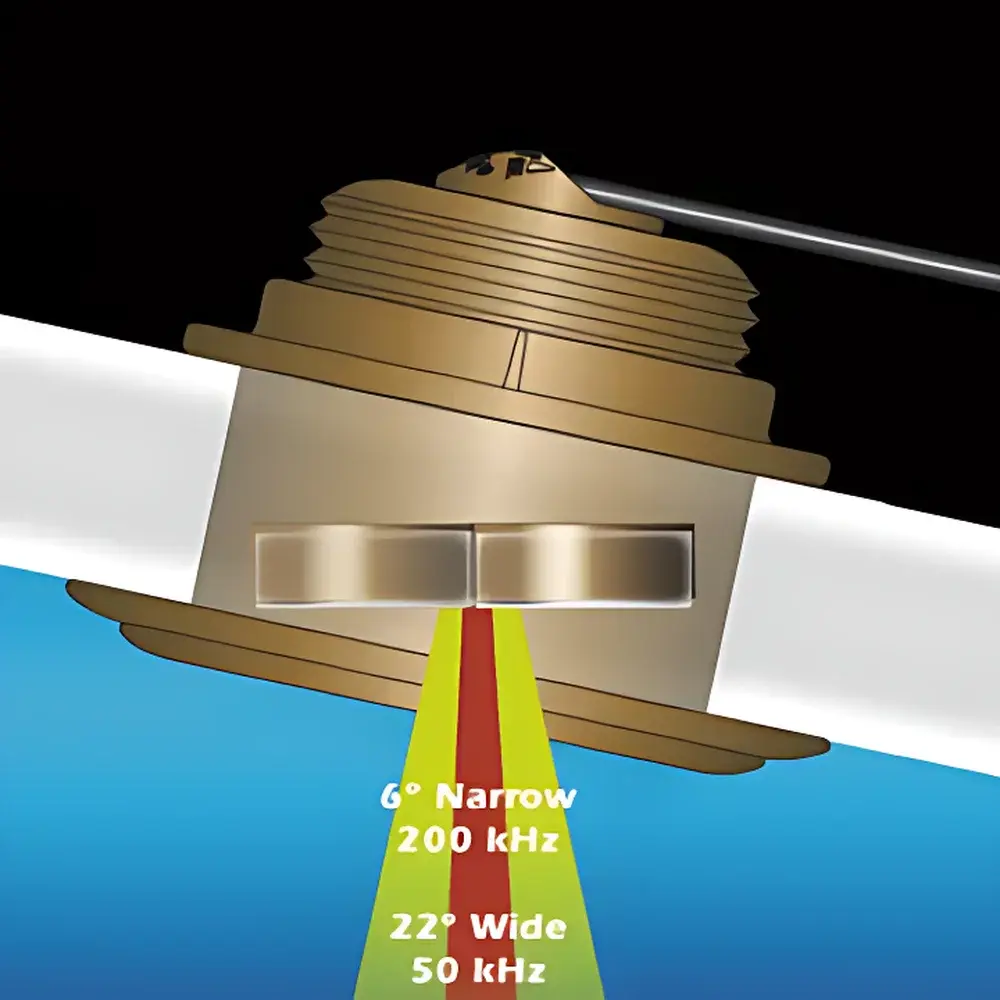
| Operating Frequencies | 50 kHz / 200 kHz |
| Beamwidth | 22° × 20° @ 50 kHz |
| Output Power | 1000 W |
| Mounting Type | Through-Hull (Low-Profile) |
| Housing Material | Bronze |
| Transducer Window | Polyurethane |
| Hole Diameter | 95 mm |
| Shaft Length | 71 mm |
| Cable Length | 10 m |
| Integrated Temperature Sensor | Yes |
| Tilt Options | 0°, 12°, or 20° |
| Maximum Hull Angle | 24° |
| Weight | 1.4 kg |
Overview
The Airmar B164 is a high-performance, low-profile through-hull depth sounder transducer engineered for precision hydrographic sensing on performance-oriented vessels ranging from 8 to 11 meters in length. It operates on dual-frequency active sonar principles—emitting and receiving acoustic pulses at both 50 kHz (for deep-water penetration and bottom contour mapping) and 200 kHz (for high-resolution shallow-water imaging and target discrimination). Its core architecture employs a single-element piezoceramic crystal with Airmar’s proprietary Tilted Element™ design, which mechanically offsets the acoustic axis to compensate for hull deadrise angles up to 24°—eliminating beam distortion without requiring external fairings or flow-through housings. Unlike conventional transducers, the B164 extends only 6.35 mm (0.25 in) beyond the hull surface, ensuring minimal drag, zero cavitation risk, and unimpaired vessel maneuverability—critical for tournament fishing, trolling, and fast-planing applications.
Key Features
- 1000 W peak acoustic output power enables reliable depth returns in turbid, sediment-laden, or thermally stratified water columns.
- Tilted Element™ technology provides intrinsic beam alignment correction across 0°, 12°, and 20° mounting configurations—each calibrated to match standard marine electronics brand protocols (Raymarine, Garmin, Furuno, Lowrance).
- Patented XducerID® digital identification ensures plug-and-play compatibility with modern multifunction displays (MFDs), auto-configuring frequency, tilt angle, and sensor calibration parameters via NMEA 2000.
- Integrated high-stability thermistor delivers real-time water temperature data with ±0.5°C accuracy—essential for sound velocity correction in bathymetric calculations per ISO 17025-compliant survey workflows.
- Bronze housing offers superior corrosion resistance in saltwater environments and galvanic compatibility with fiberglass, wood, and aluminum hulls; stainless steel variant (SS164) is available for steel-hulled vessels.
- Polyurethane acoustic window provides broadband impedance matching, wide operating temperature range (−10°C to +60°C), and resilience against impact and biofouling.
Sample Compatibility & Compliance
The B164 is certified for use in commercial and recreational marine environments under IEC 60945 (Maritime Navigation and Radiocommunication Equipment) and meets EMC requirements per EN 301 489-1/17. Its mechanical design complies with ABYC TE-14 (Transducer Installation Standards) and adheres to NMEA 2000 PGN 128259 (Depth, Water Temperature) and PGN 127250 (Environmental Parameters). The transducer supports GLP-aligned data traceability when paired with NMEA 2000-certified chartplotters that implement timestamped sensor logging and audit-trail metadata—supporting post-mission QA/QC verification in fisheries research and coastal zone management applications.
Software & Data Management
No proprietary software is required. The B164 communicates natively with all major MFD platforms using standardized NMEA 0183 (depth, temperature, and transducer status sentences) and NMEA 2000 (PGN-based parameter streaming). When integrated into systems supporting NMEA OneNet or SeaTalkNG, it enables synchronized multi-sensor fusion—including GPS position, heading, and motion data—for georeferenced echogram generation. Firmware updates (if applicable) are delivered via MFD interface; XducerID® stores persistent transducer-specific calibration coefficients, eliminating manual setup during hardware replacement or system migration.
Applications
- High-speed sportfishing operations requiring real-time bottom tracking and thermocline detection at speeds exceeding 35 knots.
- Shallow-water bathymetric profiling for marina development, dredging planning, and habitat mapping (e.g., seagrass bed delineation).
- Scientific echo-sounding in estuarine and nearshore zones where variable salinity and suspended solids demand robust signal-to-noise ratio.
- OEM integration into autonomous surface vehicles (ASVs) and remotely operated hydrographic platforms due to its compact footprint and vibration-damped mounting geometry.
- Regulatory compliance monitoring for fisheries observers, including depth-referenced catch location logging aligned with FAO Standardized Fishery Statistics reporting formats.
FAQ
Does the B164 require a fairing or speed dome for installation?
No. Its ultra-low profile and Tilted Element™ design eliminate the need for external hydrodynamic housings.
Can the B164 be installed on cored fiberglass hulls?
Yes—provided the core material is properly sealed and reinforced around the 95 mm cutout per ABYC TE-14 guidelines.
Is the built-in temperature sensor calibrated to NIST-traceable standards?
The thermistor is factory-calibrated to ±0.5°C tolerance; full traceability documentation is available upon request for ISO/IEC 17025-accredited laboratories.
What is the maximum operational depth range at 50 kHz?
Under typical oceanic conditions (1500 m/s sound velocity), the B164 achieves usable bottom detection to 300 m at 50 kHz with 1000 W output and appropriate receiver gain settings.
How does XducerID® improve system interoperability?
It embeds transducer-specific metadata—including model, tilt angle, frequency pair, and serial number—into the NMEA 2000 stream, enabling automatic configuration and reducing commissioning time by >80% in multi-transducer installations.