
Baltic FuelCells qCF RFB Redox Flow Battery Test Fixture
| Brand | Baltic FuelCells |
|---|---|
| Origin | Germany |
| Model | qCF RFB |
| Weight (Fixture) | 10 kg |
| Dimensions (Fixture) | 300 mm × 300 mm × 230 mm |
| Active Area | 40 cm² (52 mm × 77 mm) |
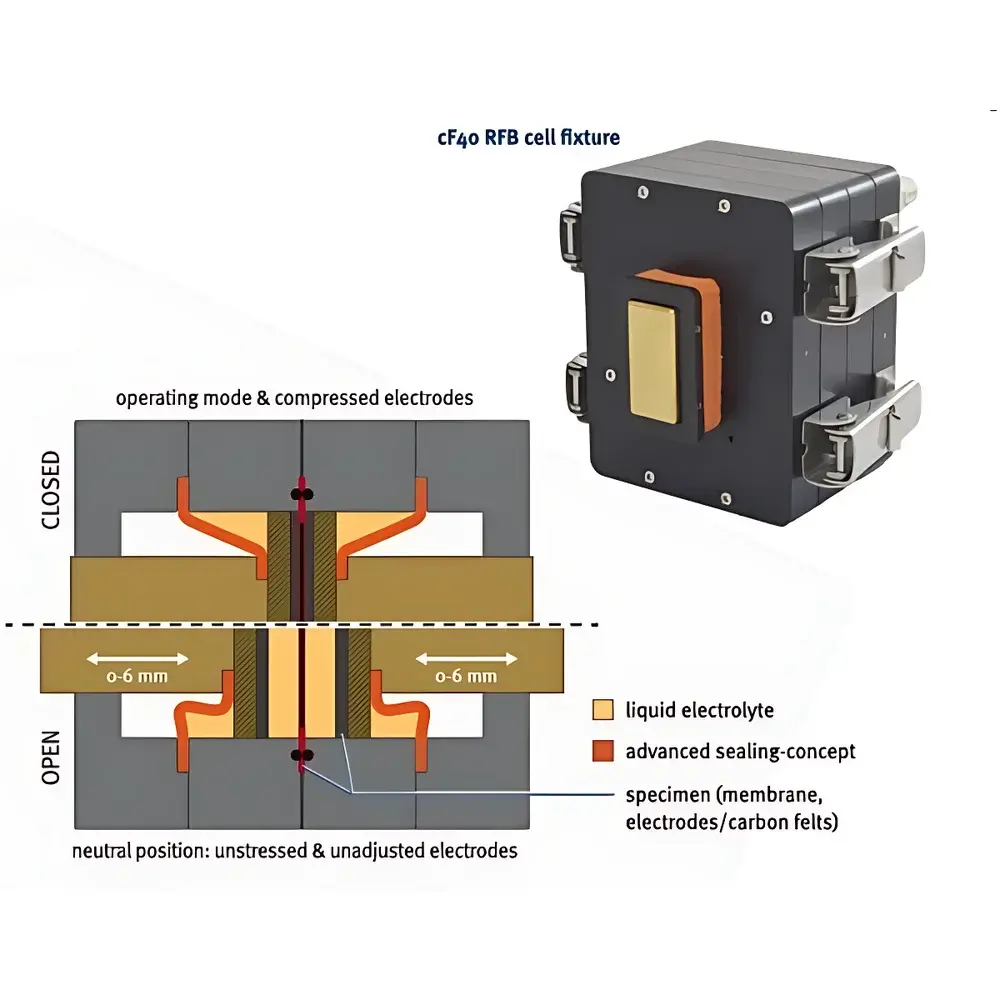
| Electrode Travel Range | ±6 mm per side |
| Compression Adjustment | Manual, center-supported lever mechanism |
| Force Transmission | Direct clamping via quick-link principle |
| Temperature Control | External recirculating chiller/heater required |
| Operating Temperature Range | −6 °C to +60 °C |
| Fluid Contact Materials | Graphite and chemically resistant plastics only |
| Current Collection | Stainless steel / gold-plated terminals |
| Electrical Interface | 6 mm multi-point binding posts |
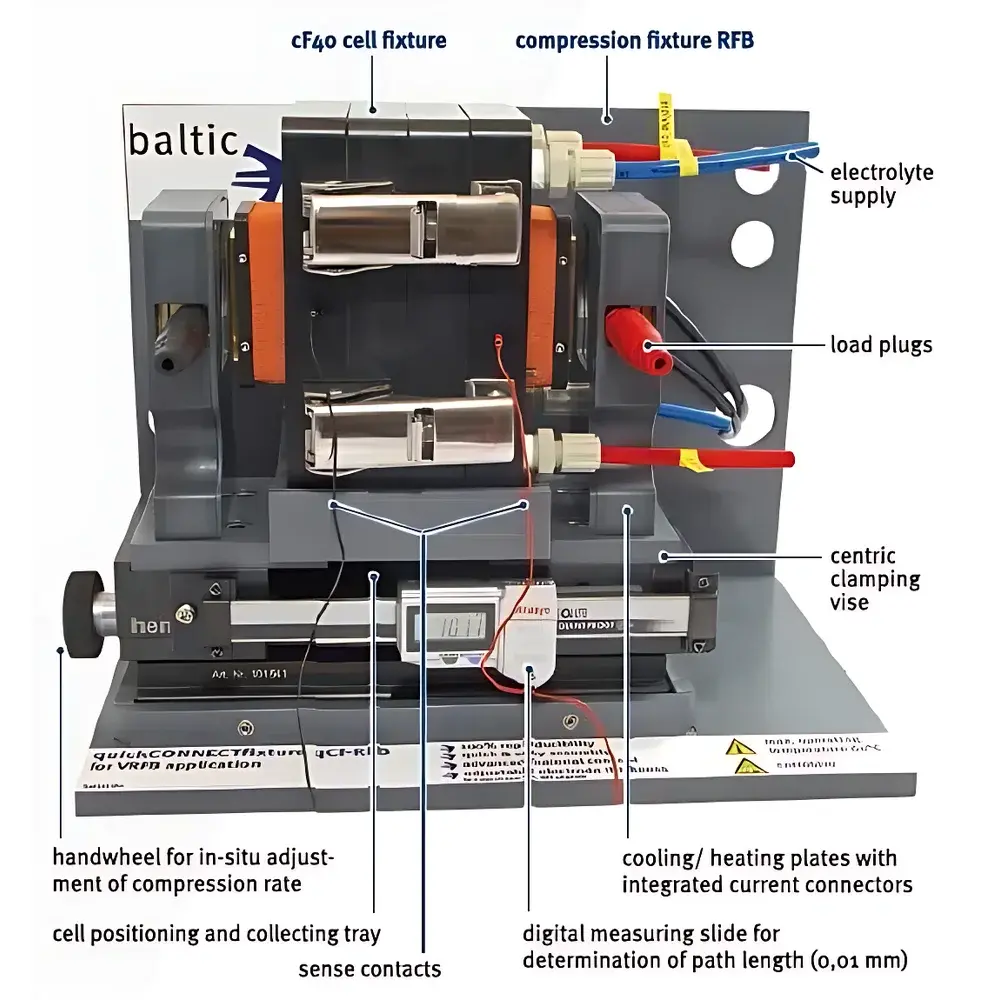
| Distance Measurement | Digital caliper with 0.01 mm resolution |
| Tubing Material | PVC |
| Compliance | Designed for ASTM E2981, IEC 62933-2-1, and ISO 14687-compliant RFB component validation |
Overview
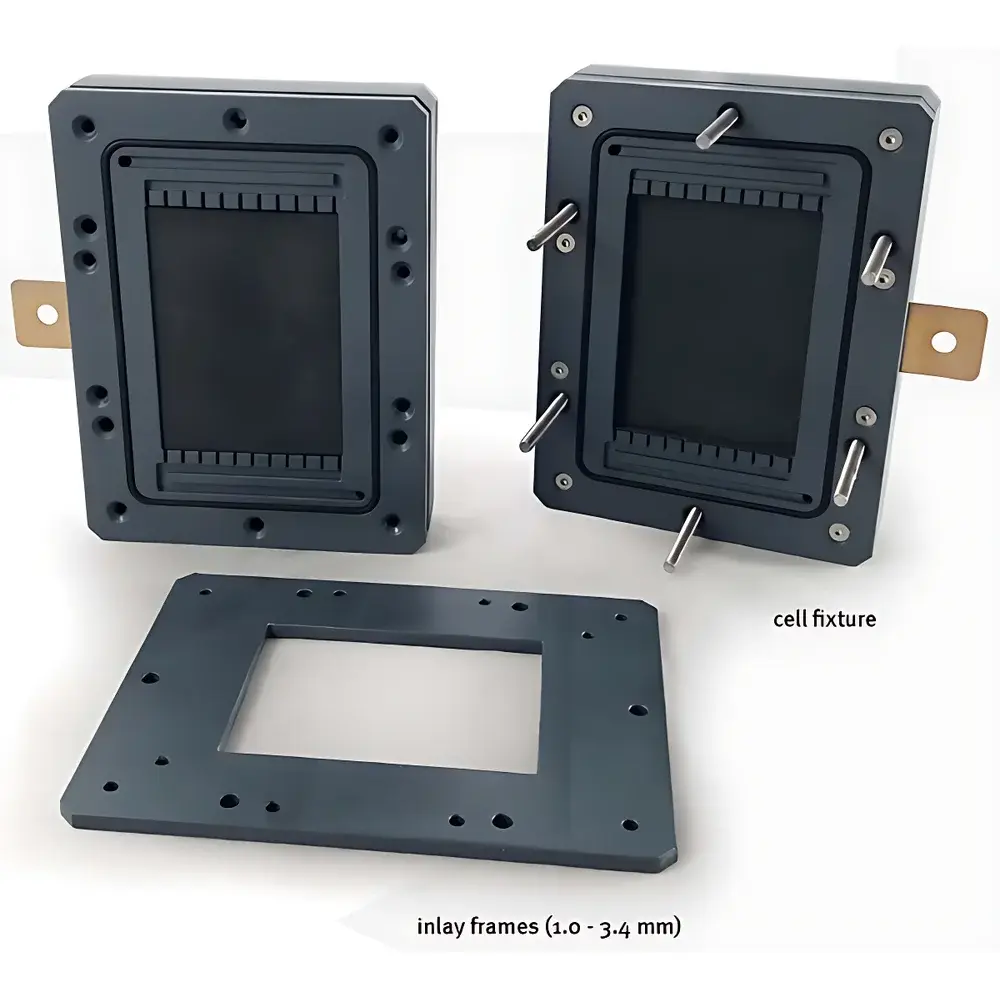
The Baltic FuelCells qCF RFB Redox Flow Battery Test Fixture is an engineered mechanical test platform specifically developed for the standardized, reproducible evaluation of redox flow battery (RFB) stack components—including ion-exchange membranes, carbon-based electrodes, gas diffusion layers (GDLs), and flow field plates—under controlled compression, thermal, and electrochemical conditions. Built upon Couette-type mechanical principles, the fixture applies uniform, center-supported compressive load across the active area (40 cm²) while maintaining precise alignment and eliminating parasitic shear or edge stress. Its design strictly adheres to the material compatibility requirements of aggressive aqueous electrolytes (e.g., vanadium, iron-chromium, or zinc-bromide systems), permitting contact only with graphite, fluoropolymer-coated metals, and inert thermoplastics such as PVC. The absence of elastomeric seals and reliance on rigid, machined graphite frames ensure zero electrolyte leakage during long-duration cycling tests—critical for quantitative mass balance studies and degradation root-cause analysis.
Key Features
- Center-supported compression architecture enabling repeatable, path-length-dependent force application—eliminating torque-induced non-uniformity common in bolted fixtures.
- Adjustable electrode gap from 0 to 6 mm per side, accommodating GDL thicknesses from 2.5 mm to 6 mm without re-machining or adapter inserts.
- Digital caliper-integrated displacement monitoring with 0.01 mm resolution, synchronized with load history for mechanical compliance mapping.
- Gold-plated stainless steel current collectors and 6 mm multi-point binding posts ensuring low-contact-resistance (< 5 mΩ) electrical interfaces traceable to IEC 62933-2-1 measurement protocols.
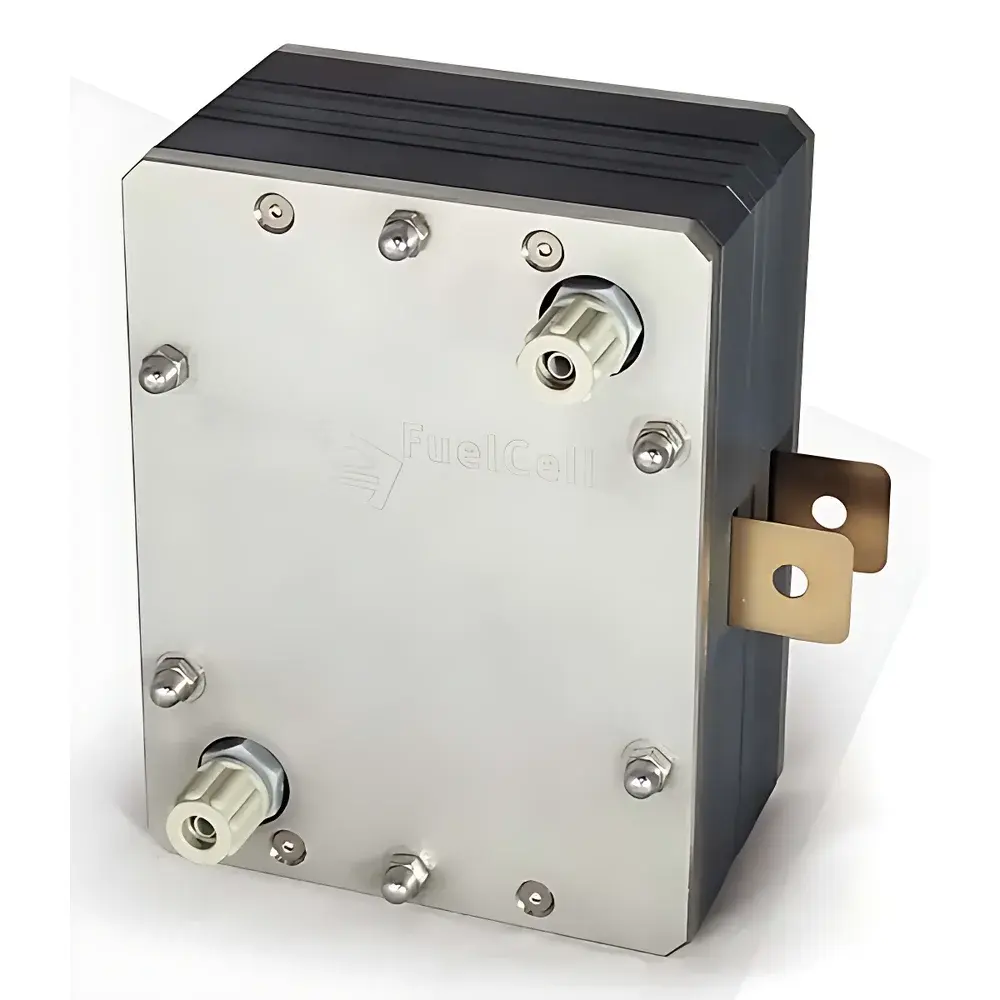
- Modular fluid porting (inlet/outlet) compatible with standard 1/4″ NPT or M6 threaded connections; all wetted tubing constructed from UV-stabilized PVC rated for pH 0–14 and oxidative potentials up to +1.6 VSHE.
- Thermally isolated housing design allows integration with external recirculating chillers or heaters, supporting isothermal testing from −6 °C to +60 °C per IEC 62933-3-1 environmental specifications.
Sample Compatibility & Compliance
The qCF RFB fixture is validated for use with proton exchange membranes (e.g., Nafion™ 115, Fumapem®), porous carbon electrodes (graphite felt, carbon paper), and conductive polymer composites. All internal surfaces contacting electrolyte are restricted to ASTM D471-resistant materials: high-purity graphite (≥99.9% C), PTFE-lined stainless steel, and medical-grade PVC. It supports qualification testing aligned with ISO 14687 (hydrogen fuel quality) annexes applicable to RFB auxiliary systems, and meets mechanical preconditioning requirements outlined in US Department of Energy’s “Redox Flow Battery Stack Testing Protocol v2.1”. No adhesives, gaskets, or organic sealants are used—ensuring full compatibility with post-test elemental analysis (ICP-MS, XRF) and avoiding cross-contamination in multi-cycle validation campaigns.
Software & Data Management
While the qCF RFB is a hardware-only platform (no embedded controller or firmware), it is fully interoperable with industry-standard electrochemical workstations (BioLogic SP-300, Gamry Interface 5000E, Metrohm Autolab PGSTAT302N) via analog voltage/current I/O and digital trigger lines. Compression displacement data from the integrated caliper can be logged synchronously using third-party DAQ systems (NI USB-6211, Keysight 34972A) with timestamped CSV export. All mechanical and electrical interface specifications comply with GLP audit requirements: calibration certificates for calipers and load cells are retained per ISO/IEC 17025, and fixture assembly logs—including torque values, serial numbers of replaced graphite frames, and date-stamped thermal soak records—are maintained in laboratory electronic notebooks (e.g., LabArchives, Benchling) to satisfy FDA 21 CFR Part 11 data integrity mandates.
Applications
- Quantitative assessment of membrane area-specific resistance (ASR) under variable compressive load (1–5 MPa range).
- In-situ monitoring of electrode thickness swelling/dimensional stability during extended charge/discharge cycling.
- Flow distribution uniformity mapping via segmented current collector arrays coupled with IR imaging.
- Accelerated aging studies of GDL hydrophobicity loss under oxidative electrolyte exposure.
- Validation of novel bipolar plate coatings (e.g., TiN, CrN) for interfacial contact resistance stability.
- Pre-qualification of stack components prior to multi-cell module integration per IEEE 1547.8 guidelines.
FAQ
Does the qCF RFB include integrated temperature control?
No. Temperature regulation requires an external recirculating chiller/heater connected via standard 6 mm barb fittings. The fixture housing includes thermal isolation channels to minimize ambient heat transfer.
Can the active area be scaled beyond 40 cm²?
Not without structural redesign. The 52 mm × 77 mm aperture is mechanically optimized for uniform stress distribution at ≤5 MPa; larger areas would require finite-element revalidation per ASTM E2981 Annex B.
Is corrosion testing of current collectors supported?
Yes—provided test electrolytes remain within the chemical resistance envelope of gold-plated stainless steel (per ASTM G31 immersion standards) and graphite (per ISO 8501-1 surface prep protocols).
Are calibration services available for the digital caliper system?
Yes. Baltic FuelCells provides NIST-traceable calibration documentation upon request, with annual recalibration recommended per ISO/IEC 17025 Clause 6.6.
What safety certifications apply to the qCF RFB fixture?
It conforms to EN 61010-1:2019 (electrical safety) for laboratory equipment and carries CE marking for mechanical integrity under Directive 2006/42/EC. No ATEX or IECEx certification is provided, as no intrinsic ignition sources are present.






