
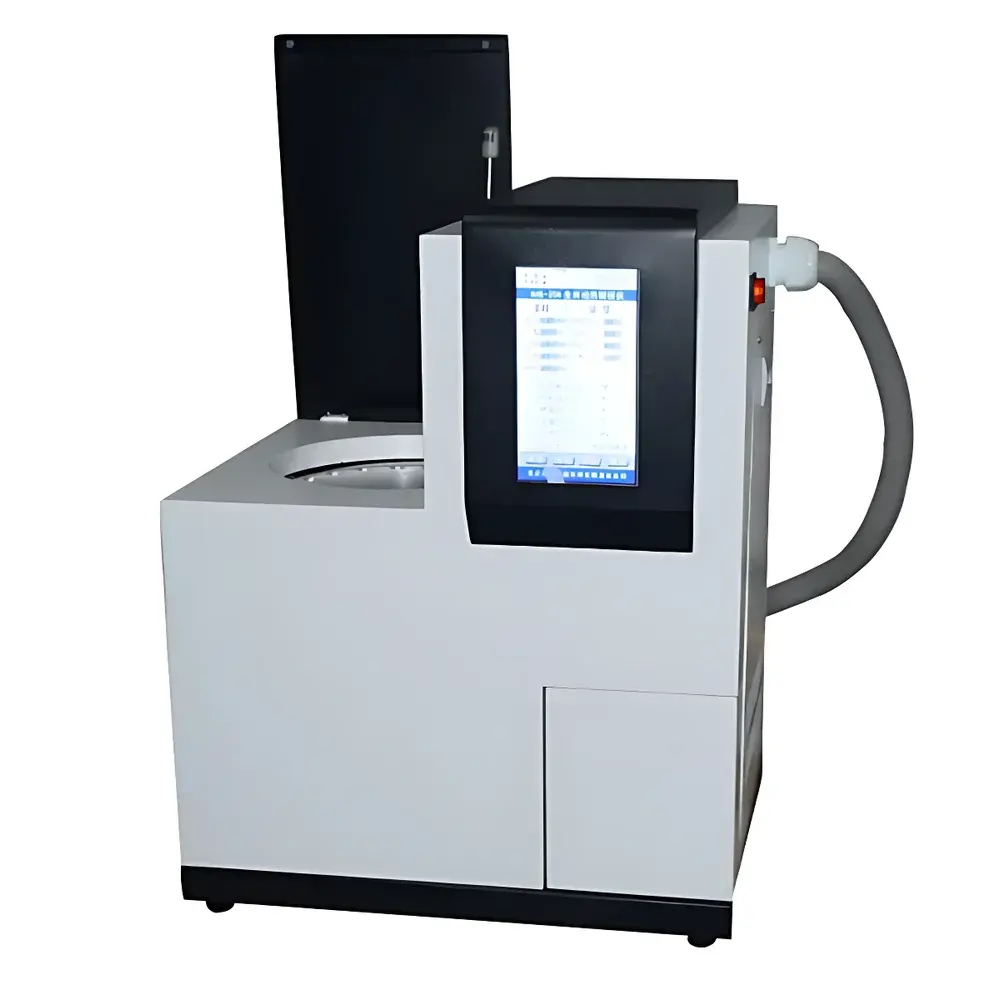
Beifen Sanpu ATDS-20A Cryogenic Cold Trap Automated Two-Stage Thermal Desorber
| Brand | Beifen Sanpu |
|---|---|
| Origin | Beijing, China |
| Manufacturer Type | Direct Manufacturer |
| Model | ATDS-20A |
| Configuration | Fully Automated Two-Stage Thermal Desorption with Electronic Cryogenic Cold Trap (−35 °C) |
| Sample Capacity | 20-Position Carousel |
| Temperature Control Precision | ±0.5 °C |
| Detection Compatibility | Universal Interface for GC & GC-MS Systems (Including Agilent, Thermo Fisher, Shimadzu, PerkinElmer) |
| Compliance | Designed to meet HJ 644–2013, HJ 583–2010, HJ 734–2014, GB/T 18883–2002, GB 50325–2010, and HJ/T 400–2007 requirements |
Overview
The Beifen Sanpu ATDS-20A Cryogenic Cold Trap Automated Two-Stage Thermal Desorber is an engineered solution for quantitative trace-level analysis of volatile and semi-volatile organic compounds (VOCs and SVOCs) in air, indoor environments, building materials, food packaging headspace, and industrial emissions. It operates on the principle of two-stage thermal desorption: first, analytes are thermally released from sorbent tubes under controlled inert gas flow; second, they are cryogenically focused in a low-temperature trap (down to −35 °C) prior to rapid, narrow-band re-desorption into the gas chromatograph. This two-stage process—combined with electronic refrigeration (no liquid nitrogen or mechanical compressor required)—ensures high analyte recovery (>99%), minimal band broadening, and reproducible peak shapes essential for regulatory-grade quantitation. The system integrates seamlessly with all major GC and GC-MS platforms via standardized hardware interfaces and software-triggered synchronization, supporting method-driven automation from sample loading through GC injection and post-run tube regeneration.
Key Features
- Fully automated 20-position carousel with motorized six-port valve actuation and self-calibrating sample tray positioning;
- Independent four-zone temperature control: primary desorption oven (RT–450 °C), secondary desorption zone (RT–450 °C), valve manifold (RT–300 °C), and transfer line (RT–300 °C, 24 V low-voltage heating);
- Integrated electronic cryogenic cold trap operating from −35 °C to ambient, enabling sharp focusing of C2–C16 VOCs without consumables;
- Programmable time-segmented operation: includes primary desorption, inert gas purge, cold trapping, flash desorption, GC injection, and automated back-flush cleaning of transfer lines and valves;
- Onboard tube activation protocol with programmable heating and purging cycles to restore sorbent integrity between analyses;
- Real-time status visualization via 7-inch capacitive touchscreen interface with animated workflow display and parameter logging;
- Dual-mode triggering support: synchronized start with GC acquisition software (e.g., OpenLab, Chromeleon, MassHunter) or external TTL/RS232 command initiation;
- Optional quartz-lined transfer tubing for enhanced recovery of reactive or polar analytes (e.g., aldehydes, organic acids);
- Adjustable purge flow (0–100 mL/min) and simulated sampling flow (0–160 mL/min) for method development and calibration curve generation;
- Robust mechanical architecture with EMI-shielded electronics and fail-safe thermal monitoring (over-temperature shutdown, sensor fault detection).
Sample Compatibility & Compliance
The ATDS-20A accepts standard 1/4″ OD × 3.5″ (US EPA/ISO-compliant) stainless steel or glass sorbent tubes packed with Tenax TA, Carbopack B/C, Carboxen, or custom multi-bed media. Its performance meets or exceeds critical parameters specified in multiple international and national standards, including but not limited to: HJ 644–2013 (ambient air VOCs by TD-GC-MS), HJ 583–2010 (benzene series in ambient air), HJ 734–2014 (stack emission VOCs), GB/T 18883–2002 (indoor air quality), and GB 50325–2010 (civil construction IAQ control). The instrument supports GLP-aligned workflows through audit-trail-capable method storage, user-access-level permissions, and timestamped event logging—facilitating compliance with ISO/IEC 17025 laboratory accreditation requirements and internal QA/QC protocols.
Software & Data Management
Control is managed via embedded firmware with intuitive touch-based navigation. All methods—including temperature ramps, timing sequences, flow rates, and GC trigger logic—are stored as encrypted binary files with version timestamps. Raw operational logs (including temperature deviations, valve actuation events, and error codes) are exportable in CSV format for LIMS integration. While the device does not include proprietary chromatography data system (CDS) software, its hardware-level GC synchronization ensures full compatibility with FDA 21 CFR Part 11–compliant CDS platforms when used with appropriate audit trail and electronic signature configurations. Method validation documentation—including RSD ≤2.5% (n=6, 0.05 μg benzene in methanol) and recovery >99% across target analytes—is provided per ICH Q2(R2) guidance for analytical procedure verification.
Applications
- Environmental monitoring: ambient air, stack emissions, landfill fugitive gases;
- Indoor air quality (IAQ) assessment per WHO and national guidelines;
- Building material emissions testing (carpets, adhesives, paints, composite wood products);
- Automotive cabin air analysis (HJ/T 400–2007 compliance);
- Food packaging migration studies and flavor compound profiling;
- Occupational hygiene exposure assessments (NIOSH/OSHA-relevant VOCs);
- Method development and reference material certification in accredited third-party laboratories;
- Research applications requiring high-fidelity thermal desorption of thermally labile or low-concentration analytes.
FAQ
What distinguishes single-stage from two-stage thermal desorption?
Two-stage desorption incorporates a cryofocusing step between primary desorption and GC injection, resulting in sharper peaks, lower detection limits, and improved resolution for co-eluting compounds—especially critical for complex environmental matrices.
Does the ATDS-20A require liquid nitrogen or external chillers?
No. It uses solid-state Peltier cooling for the cold trap, eliminating consumables and enabling stable −35 °C operation in standard laboratory environments.
Can it be validated for ISO/IEC 17025 or GLP environments?
Yes—through configurable user access levels, electronic audit trails, method versioning, and full operational logging, all supporting formal validation per ISO/IEC 17025 Clause 7.7 and OECD GLP Principles.
Is tube activation performed automatically?
Yes. The built-in activation protocol applies precise temperature ramps and inert gas purging to regenerate sorbent tubes between analyses, reducing manual handling and contamination risk.
How is carryover minimized between samples?
Via programmable back-flush of the transfer line and six-port valve using high-purity carrier gas, combined with heated zones maintained above desorption temperatures during idle periods.
What GC/MS systems is it compatible with?
All major platforms—including Agilent 8890/8860, Thermo ISQ/Trace 1300, Shimadzu GC-2030/GCMS-QP2020NX, and PerkinElmer Clarus SQ 8—via analog/digital trigger signals and mechanically standardized inlet connections.
Related Products







