
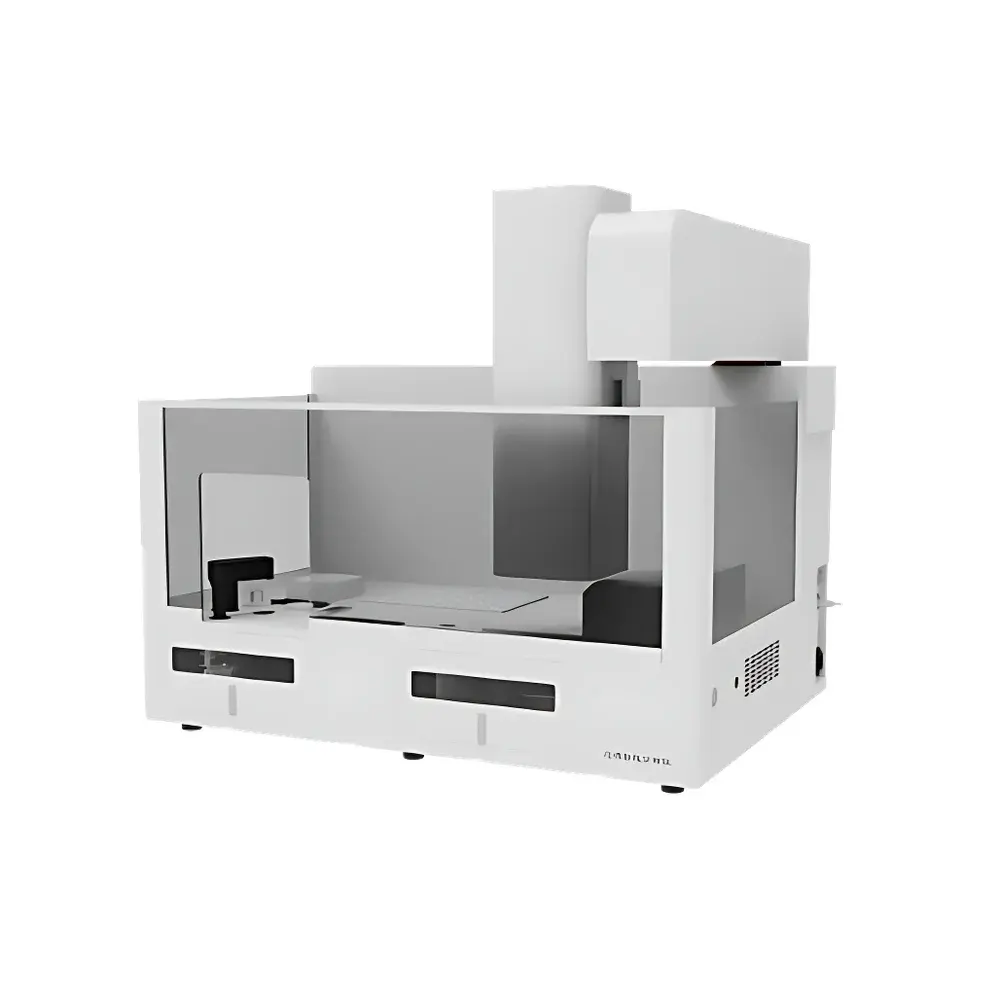
BEIYU TECHNOLOGIES CGC-699 Fully Automated CODCr Analyzer
| Brand | BEIYU TECHNOLOGIES |
|---|---|
| Origin | Shanghai, China |
| Model | CGC-699 |
| Measurement Principle | Spectrophotometric Detection after Rapid Digestion (HJ/T 399–2007) |
| Wavelengths | 440 nm & 600 nm |
| COD Range | 5–150 mg/L (low), 100–1000 mg/L (high) |
| Chloride Tolerance | <1000 mg/L |
| Sample Positions | 118 or 178 |
| Digestion Positions | 18 |
| Temperature Control | PID-regulated |
| Automation Level | Fully Integrated (sampling, reagent addition, digestion, cooling, colorimetry) |
| Compliance | HJ/T 399–2007 |
Overview
The BEIYU TECHNOLOGIES CGC-699 Fully Automated CODCr Analyzer is an engineered solution for high-throughput, regulatory-compliant chemical oxygen demand (COD) determination in environmental laboratories. It implements the rapid digestion-spectrophotometric method specified in China’s national standard HJ/T 399–2007, which aligns with internationally recognized principles of dichromate oxidation under acidic, high-temperature conditions followed by quantitative absorbance measurement. Unlike manual or semi-automated systems, the CGC-699 executes the entire analytical workflow—including precise liquid handling, timed digestion at controlled temperatures (typically 165 °C for 15 min), forced air cooling, and dual-wavelength photometric detection—without operator intervention. Its architecture supports unattended operation over extended periods, making it suitable for routine monitoring programs in municipal water treatment facilities, industrial effluent control labs, and third-party environmental testing centers requiring traceable, auditable data generation.
Key Features
- Fully integrated wet chemistry platform: automates sample aspiration, reagent dispensing (potassium dichromate, sulfuric acid, Ag₂SO₄ catalyst, HgSO₄ masking agent), digestion, post-digestion cooling, and spectrophotometric quantification.
- Dual-wavelength optical system (440 nm and 600 nm) enables correction for turbidity and matrix interference, improving accuracy across complex wastewater matrices.
- PID-controlled heating blocks ensure ±0.5 °C temperature stability during digestion—critical for reaction completeness and inter-laboratory reproducibility.
- High-capacity carousel configuration: available with either 118 or 178 sample positions paired with 18 independent digestion stations, supporting batch processing aligned with daily regulatory reporting cycles.
- No preheating required: LED-based light source delivers stable intensity and spectral output from startup, reducing standby time and energy consumption.
- Time-stamped measurement logs with full audit trail: each result includes timestamp, sample ID, reagent lot numbers (if linked), digestion parameters, and raw absorbance values—supporting GLP and ISO/IEC 17025 documentation requirements.
Sample Compatibility & Compliance
The CGC-699 is validated for use with surface water, groundwater, domestic sewage, and industrial wastewater samples containing chloride concentrations up to 1000 mg/L. Mercury sulfate is automatically dosed to suppress chloride interference per HJ/T 399–2007 protocol. The system accommodates standard 16 mm borosilicate glass digestion tubes and accepts sample volumes between 2.0–5.0 mL. All fluidic pathways are chemically resistant (PTFE, PEEK, borosilicate glass), minimizing carryover and corrosion risk. Instrument performance verification follows internal calibration routines traceable to NIST-certified COD reference standards. While HJ/T 399–2007 is the primary compliance anchor, method equivalence to ISO 6060 and ASTM D1252 (Method B) is documented in the technical validation report supplied with each unit.
Software & Data Management
The embedded control software provides intuitive workflow configuration, real-time status monitoring, and automated calculation of COD concentration using user-defined or factory-loaded calibration curves. Linear regression parameters (slope, intercept, R²) are computed in situ and logged with each run. Data export is supported via USB and Ethernet interfaces in CSV and PDF formats compliant with laboratory information management system (LIMS) ingestion protocols. Optional 21 CFR Part 11-compliant software package adds electronic signatures, role-based access control, and immutable audit trails—enabling deployment in regulated environments subject to EPA, EU Water Framework Directive, or local environmental authority oversight.
Applications
- Continuous compliance monitoring of discharge permits (e.g., NPDES, GB 8978–1996).
- Process control in activated sludge, MBR, and anaerobic digestion systems.
- Performance evaluation of tertiary treatment units and advanced oxidation processes.
- Long-term trend analysis for watershed health assessment and ecological risk modeling.
- Accredited environmental testing laboratories seeking CNAS or CMA certification under ISO/IEC 17025:2017.
FAQ
Does the CGC-699 comply with international standards beyond HJ/T 399–2007?
Yes—the instrument’s digestion kinetics, reagent stoichiometry, and photometric methodology demonstrate method equivalence to ISO 6060 and ASTM D1252 (Method B), as verified in interlaboratory studies.
Can the system be integrated into an existing LIMS environment?
Yes—via standardized CSV export and optional OPC UA or HL7 interface modules for direct bidirectional communication.
What maintenance intervals are recommended for routine operation?
Daily: visual inspection of tubing and digestion tube integrity; Weekly: cleaning of optical windows and pipetting tips; Quarterly: calibration verification using certified reference materials and pump wear assessment.
Is remote diagnostics supported?
Yes—through secure HTTPS-based remote access (with customer-configurable firewall rules) enabling firmware updates, log retrieval, and real-time error diagnostics by BEIYU technical support personnel.
How is data integrity ensured during power interruption?
The system features non-volatile memory storage and automatic resume functionality: interrupted runs are flagged, and digestion timing resumes from the last validated step upon recovery—no data loss occurs.
Related Products







