
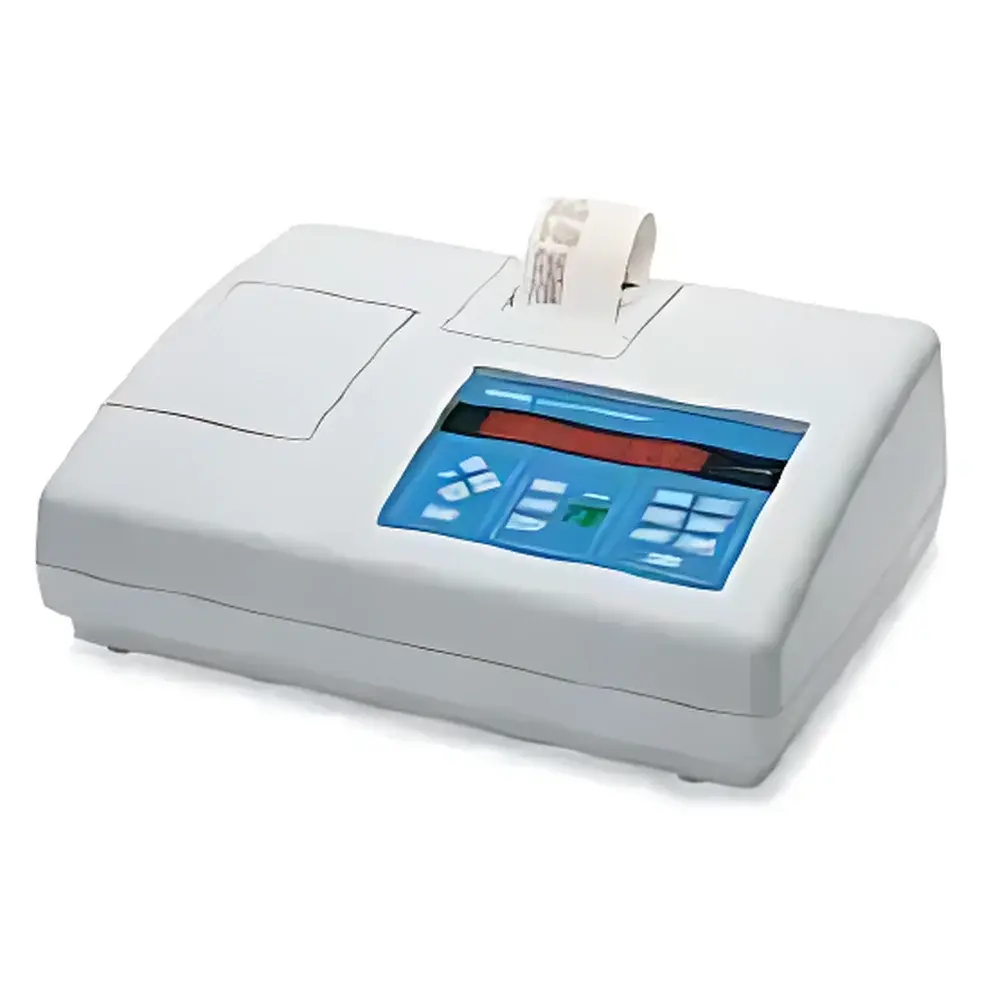
Hach 2100AN Benchtop Turbidimeter
| Brand | Hach |
|---|---|
| Origin | USA |
| Model | 2100AN |
| Measurement Principle | Nephelometric (90° light scattering) with dual-detector ratio mode |
| Turbidity Range | 0–10,000 NTU |
| Color Range | 0–500 CU |
| Accuracy | ±2% of reading (0–1000 NTU), ±5% (1000–4000 NTU), ±10% (4000–10,000 NTU) |
| Resolution | 0.001 NTU / 1 CU |
| Repeatability | ±1% of reading or 0.01 NTU |
| Minimum Sample Volume | 20 mL |
| Compliance | EPA Method 180.1 |
| Operating Environment | 10–40 °C, ≤90% RH (non-condensing at 25 °C) |
| Power Supply | 230 V, 50/60 Hz |
| Weight | 3.43 kg |
| Data Output | Built-in thermal printer, USB interface for HachLink™ software |
| Sample Chamber Purge | Compressed air port for dew prevention |
Overview
The Hach 2100AN Benchtop Turbidimeter is a precision nephelometric instrument engineered for high-accuracy turbidity and color measurement in laboratory and quality control environments. It operates on the principle of 90° scattered light detection—compliant with USEPA Method 180.1—and incorporates Hach’s proprietary dual-detector ratio measurement technology to actively compensate for interference from sample color, absorbance, and stray light. Unlike single-beam instruments, the 2100AN simultaneously measures forward-scattered and side-scattered intensities, enabling real-time correction of chromatic artifacts without requiring manual filtration or dilution. This design ensures metrological integrity across the full 0–10,000 NTU range, including highly turbid industrial process streams and low-turbidity drinking water samples. The instrument features an integrated air-purge port for controlled chamber drying—a critical capability when measuring hot or cold samples where condensation-induced scattering would otherwise compromise optical path stability.
Key Features
- Dual-detector ratio mode eliminates color interference and improves accuracy in colored or absorbing matrices
- Extended turbidity range (0–10,000 NTU) and dedicated color measurement (0–500 CU) in a single platform
- Programmable signal averaging (1–100 readings) to enhance precision in low-signal or noisy conditions
- Automated calibration verification and self-diagnostic routines—including lamp intensity monitoring, detector response validation, and optical path contamination alerts
- Thermal printer with configurable output: displays measured value, units, date/time stamp, calibration status, and operator ID
- Compressed-air purge interface to prevent condensation in the sample cell chamber during temperature-variable measurements
- Multi-unit display support: NTU, NEP, EBC, ABS, %T, CU, and user-defined units for cross-method comparability
- Non-volatile memory stores up to 1,000 measurement records with timestamp and operator tag
Sample Compatibility & Compliance
The 2100AN accommodates standard 20 mL glass vials (included) and supports optional flow-through cells (manual or automated) for continuous monitoring integration. Its optical architecture meets stringent regulatory requirements: full compliance with USEPA Method 180.1 for drinking water and wastewater analysis; alignment with ISO 7027 for instrumental turbidimetry; and suitability for GLP/GMP environments where traceability and audit readiness are mandatory. Optional EPA-recognized color filters (Cat. No. 30312-00) enable standardized platinum-cobalt (Pt-Co) color assessment per APHA Standard Methods 2120B. All firmware operations—including calibration history, data edits, and print log entries—are time-stamped and non-erasable, supporting FDA 21 CFR Part 11 readiness when used with HachLink™ software and appropriate access controls.
Software & Data Management
Data export and instrument configuration are managed via HachLink™ software (Windows-compatible), which provides secure, encrypted USB communication with full audit-trail functionality. Users can download complete datasets—including raw signals, calibration coefficients, environmental logs, and diagnostic flags—for traceable reporting. The software supports customizable report templates compliant with LIMS interfaces and enables batch calibration verification against reference standards. Instrument settings—including unit preferences, averaging parameters, and auto-print triggers—are stored locally and synchronized during each connection. No cloud dependency or subscription model is required; all data remains under direct user control on premise.
Applications
The 2100AN serves as a primary turbidity measurement system in municipal water treatment labs validating filtration efficiency and disinfection barriers per US Safe Drinking Water Act requirements. It is routinely deployed in pharmaceutical manufacturing for purified water and WFI (Water for Injection) testing per USP <<1231> and EP 2.2.2. In academic research, its ratio-mode capability supports studies on colloidal stability, coagulation kinetics, and natural organic matter interactions. Industrial users apply it for real-time QC of polymer emulsions, ceramic slurries, and beverage clarity—where color-turbidity coupling would invalidate conventional single-detector instruments. Educational institutions utilize its intuitive interface and comprehensive method library to teach fundamental photometric principles and regulatory metrology practices.
FAQ
Does the 2100AN require annual recalibration by a certified service provider?
No—routine calibration using StablCal® primary standards (Cat. No. 26595-05) satisfies EPA and ISO requirements. Full performance verification (lamp output, detector linearity, optical alignment) is performed automatically during startup and may be manually triggered via diagnostics mode.
Can the instrument measure turbidity in samples above 4000 NTU without dilution?
Yes—the 2100AN maintains specified accuracy up to 10,000 NTU using its extended-range algorithm and high-dynamic-range photodetectors. Dilution is only necessary if sample opacity exceeds the instrument’s optical path transmission limit (typically >99.9% absorption).
Is the built-in printer compatible with external label printers or networked printing systems?
No—the integrated thermal printer is fixed-function and not driver-configurable. For enterprise-scale reporting, HachLink™ software exports CSV/PDF files compatible with standard networked or label printers.
What maintenance intervals are recommended for long-term optical stability?
Quarterly cleaning of the sample cell compartment with supplied lint-free wipes (Cat. No. 47076-00) and annual inspection of the tungsten-halogen lamp intensity (logged automatically) constitute the preventive maintenance protocol.
Does the air-purge function require an external compressed air source?
Yes—a regulated, oil-free air supply (30–60 psi, ≤5 µm particulate filtration) must be connected via the rear-panel quick-disconnect fitting. An optional integrated air dryer (Cat. No. 43975-10) is available for high-humidity lab environments.





