
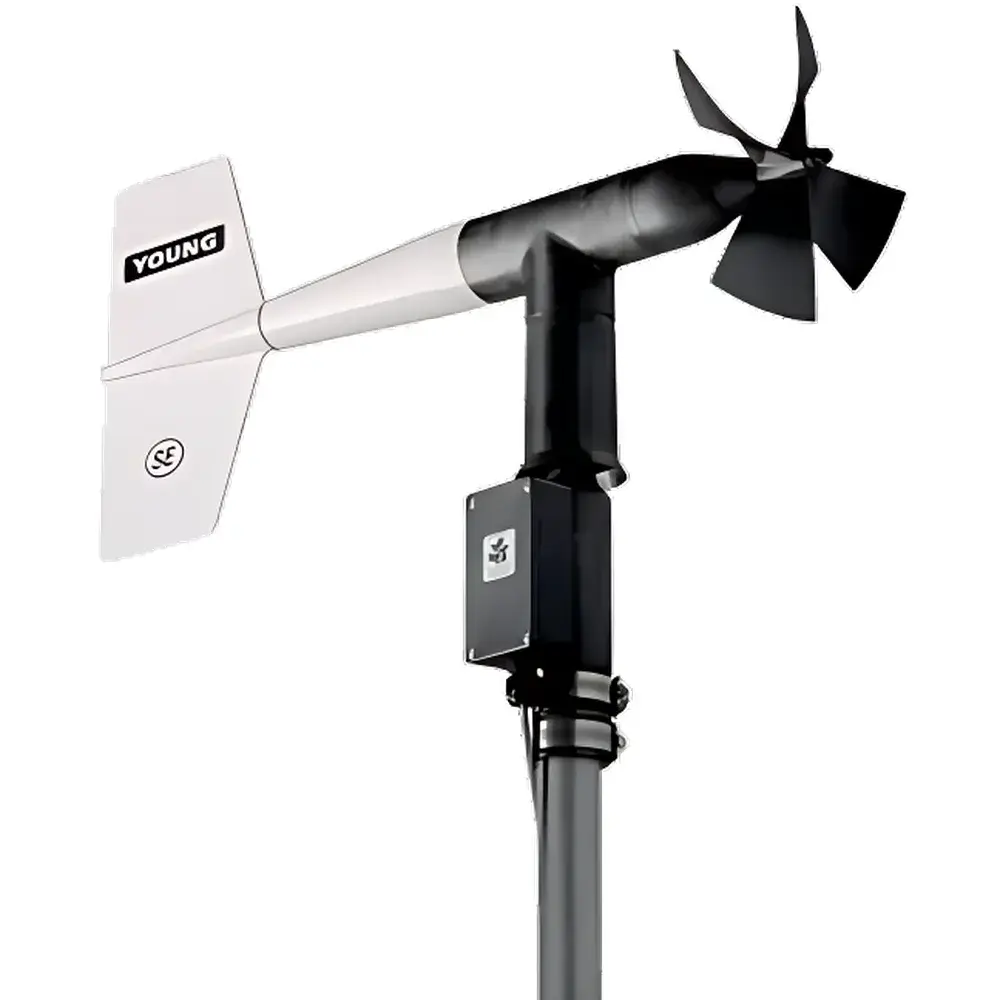
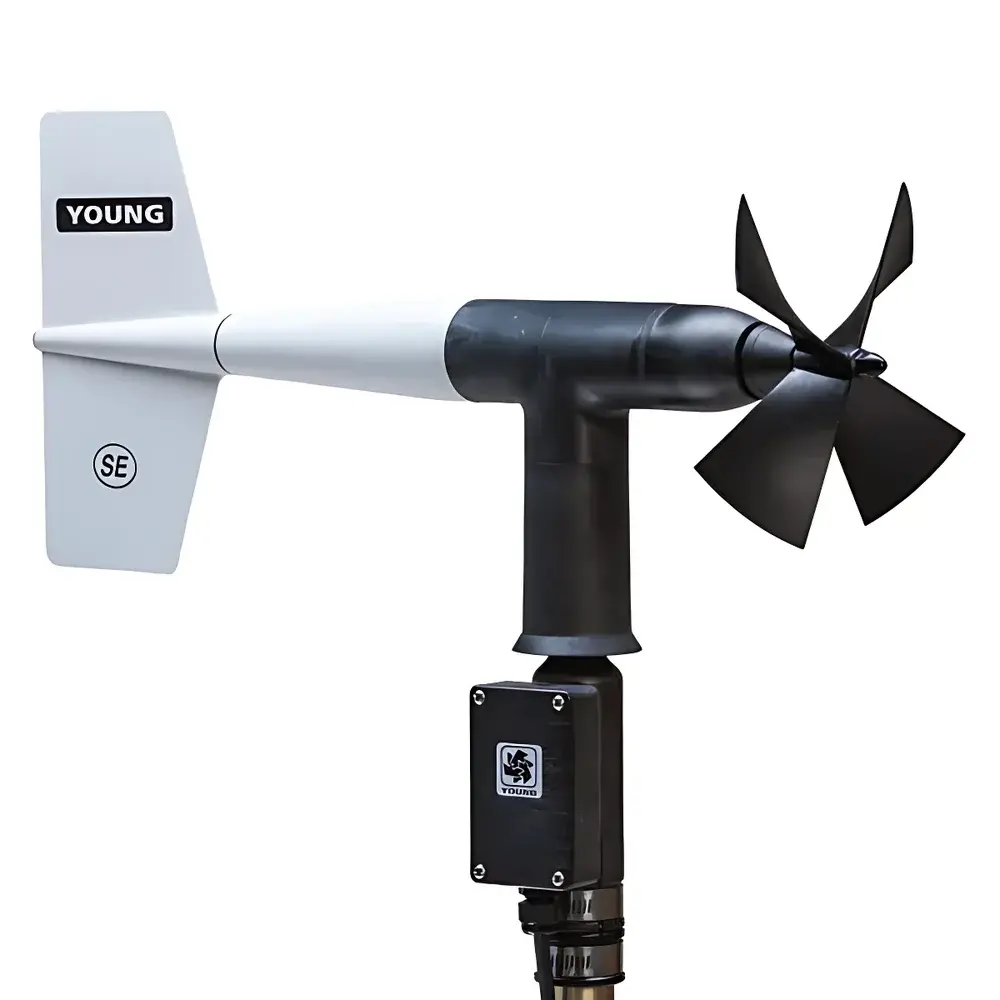
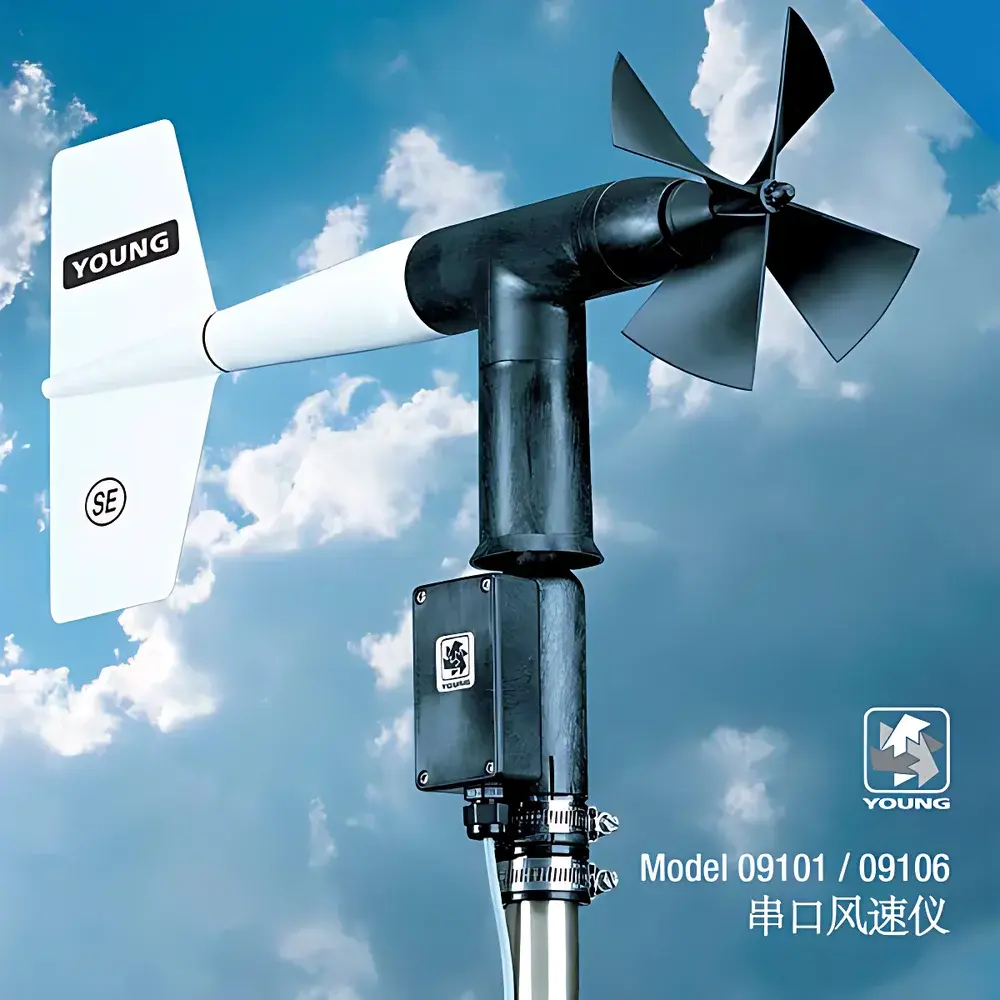
R.M. Young 09101 Serial Output Propeller Anemometer
| Brand | R.M. Young |
|---|---|
| Origin | USA |
| Model | 09101 |
| Instrument Type | Propeller Anemometer |
| Resolution | 0.1 m/s |
| Measurement Range | 0–100 m/s |
| Accuracy | ±2% of reading or ±0.3 m/s (whichever is greater) |
| Operating Temperature | −50°C to +50°C |
| Operating Humidity | 0–100% RH |
| Output Interface | RS-485 serial (RMY/NCAR/NMEA protocols) |
| Startup Wind Speed | 1.0 m/s |
| Bearing Type | Precision stainless steel ball bearing |
| Mounting | Standard 1-inch NPT pipe thread |
Overview
The R.M. Young 09101 Serial Output Propeller Anemometer is a high-reliability, precision-engineered environmental sensor designed for continuous, long-term wind speed measurement in demanding meteorological, industrial, and research applications. Based on proven propeller-based aerodynamic sensing principles, the instrument utilizes a four-blade helical rotor coupled with a rotating multi-pole magnet and stationary coil assembly—eliminating mechanical wear elements such as slip rings and brushes. The induced variable-frequency AC signal is digitized onboard by a dedicated microprocessor, enabling stable, noise-immune digital output via RS-485. Unlike potentiometric anemometers, the 09101 employs an optical encoder for angular position detection, delivering absolute, drift-free resolution without dead zones or contact degradation over time. Its robust thermal and UV-stabilized thermoplastic housing, combined with stainless steel and anodized aluminum hardware, ensures structural integrity across extreme ambient conditions—from Arctic field stations to desert monitoring networks.
Key Features
- Optical encoder-based rotor angle sensing for zero-dead-zone, non-contact wind speed transduction
- Onboard microprocessor with real-time signal conditioning and digital serial output (RS-485)
- Configurable communication protocols: RMY (R.M. Young native), NCAR, and NMEA 0183 for interoperability with legacy and modern data loggers
- Precision-ground stainless steel ball bearing assembly (ISO P6 tolerance grade) ensuring low-friction rotation and long-term repeatability
- Wide operating temperature range (−50°C to +50°C) validated per IEC 60068-2 environmental stress testing standards
- IP65-rated enclosure with UV-resistant thermoplastic housing and corrosion-resistant metallic components
- Field-selectable output mode: jumper-configurable between RS-485 serial and analog 0–5 VDC outputs
- Low startup threshold (1.0 m/s) and optimized aerodynamic damping (damping ratio = 0.3) for accurate transient response in turbulent flow regimes
Sample Compatibility & Compliance
The 09101 is compatible with standard 1-inch NPT mounting infrastructure and integrates seamlessly into WMO-compliant surface observation systems. It meets applicable requirements for Class II meteorological sensors under WMO Guide to Instruments and Methods of Observation (CIMO Guide, Chapter 12). While not intrinsically safe, its low-power design (11–24 VDC, 20 mA) supports deployment in non-hazardous environments per IEC 60079-0. The device complies with FCC Part 15 Subpart B and CE EMC Directive 2014/30/EU for electromagnetic compatibility. Calibration traceability follows NIST-traceable procedures, and factory calibration certificates include uncertainty budgets per ISO/IEC 17025:2017. For regulatory deployments, the instrument supports audit-ready data logging when paired with compliant DAQ systems adhering to FDA 21 CFR Part 11 electronic record requirements.
Software & Data Management
The 09101 communicates via ASCII-based serial commands supporting both polled and continuous streaming modes. Native RMY protocol enables direct integration with Campbell Scientific CR-series dataloggers, Onset HOBO systems, and NOAA’s ASOS/MAWS platforms. Third-party software support includes MATLAB Instrument Control Toolbox, LabVIEW NI-VISA drivers, and Python-based libraries (e.g., PySerial with custom parser modules). All firmware versions maintain backward compatibility; field-upgradable via UART interface using vendor-provided utilities. Timestamped output packets include checksum validation and configurable baud rates (up to 115.2 kbps). When deployed in GLP/GMP-regulated settings, metadata tagging (sensor ID, timestamp, CRC) satisfies raw data integrity requirements for environmental monitoring reports.
Applications
- Surface meteorological networks (ASOS, AWOS, synoptic stations) requiring WMO-grade wind speed continuity
- Wind resource assessment for pre-construction feasibility studies and turbine siting validation
- Industrial stack emission monitoring where cross-wind velocity correction is required per EPA Method 9 and ASTM D7455
- Boundary layer research in atmospheric science laboratories and mesoscale modeling validation campaigns
- Environmental impact assessments (EIA) for construction, mining, and offshore energy projects
- Long-term climate observatories operating under GCOS and GSN observational guidelines
FAQ
What communication protocols does the 09101 support?
The sensor supports three standardized serial protocols: proprietary RMY format, NCAR-compatible ASCII, and NMEA 0183 v3.01 sentence structure (e.g., $WIMWV). Protocol selection is hardware-jumper configurable.
Can the 09101 be used in marine environments?
While the 09101 is rated for high-humidity operation (0–100% RH), it is not optimized for salt-laden atmospheres. For sustained marine deployment, R.M. Young recommends the 09106 variant with ceramic bearings and enhanced shaft corrosion resistance.
Is analog voltage output available alongside serial?
Yes—via internal jumper configuration, users may select either RS-485 digital output or 0–5 VDC analog scaling (0–100 m/s), allowing integration with legacy PLCs or analog-input DAQ systems.
Does the device require periodic recalibration?
Per R.M. Young’s maintenance recommendations, field verification every 24 months is advised. Full recalibration is recommended after physical impact, exposure to icing events, or when operational drift exceeds ±0.5 m/s against a reference standard.
How is directional data handled in the 09101 model?
The 09101 is a wind speed-only sensor. Directional capability requires pairing with a separate R.M. Young wind vane (e.g., model 05103 or 05106), which shares identical mounting and serial interface architecture for synchronized deployment.







