
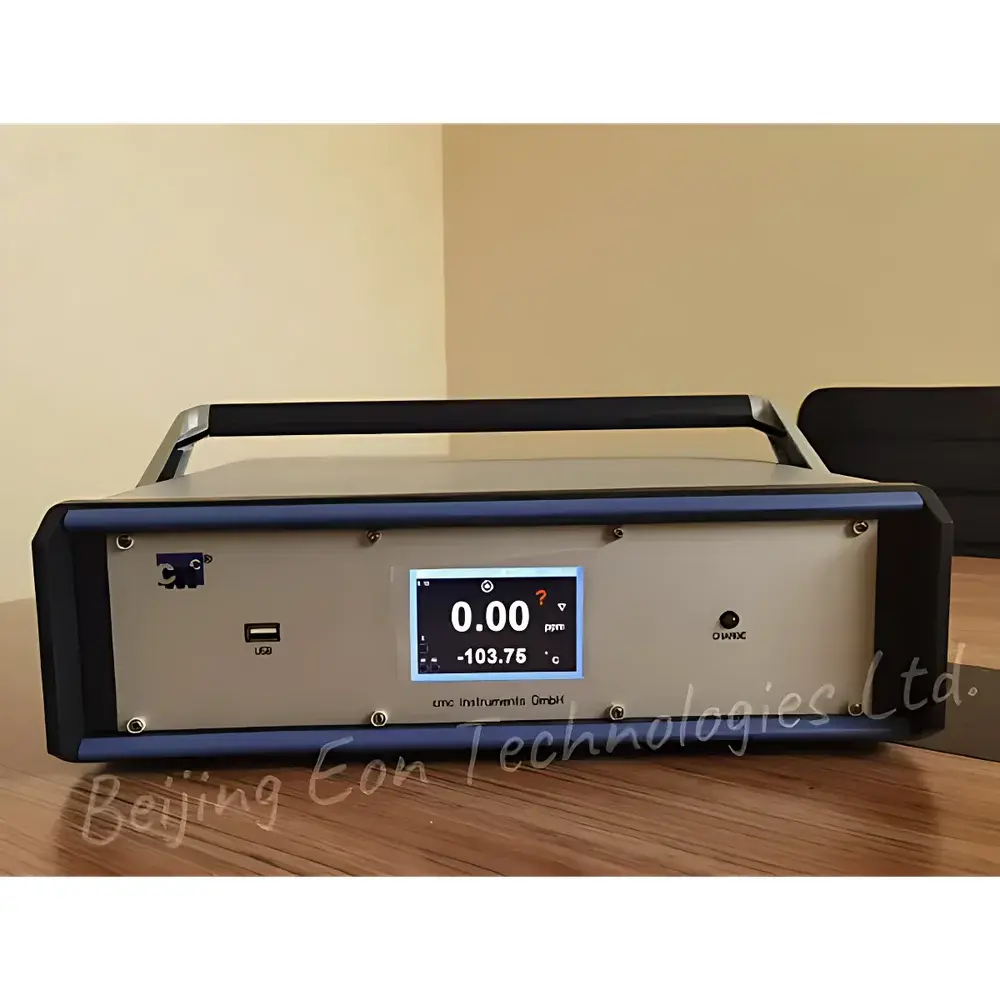
CMC Germany iTMA-204-P Portable Electrolytic Dew Point Analyzer for Chlorine and Corrosive Gases
| Brand | CMC |
|---|---|
| Origin | Germany |
| Model | iTMA-204-P |
| Instrument Principle | Electrolytic (P₂O₅ sensor) |
| Operating Temperature | +5 to +50 °C |
| Accuracy | ±1% of full scale |
| Repeatability | ±0.1% of full scale |
| Measurement Ranges | 0–10 ppm, 0–100 ppm, 0–1000 ppm, 0–2500 ppm (auto/manual range switching) |
| Response Time (T₉₀) | <1 s |
| T₅₀ Response | <8 s |
| Sample Flow Rate | 20 NL/h |
| Recommended Sample Pressure | 0.1–0.5 barg |
| Display | Touchscreen with multilingual support (including Chinese) |
| Analog Output | 0/4–20 mA (configurable) |
| Alarm Outputs | High/Low (user-definable thresholds) |
| Power Supply | Rechargeable Li-ion battery or 80–230 VAC, 50–60 Hz |
| Dimensions | 420 × 115 × 390 mm (W × H × D) |
| Weight | ~6 kg |
Overview
The CMC Germany iTMA-204-P is a portable, microprocessor-controlled electrolytic moisture analyzer engineered for trace water measurement in aggressive, corrosive, and flammable process gases—including chlorine (Cl₂), hydrogen chloride (HCl), sulfur dioxide (SO₂), hydrogen sulfide (H₂S), and other high-purity acid gases. It employs the well-established phosphorus pentoxide (P₂O₅) electrolytic sensing principle: water vapor in the sample gas is quantitatively decomposed via electrolysis into hydrogen and oxygen at a hygroscopic P₂O₅-coated electrode pair. The resulting electrolytic current is directly proportional to the water concentration—enabling absolute, calibration-free measurement across four selectable ranges (0–10 ppm to 0–2500 ppm). Unlike optical or capacitive methods, this technique delivers inherent stability, zero drift over time, and immunity to interference from hydrocarbons, CO₂, or inert gases such as He, Ar, N₂, and SF₆. Its robust glass-bodied sensor cell—fitted with platinum or rhodium electrodes and a thin, self-regenerating H₃PO₄ electrolyte film—ensures long-term reliability even under continuous exposure to chemically demanding streams.
Key Features
- True absolute measurement: No periodic recalibration required; baseline stability maintained via electrochemical regeneration of the P₂O₅ sensing layer
- Ultra-fast response: T₉₀ < 1 second, T₅₀ < 8 seconds—critical for real-time process monitoring and purge validation
- Corrosion-resistant design: Sensor housing and flow path compatible with Cl₂, HCl, SO₂, and other halogenated or acidic gases per ISO 8573-3 and ASTM D7445 guidelines
- Intelligent auto-ranging: Seamless switching between 0–10 ppm, 0–100 ppm, 0–1000 ppm, and 0–2500 ppm ranges without manual intervention
- Onboard diagnostics: Power-on self-test (POST), sensor health monitoring, and real-time fault logging compliant with NAMUR NE 43 standards
- Flexible power architecture: Integrated rechargeable Li-ion battery (up to 8 h operation) + universal AC input (80–230 VAC, 50–60 Hz)
- Touchscreen HMI: Graphical interface with configurable language support (including English, German, Chinese), data logging, and parameter setup
Sample Compatibility & Compliance
The iTMA-204-P is validated for use with gases listed in IEC 61511 Annex B and ISO 8573-8 for compressed air purity class 1–4, and routinely deployed in chlorine production, semiconductor etch gas delivery, fluorocarbon synthesis, and LNG dehydration verification. It meets EN 61326-1 (EMC) and EN 61010-1 (safety) requirements. While not intrinsically safe certified, its low-energy sensor circuitry and optional explosion-proof enclosure kits (ATEX Zone 2 / IECEx Zone 2) enable deployment in classified areas when configured per local authority requirements. The instrument supports GLP/GMP-aligned audit trails when paired with external SCADA systems via its 4–20 mA output and digital event logging.
Software & Data Management
Data handling is facilitated through dual-channel analog output (0/4–20 mA) with user-defined scaling and alarm thresholds, plus non-volatile internal memory storing >10,000 timestamped readings. Optional USB-C interface enables direct export of CSV-formatted datasets for post-acquisition analysis in MATLAB, Excel, or LIMS platforms. Firmware updates are performed via secure HTTPS-based OTA protocol. All configuration changes, alarm events, and sensor status transitions are logged with ISO 8601 timestamps—supporting FDA 21 CFR Part 11 compliance when integrated into validated laboratory networks using electronic signature workflows.
Applications
- Chlorine liquefaction and cylinder filling lines: Monitoring residual moisture to prevent hydrochloric acid formation and valve corrosion
- Electrolytic hydrogen production: Verifying dew point in PEM stack feed gas per ISO 14687-2 Class 1 specifications
- High-purity specialty gas manufacturing (e.g., SF₆, NF₃, ClF₃): Final quality release testing prior to cylinder certification
- Pharmaceutical inert gas blanketing: Ensuring ≤1 ppm H₂O in nitrogen or argon used for lyophilization chamber purging
- Refinery sour water stripper off-gas: Real-time tracking of H₂S/H₂O ratios to optimize amine regeneration efficiency
FAQ
Does the iTMA-204-P require zero or span calibration during routine operation?
No. The P₂O₅ sensor operates on an absolute electrolytic principle; calibration is factory-performed and remains stable over sensor lifetime. Only periodic verification against NIST-traceable moisture standards is recommended annually.
Can the instrument measure moisture in wet chlorine gas containing condensate?
No. The analyzer requires fully gaseous, particle-free sample streams. A heated sample line and coalescing filter are mandatory upstream of the inlet to prevent liquid ingress and sensor damage.
Is the touchscreen display operable with gloved hands in industrial environments?
Yes. The capacitive touch panel supports glove-mode operation and features anti-glare, chemically strengthened glass rated to IP65 front-panel protection.
What maintenance intervals are recommended for the P₂O₅ sensor?
Sensor regeneration occurs automatically during normal operation. Full sensor replacement is typically required every 24–36 months depending on cumulative exposure to reactive gases and total operating hours.
Can the device be integrated into a Modbus RTU or Ethernet/IP network?
Not natively. Communication is limited to 4–20 mA analog output and local touchscreen interface. For digital integration, third-party protocol converters or PLC gateways are required.
Related Products



