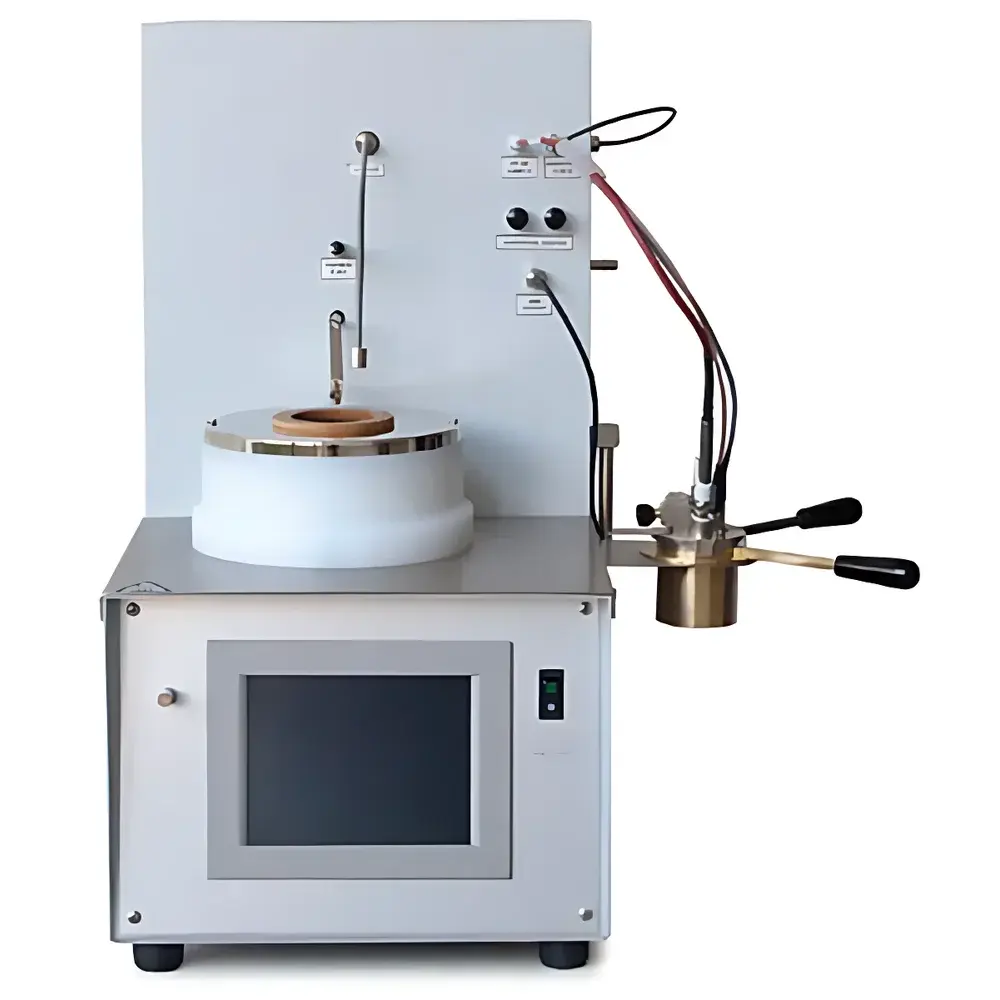
Ducom FPM Pensky-Martens Closed-Cup Flash Point Tester
| Brand | Ducom |
|---|---|
| Origin | USA |
| Model | FPM |
| Detection Method | Closed-Cup |
| Operation Mode | Fully Automated |
| Compliant Standards | ASTM D93 (Methods A, B, C), DIN EN 22719, IP 34, ISO 2719 |
| Temperature Range | 0 °C to 420 °C |
| Temperature Resolution | 0.01 °C |
| Accuracy | ±0.1 °C |
| Repeatability | ±0.1 °C |
| Ignition System | Automated electronic spark ignition with temperature-controlled test sequence |
| Sample Chamber | Stainless steel, corrosion- and impact-resistant |
| Temperature Sensors | Dual PT100 (sample & bath) |
| Dimensions (W×D×H) | 37 × 52 × 32 cm |
| Weight | 30 kg |
| Power Supply | 220 V ±15 %, 50–60 Hz or 115 V ±15 %, 60 Hz |
Overview
The Ducom FPM Pensky-Martens Closed-Cup Flash Point Tester is an ASTM D93-compliant, fully automated analytical instrument engineered for precise, repeatable, and safe determination of the flash point of petroleum-based liquids—including distillate fuels, residual oils, lubricants, biodiesel blends (B5–B100), and complex mixtures containing solids or surface-film-forming components. Based on the classical Pensky-Martens closed-cup principle, the FPM applies controlled heating and regulated stirring to a sealed sample cup while monitoring vapor concentration via automated electronic spark ignition. Flash point is defined as the lowest temperature at which vapors above the sample ignite momentarily when exposed to an ignition source under standardized atmospheric pressure (typically 101.3 kPa). The instrument’s thermally isolated bath, dual PT100 sensing architecture, and real-time thermal feedback loop ensure strict adherence to the ramp rate, stirring frequency, and ignition timing requirements specified in ASTM D93, ISO 2719, IP 34, and DIN EN 22719.
Key Features
- Fully integrated 8.4-inch high-resolution TFT/LCD touchscreen interface with intuitive navigation—no external PC required for routine operation.
- Dual independent PT100 sensors: one immersed directly in the sample for true liquid-phase temperature measurement; another embedded in the heating bath for precise thermal gradient control.
- Automated electronic spark ignition system with adjustable spark energy and position—eliminates manual flame sources and ensures consistent ignition timing per ASTM D93 protocols.
- Real-time self-diagnostic routines for sensor integrity, gas valve actuation, ignition circuit continuity, and thermal safety interlocks.
- Integrated fire detection and suppression subsystem combining ionization and thermal sensing elements—triggers automatic gas shutoff (30 mbar supply cutoff) and initiates localized inert gas purge upon anomaly detection.
- Overtemperature protection with hardware-level thermal cutoff independent of software control—meets IEC 61010-1 safety requirements for laboratory equipment.
- Robust stainless-steel sample cup assembly resistant to corrosion from sulfur-containing fuels, used lubricants, and acidic biodiesel residues.
Sample Compatibility & Compliance
The FPM supports three distinct ASTM D93 test procedures optimized for diverse sample classes: Method A for homogeneous distillates (e.g., diesel, jet fuel, kerosene, new and in-service lubricating oils); Method B for viscous or heterogeneous materials including residual fuel oils, re-refined lubricants, slurry-like cutback asphalts, and samples prone to surface film formation; and Method C specifically validated for pure biodiesel (B100), where low-volatility alcohol residuals necessitate high-sensitivity electronic detection rather than visual flame observation. All methods are executed within the certified temperature range of 0 °C to 420 °C with 0.01 °C resolution and ±0.1 °C repeatability—validated against NIST-traceable reference standards. The system is preconfigured to enforce mandatory procedural parameters (e.g., stir rate: 90 ± 5 rpm for Method A; 250 ± 10 rpm for Method B; ramp rate: 5.5–6.5 °C/min), ensuring full compliance during GLP/GMP audits and regulatory submissions.
Software & Data Management
The embedded operating system logs all critical test parameters—including time-stamped temperature profiles, ignition event timestamps, ramp rates, stir motor current draw, and diagnostic status flags—in a structured CSV format compatible with Excel, LIMS, and ELN platforms. Each test record includes operator ID, sample ID, method selection, calibration certificate ID, and digital signature fields compliant with FDA 21 CFR Part 11 requirements (audit trail, electronic signature, data integrity controls). Raw data export supports batch reporting, statistical process control (SPC) charting, and trend analysis across multiple instruments. Firmware updates are delivered via secure USB import with cryptographic signature verification to prevent unauthorized modification.
Applications
The FPM serves as a primary quality control tool across upstream, midstream, and downstream petroleum operations: verifying flash point conformity of crude assay fractions prior to refining; certifying finished diesel and marine fuel batches per ISO 8217; assessing thermal stability of turbine oils in power generation; validating flash safety margins of transformer insulating fluids (IEC 60296); screening reclaimed lubricants for reprocessing eligibility; and supporting R&D of alternative fuels including hydrotreated vegetable oil (HVO) and synthetic paraffinic kerosene (SPK). Its robust design also supports testing in mobile laboratories, refinery field labs, and third-party contract testing facilities requiring CLIA- or ISO/IEC 17025-accredited flash point data.
FAQ
Does the FPM support both ASTM D93 Method A and Method B without hardware modification?
Yes—the instrument automatically configures stir speed, heating ramp, and ignition timing based on user-selected method, with no mechanical adjustments required.
Can test data be exported in formats compatible with enterprise LIMS systems?
Yes—CSV export includes all metadata required for seamless ingestion into major LIMS platforms, with optional ODBC connectivity available via optional software module.
Is the FPM certified for use in hazardous locations (e.g., Zone 1 or Class I Div 1)?
No—the FPM is designed for general laboratory use per IEC 61010-1; installation in classified areas requires external explosion-proof enclosures and site-specific risk assessment.
How often must the PT100 sensors be recalibrated?
Annual calibration is recommended; the system stores calibration history and prompts users 30 days prior to due date, with traceability to NIST SRM 7461a reference standards.
What maintenance is required between tests?
After each test, the system performs an automated cleaning cycle using compressed air purge and thermal bake-out; cup cleaning with solvent is only required after highly viscous or carbonaceous samples.