
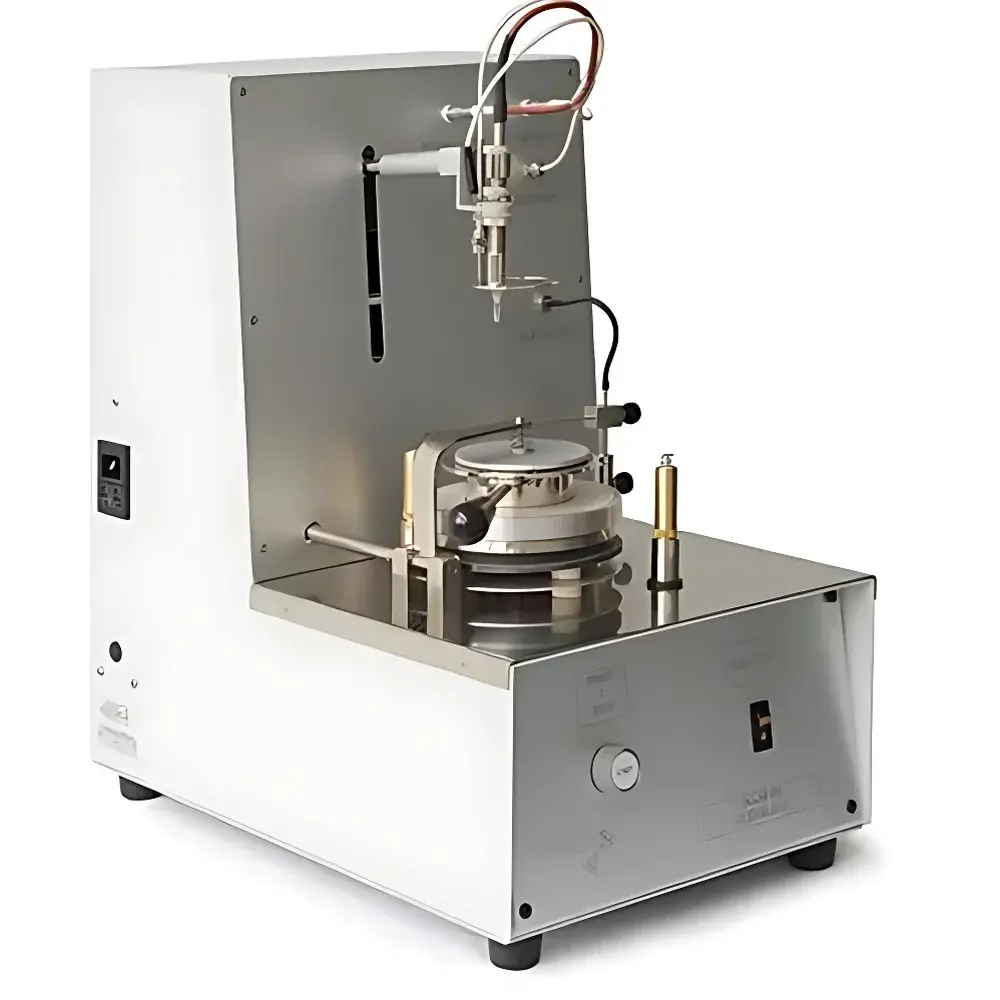
English Product Name
| Origin | Switzerland |
|---|---|
| Type | ASTM D92 Cleveland Open Cup Flash Point Tester |
| Temperature Range | +79 °C to +400 °C |
| Temperature Resolution | 0.06 °C |
| Temperature Accuracy | ±0.1 °C |
| Temperature Probe | PT100 Platinum Sensor (1/10 DIN Class) |
| Sample Cup | ASTM D92 / IP 36–compliant dimensions and fill level markings |
| Heating System | Electronic heater with overtemperature protection |
| Repeatability & Reproducibility | Meets or exceeds ASTM D92 and IP 36 requirements |
| Dimensions (W×D×H) | 48 × 37 × 61 cm |
| Weight | 32 kg |
| Power Supply | 220 V ±15 %, 50/60 Hz |
| Ambient Operating Limit | ≤35 °C |
| Safety Certification | CE-marked |
Overview
The OilLab 670 is a precision-engineered Cleveland Open Cup (COC) automatic flash point tester designed for rigorous compliance with ASTM D92, IP 36, ISO 2592, EN 22592 (observed), and DIN 51376. It implements the classical Cleveland method—where a sample is heated at a controlled rate in a standardized brass cup, and an ignition source is automatically traversed across the surface at prescribed temperature intervals. Flash point is determined when the vapor above the sample ignites momentarily upon exposure to the test flame; ignition is detected via a highly sensitive ionization sensor. For fire point determination, heating continues until sustained combustion (>5 s) is confirmed by a secondary PT100 probe, after which the instrument initiates automatic flame suppression. This dual-probe architecture ensures unambiguous differentiation between flash and fire points while maintaining full traceability to international standard protocols.
Key Features
- Automated flame delivery system with dual guided flame options (single- or double-flame configurations) and programmable sweep timing per ASTM D92 cycle requirements.
- Two independent, high-stability PT100 platinum resistance thermometers: one for sample bulk temperature monitoring (ASTM D92–specified immersion depth), and a second dedicated ionization-triggered probe for fire point confirmation.
- Electronically regulated heating platform with real-time thermal feedback control and hardware-level overtemperature cutoff—eliminating risk of thermal runaway during extended high-range tests (up to +400 °C).
- Standard-compliant brass test cup manufactured to exact ASTM D92 and IP 36 dimensional tolerances, including engraved meniscus-level fill marks for consistent sample volume (70 mL).
- Robust mechanical architecture (32 kg mass, vibration-damped base) ensures measurement stability under laboratory bench conditions and long-term calibration retention.
- CE-certified electrical safety design with integrated grounding, isolation transformers, and gas flow interlocks for propane/butane fuel systems.
Sample Compatibility & Compliance
The OilLab 670 is validated for use with petroleum-based liquids—including lubricating oils, residual fuels, bitumens, and distillates—with initial flash points ≥+79 °C. Its open-cup configuration aligns with regulatory frameworks requiring physical simulation of large-volume, atmospheric-exposed storage scenarios (e.g., tank farm safety assessments). The instrument satisfies technical validation criteria under ASTM D92 Section 7 (Apparatus Requirements), ISO/IEC 17025–accredited calibration traceability (via NIST-traceable PT100 reference standards), and supports audit-ready documentation for GLP and GMP environments. All firmware and LabLink software modules comply with FDA 21 CFR Part 11 requirements for electronic records and signatures when configured with user authentication, audit trails, and secure data archiving.
Software & Data Management
Controlled exclusively via the Windows-native LabLink software (compatible with Windows 2000 through Windows 10), the OilLab 670 enables centralized management of up to ten analyzers on a single network. LabLink provides method-driven operation through three structured menus: Analysis (with preloaded ASTM/IP/ISO/EN/DIN methods, unknown-sample adaptive mode, and configurable audio/visual alerts), Diagnostics (real-time I/O monitoring, analog/digital signal visualization in °C or mV), and Calibration (automated multi-point PT100 verification, date-stamped calibration logs, compensation coefficient entry, and graphical deviation plots). All raw temperature/time datasets are stored in Excel-compatible CSV format with metadata fields (operator ID, sample ID, method version, environmental conditions). Internal database capacity exceeds 60,000 test records, and optional LIMS integration supports HL7 and ASTM E1384 message exchange for enterprise-scale quality data aggregation.
Applications
- Refinery QC laboratories performing routine flash point verification on crude fractions, vacuum gas oils, and marine fuels per MARPOL Annex I discharge regulations.
- Independent testing labs providing third-party certification for API RP 2000-compliant flammability hazard classification of industrial lubricants and hydraulic fluids.
- R&D facilities evaluating thermal stability of bio-based diesel blends and synthetic ester dielectric fluids under elevated temperature stress conditions.
- Regulatory agencies conducting forensic analysis of fire origin investigations where reproducible open-cup ignition thresholds are legally admissible evidence.
- Contract manufacturing sites validating batch-to-batch consistency of transformer oils against IEEE C57.106 flash point acceptance limits.
FAQ
Does the OilLab 670 support both flash point and fire point determination in a single run?
Yes. The instrument performs sequential flash point detection via ionization sensing, then continues heating under ASTM D92–defined ramp rates until sustained combustion is verified by the secondary PT100 probe—automatically recording both values with timestamped event logs.
Can the system be operated without a PC connection?
The OilLab 670-SA variant includes an integrated LCD interface and onboard keypad for standalone method selection, real-time temperature display, and manual start/stop functions. The base OilLab 670 model requires LabLink software and external PC control.
What calibration standards are recommended for routine verification?
NIST-traceable certified reference materials (CRMs) such as n-decane (flash point +101 °C) and tetradecane (+205 °C) are recommended for daily performance checks. The OilLab 80 calibration kit includes a PT100 simulator for full electronic sensor verification without thermal cycling.
Is gas supply regulation handled internally or externally?
Gas flow is managed externally via optional LAB-6XX/06-21 solenoid valve modules, allowing integration with centralized lab gas manifolds. The instrument monitors pressure integrity and halts operation if flow falls outside ASTM-specified 3–5 L/min range for propane ignition sources.
How is data integrity maintained during power interruption?
All active measurements are buffered in non-volatile memory. Upon recovery, LabLink resumes logging from the last stable temperature reading and appends continuity flags to the audit trail—ensuring uninterrupted compliance with 21 CFR Part 11 §11.10(e) data retention requirements.




