
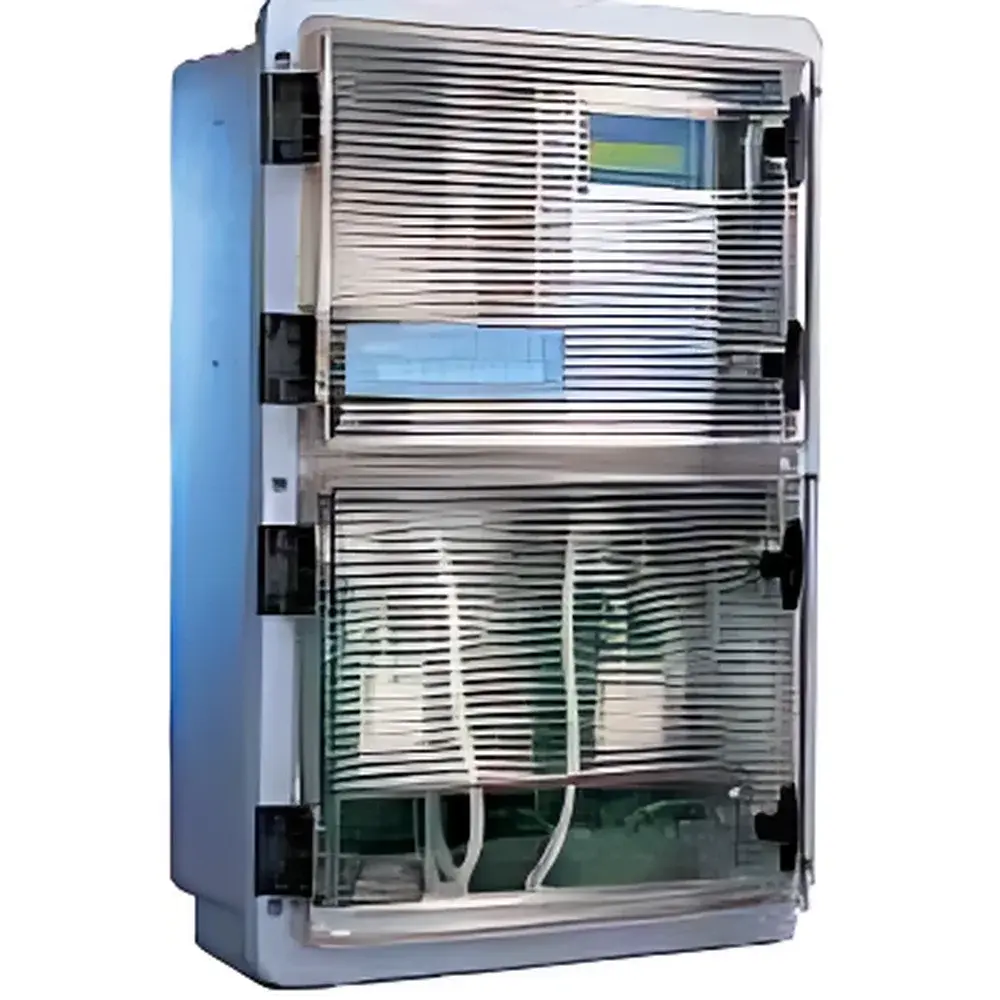
Hach 5000 Online Silicon Analyzer
| Brand | Hach |
|---|---|
| Origin | Imported |
| Manufacturer Type | Manufacturer |
| Model | 5000 Online Silicon |
| Measurement Range | 0–5000 ppb as SiO₂ |
| Detection Limit | <0.5 ppb |
| Accuracy | ±0.5 ppb or ±1.0% of reading (whichever is greater) |
| Response Time | 8.8 min (sample temperature 30–50 °C) |
| Ambient Operating Temperature | 10–45 °C |
| Sample Pressure Requirement | 5 ± 3 psig (34.5 ± 20.7 kPa) |
| Sample Flow Rate | 100–300 mL/min |
| Analog Outputs | 0–0.01 V, 0–0.1 V, 0–1 V, or 4–20 mA (user-configurable range) |
| Power Supply | 115/230 VAC, 50–60 Hz |
| Alarm Outputs | 2 concentration alarms, 1 system warning alarm, 1 system shutdown alarm |
| Enclosure Rating | NEMA 4X / IP65 (ABS plastic) |
| Mounting Options | Benchtop or panel-mount |
| Reagent Delivery | Patented pressure-driven reagent metering system |
| Calibration Modes | Programmable auto-calibration with three selectable methods |
| Channel Configuration | Configurable up to 8-channel silicon analysis |
Overview
The Hach 5000 Online Silicon Analyzer is a fully automated, laboratory-grade photometric analyzer engineered for continuous, real-time monitoring of dissolved silica (as SiO₂) in ultra-pure water streams critical to power generation and semiconductor manufacturing. It employs the internationally standardized molybdenum blue colorimetric method—identical to ASTM D859 and ISO 10523 protocols—ensuring direct comparability with reference laboratory results. The instrument operates on a fixed-wavelength photometer (typically 815 nm) optimized for high sensitivity in low-concentration regimes, where trace silica contamination (<10 ppb) can initiate boiler tube scaling, turbine deposition, or wafer surface defects. Its design prioritizes long-term stability in demanding industrial environments, with minimal drift and rigorous baseline correction via automatic zero adjustment before each analysis cycle.
Key Features
- Patented pressure-actuated reagent delivery system eliminates peristaltic pump wear and reduces reagent consumption by up to 40% compared to conventional flow-cell analyzers.
- Automatic zero-point compensation performed prior to every sample measurement, dynamically correcting for optical path fouling and baseline drift caused by ambient temperature fluctuations or lamp aging.
- Multi-level diagnostic architecture: detects and reports flow interruption, reagent depletion, photometer saturation, and heater failure with discrete relay outputs compliant with ISA-84 SIS requirements.
- Factory-prepared, lot-certified reagent kits ensure batch-to-batch consistency and eliminate on-site reagent preparation errors—critical for GLP-compliant operation.
- Configurable 1–8 channel multiplexing enables centralized monitoring of multiple sampling points (e.g., condensate, feedwater, steam, and blowdown lines) from a single analyzer platform without signal degradation.
- Robust NEMA 4X/IP65 enclosure constructed from UV-stabilized ABS allows installation in non-hazardous utility rooms, turbine halls, or chemical dosing shelters without additional climate control.
Sample Compatibility & Compliance
The analyzer accepts pressurized liquid samples within 5 ± 3 psig (34.5 ± 20.7 kPa) and 100–300 mL/min flow rate, compatible with standard ¼” PFA or stainless-steel sample tubing. It meets IEC 61326-1 for electromagnetic compatibility and conforms to UL 61010-1 for electrical safety. Data integrity is maintained per FDA 21 CFR Part 11 requirements through audit-trail-enabled firmware: all calibration events, alarm triggers, parameter changes, and system resets are timestamped, user-identified, and non-erasable. The method is validated per ASTM D859 for silica in high-purity water and supports ISO 5725-2 precision criteria across its full 0–5000 ppb range.
Software & Data Management
Embedded firmware supports Modbus TCP and RS-485/RTU communication protocols for seamless integration into DCS, SCADA, or MES platforms. Local configuration is managed via a password-protected web interface accessible over Ethernet; no proprietary software installation is required. All analog outputs (4–20 mA, 0–1 V, etc.) are independently scalable and assignable to primary measurement, diagnostic status, or calculated deviation values. Historical data—including raw absorbance, corrected concentration, reagent usage counters, and alarm logs—is stored internally for ≥30 days and exportable via USB or HTTP GET request in CSV format. Firmware updates are delivered via signed .bin files to prevent unauthorized modification.
Applications
- Real-time monitoring of silica breakthrough in mixed-bed ion exchange effluent in power plant makeup water systems.
- Continuous verification of silica removal efficiency in reverse osmosis and electrodeionization (EDI) pretreatment stages.
- Boiler feedwater and drum water surveillance to prevent silica carryover and subsequent turbine blade deposition.
- Steam purity validation in supercritical and ultra-supercritical boilers per ASME PTC 19.11 guidelines.
- Critical point-of-use monitoring in semiconductor fab ultrapure water (UPW) distribution loops, aligned with SEMI F63 specifications.
FAQ
What is the recommended maintenance interval for routine service?
Preventive maintenance—including optical window cleaning, reagent line inspection, and calibration verification—is recommended every 90 days under continuous operation. Full reagent kit replacement occurs every 6 months at nominal flow rates.
Can the analyzer operate unattended for extended periods?
Yes. With scheduled auto-calibration (configurable from daily to weekly), self-diagnostic reporting, and redundant alarm relays, the system supports >6 months of uninterrupted operation in accordance with IEC 62443-3-3 SL2 cybersecurity requirements.
Is the method interferent-resistant to phosphate or iron?
The integrated interference correction algorithm compensates for common spectral overlaps from orthophosphate and Fe³⁺ ions up to 500 ppb, as verified per ASTM D859 Annex A1.
How is data traceability ensured for regulatory audits?
All measurements include embedded metadata: instrument ID, firmware version, calibration certificate ID, operator login token, and UTC timestamp—fully compliant with ALCOA+ principles for data integrity in GMP environments.







