
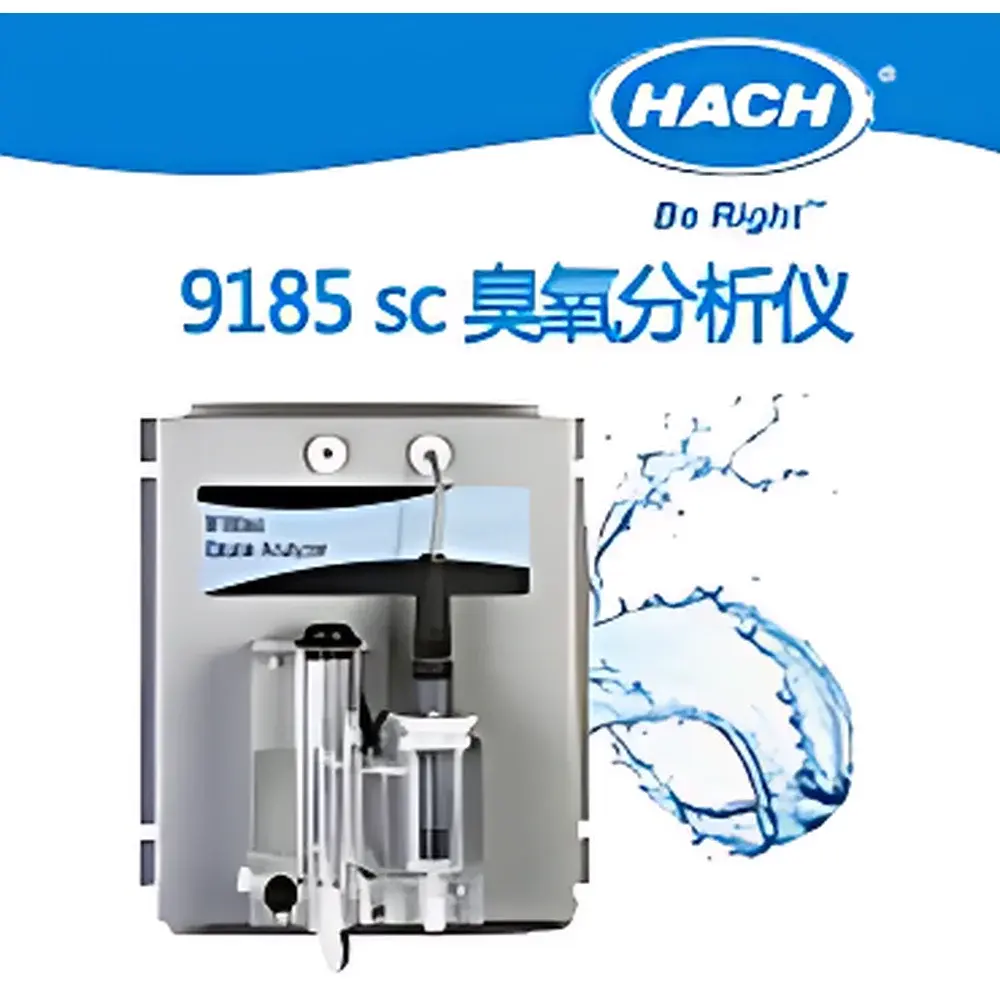
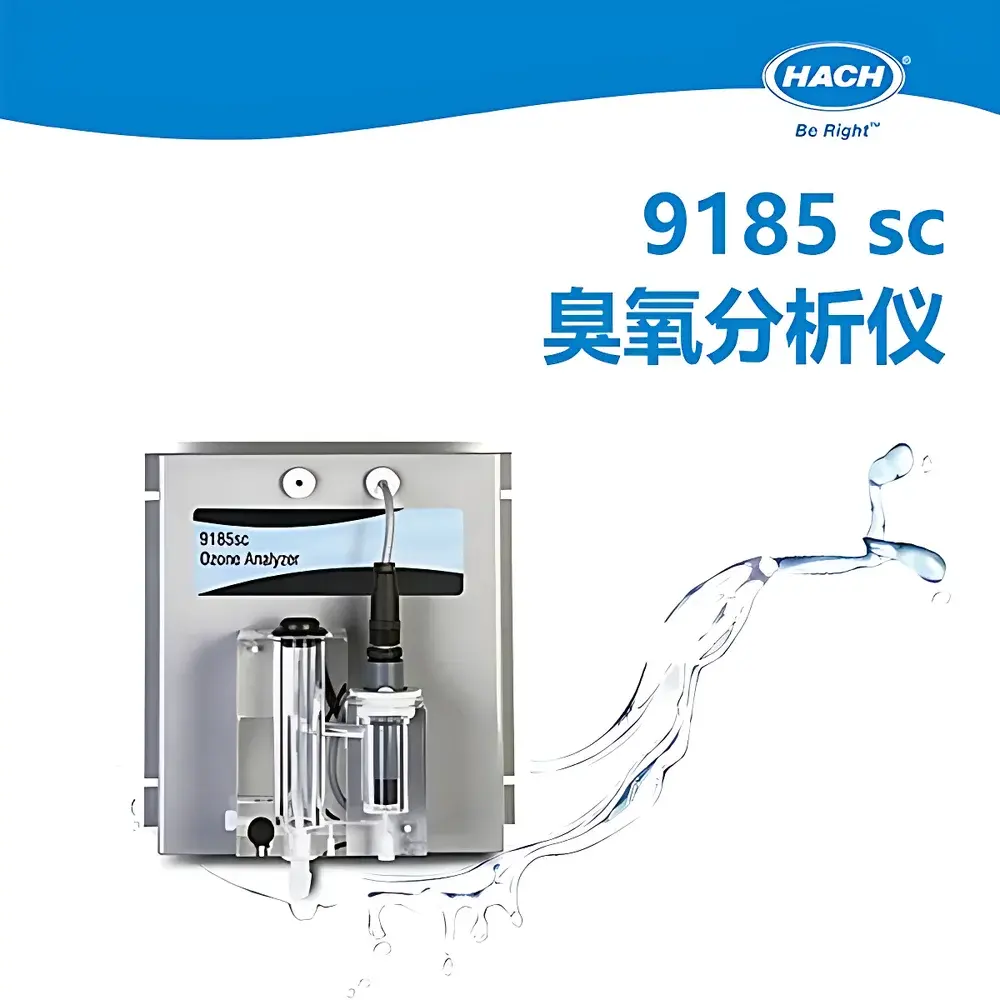
HACH 9185sc Ozone Analyzer
| Brand | HACH |
|---|---|
| Origin | USA |
| Manufacturer Type | Original Equipment Manufacturer (OEM) |
| Product Origin | Imported |
| Model | 9185sc |
| Pricing | Available Upon Request |
Overview
The HACH 9185sc Ozone Analyzer is a field-deployable, amperometric electrochemical sensor engineered for continuous, real-time measurement of dissolved ozone (O₃) in water streams. It operates on a well-established two-electrode amperometric principle: ozone diffuses through a selective hydrophobic membrane and is reduced at a gold cathode according to the reaction O₃ + H₂O + 2e⁻ → O₂ + 2OH⁻; concurrently, silver oxidation occurs at the reference anode (Ag → Ag⁺ + e⁻), with Ag⁺ immediately precipitating as AgBr in the presence of bromide ions in the internal electrolyte. The resulting diffusion-limited current is linearly proportional to the aqueous ozone concentration, enabling stable, drift-resistant quantification across a wide dynamic range. Designed specifically for integration into online water quality monitoring systems, the 9185sc delivers reliable performance in municipal drinking water disinfection control, wastewater reuse applications, pharmaceutical purified water (PW) and water-for-injection (WFI) loop monitoring, and semiconductor ultrapure water (UPW) treatment processes.
Key Features
- Selective gas-permeable membrane electrode architecture minimizes cross-sensitivity to common oxidants — including free chlorine, combined chlorine, bromine, chlorine dioxide, and hydrogen peroxide — ensuring specificity in complex matrices.
- Low detection limit of 5 ppb enables precise control of low-dose ozone applications, such as final disinfection polishing or advanced oxidation process (AOP) residual monitoring.
- Fast 90% response time ≤ 90 seconds supports dynamic process feedback and closed-loop control integration.
- Robust IP66 (NEMA 4X) rated enclosure ensures operational integrity in wet, outdoor, or high-humidity environments typical of pump stations, clearwells, and industrial skids.
- Modular design facilitates rapid membrane and electrolyte replacement — completed in under 10 seconds without tools or recalibration — minimizing instrument downtime and reducing total cost of ownership.
- Low power consumption (1.5 W) allows deployment in remote or energy-constrained locations, including solar-powered telemetry sites.
Sample Compatibility & Compliance
The 9185sc is validated for use with potable water, secondary and tertiary treated wastewater, process cooling water, pharmaceutical-grade purified water (USP , EP 2.2.43), and ultrapure water (ASTM D5127, SEMI F63). Its electrochemical measurement principle is unaffected by pH variations (pH 4–9), turbidity, or moderate organic loading. The analyzer meets NEMA 4X and IP66 ingress protection standards and complies with CE marking requirements for electromagnetic compatibility (EMC Directive 2014/30/EU) and low-voltage safety (LVD Directive 2014/35/EU). While not intrinsically safe, it is suitable for non-hazardous area installation per IEC 60079-0 general requirements.
Software & Data Management
The 9185sc outputs a standard 4–20 mA analog signal with HART® protocol support (version 7), enabling seamless integration with SCADA, DCS, and PLC-based control systems. Optional digital communication via Modbus RTU over RS-485 allows direct connection to data loggers or centralized telemetry platforms. When deployed within HACH’s SC1000 or SC200 controller ecosystems, the analyzer supports automated calibration logging, maintenance alerts (e.g., membrane expiration counter), and audit-trail-enabled event history — aligning with GLP and GMP documentation expectations for regulated water systems. Data timestamps, operator IDs, and configuration changes are retained per FDA 21 CFR Part 11 principles when paired with compliant host software.
Applications
- Real-time monitoring of ozone residual in drinking water distribution system contact tanks and clearwells.
- Process control of ozone injection in municipal wastewater disinfection and micropollutant abatement systems.
- Verification of ozone decay kinetics during ozonation of industrial process water and recycled cooling water.
- Validation and routine surveillance of ozone-based sterilization cycles in pharmaceutical clean utilities (e.g., PW loops).
- Performance verification of ozone generators and destruct units in semiconductor fab UPW treatment trains.
FAQ
What is the recommended calibration frequency?
Calibration is recommended every two months under typical operating conditions; however, field validation using standardized ozone-spiked samples or certified reference materials should be performed weekly or per site-specific QA/QC protocols.
Does the sensor require temperature compensation?
Yes — the 9185sc incorporates an integrated Pt1000 temperature sensor and applies automatic temperature compensation based on the Arrhenius relationship between ozone solubility and diffusion rate.
Can the 9185sc be installed in-line or only in bypass configurations?
It is designed for sidestream (bypass) sampling with controlled flow (200–250 mL/min); direct in-line insertion is not supported due to mechanical and hydraulic constraints of the membrane electrode assembly.
Is the electrolyte solution proprietary?
Yes — the internal electrolyte is a buffered potassium bromide–silver nitrate formulation supplied exclusively by HACH; use of third-party electrolytes voids warranty and compromises accuracy and lifetime.
What maintenance tasks are required beyond membrane replacement?
Beyond quarterly membrane/electrolyte replacement, annual inspection of the O-ring seal integrity, flow regulator function, and electrical connections is advised to maintain IP66 compliance and measurement stability.
Related Products







