
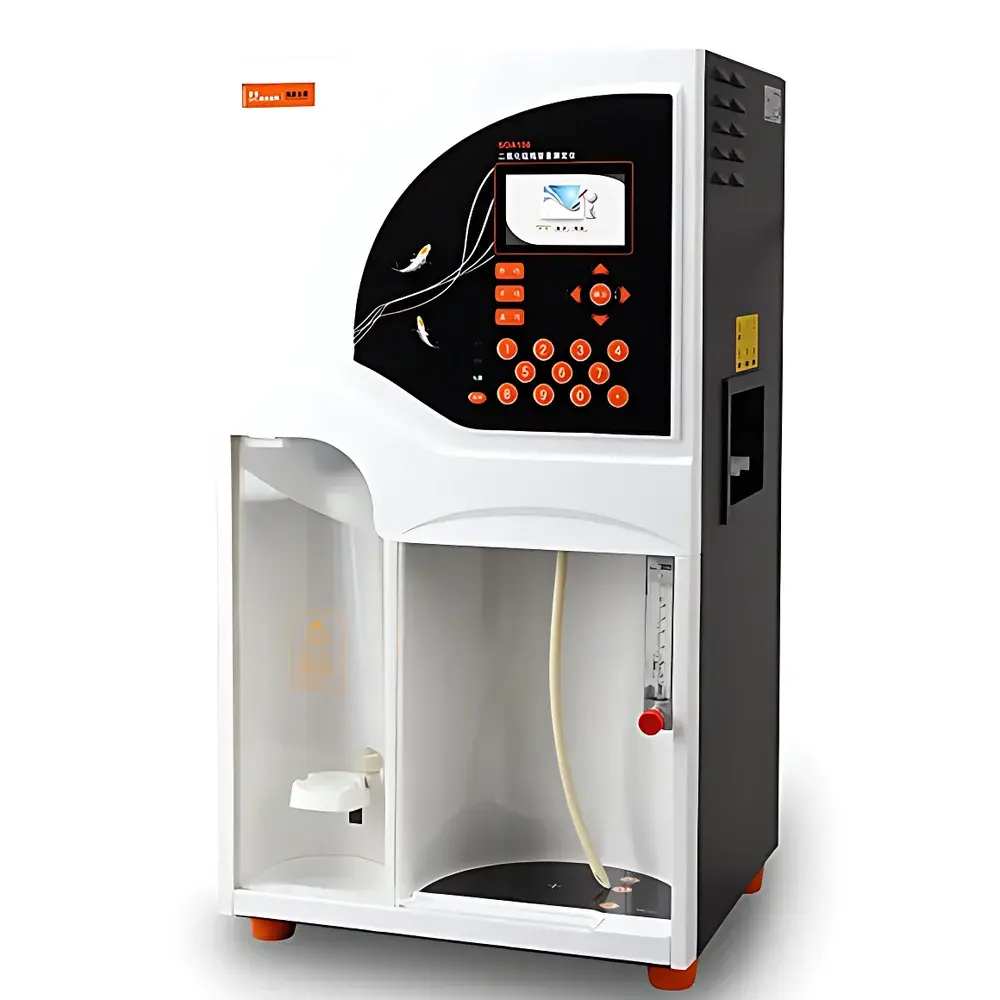
Hanon SOA100 Automated Sulfur Dioxide Residue Analyzer
| Brand | Hanon |
|---|---|
| Origin | Shandong, China |
| Model | SOA100 |
| Detection Range | 0.1–50 mg |
| Detection Limit | ppm-level |
| Sample Throughput | 5–10 min/sample |
| Stirring Speed | 15–1500 rpm |
| Repeatability | RSD ≤ 1% |
| Distillation Time | 0–90 min |
| Cooling Water Consumption | 1.5 L/min |
| Display | 4.3-inch high-resolution color LCD |
| Rated Power | 1.3 kW |
| Input Voltage | 220 VAC ±10%, 50 Hz |
| Dimensions (L×W×H) | 400 × 385 × 735 mm |
| Net Weight | 30 kg |
Overview
The Hanon SOA100 Automated Sulfur Dioxide Residue Analyzer is a fully integrated, benchtop analytical system engineered for precise and compliant quantification of residual sulfur dioxide (SO₂) in pharmaceutical raw materials, herbal medicines, food matrices, and excipients. It implements the official distillation-based methodology specified in Chinese Pharmacopoeia (ChP) General Chapter 2331, USP , and ISO 5776:2021—relying on acid liberation, steam distillation, absorption into hydrogen peroxide solution, and subsequent iodometric or spectrophotometric titration. Unlike manual glassware setups, the SOA100 replaces operator-dependent steps with programmable fluidic control, thermally regulated distillation, real-time safety monitoring, and closed-loop nitrogen purging—ensuring consistent sample treatment, minimized analyst exposure to corrosive reagents (e.g., HCl), and elimination of carryover artifacts.
Key Features
- Fully automated workflow: Sequential execution of reagent dispensing (distilled water, hydrochloric acid, absorbing solution), controlled heating, steam distillation, condensate collection, post-distillation tube rinsing, nitrogen purging, and magnetic stirring—all under single method programming.
- Integrated safety architecture: Real-time interlock monitoring of cooling water flow, digestion tube placement, safety door status, and thermal over-limit conditions; automatic shutdown and audible/visual alarm upon anomaly detection.
- Precision liquid handling: High-accuracy peristaltic and piston pumps deliver calibrated volumes of receiving solution, HCl, and rinse water—eliminating volumetric error and manual pipetting hazards.
- Intelligent nitrogen management: Built-in mass-flow-controlled N₂ purge system with on-screen flow rate display and adjustment (0–5 L/min), ensuring complete removal of residual SO₂ from transfer lines and condenser tubing.
- Adaptive magnetic stirring: Dual-direction, variable-speed stirrer (15–1500 rpm) integrated into the receiver flask compartment—optimizing oxidation efficiency during H₂O₂ absorption and enabling kinetic consistency across heterogeneous samples.
- Resource-efficient operation: Auto-activated condenser cooling only during distillation phase; adjustable distillation duration (0–90 min); low standby power consumption (<5 W).
Sample Compatibility & Compliance
The SOA100 accommodates solid samples up to 10 g and liquid samples up to 20 mL, supporting diverse pharmacopeial matrices including dried herbs, processed botanicals, sulfited fruits, starch derivatives, and injectable excipients. Its design conforms to Good Laboratory Practice (GLP) operational principles, with audit-trail-capable method storage, user-access-level permissions (admin/operator), and timestamped run logs. While not inherently 21 CFR Part 11 compliant out-of-the-box, its firmware supports optional electronic signature modules and data export in CSV/Excel formats compatible with LIMS integration. Validation documentation—including IQ/OQ protocols aligned with ASTM E2500 and ISO/IEC 17025—can be supplied upon request for GMP-regulated environments.
Software & Data Management
The instrument is operated via an embedded Linux-based control system with a 4.3-inch capacitive touch LCD interface. Users define methods using intuitive parameter fields: distillation time, heating ramp profile, stir speed, nitrogen flow setpoint, and rinse volume. All method parameters are saved with version control and user ID tagging. Run history includes start/stop timestamps, detected anomalies, actual measured temperatures, and pump actuation logs—exportable via USB port. No proprietary software installation is required; raw data files contain unprocessed sensor outputs (temperature, flow, pressure) for retrospective troubleshooting or third-party statistical analysis.
Applications
- Pharmaceutical quality control: SO₂ residue testing of traditional Chinese medicine (TCM) decoction pieces per ChP 2020 Edition, Section 2331.
- Food safety laboratories: Verification of sulfite compliance in dried fruits, wine musts, and seafood products against EU Regulation (EC) No 1333/2008 and FDA 21 CFR §100.100.
- Contract research organizations (CROs): High-throughput screening of SO₂ leaching from packaging materials under accelerated stability conditions.
- Regulatory submission support: Generation of reproducible, auditable datasets for ANDA, DMF, or CEP dossiers requiring documented SO₂ control strategies.
- Method development labs: Optimization of distillation kinetics and absorbent chemistry for novel SO₂-binding matrices (e.g., cyclodextrin complexes, chitosan films).
FAQ
What regulatory standards does the SOA100 support?
It implements methodologies referenced in ChP 2331, USP , ISO 5776, and AOAC Official Method 990.12—enabling compliance with national and international SO₂ residue limits.
Can the SOA100 be validated for GMP use?
Yes—IQ/OQ documentation packages, traceable calibration certificates for pumps and temperature sensors, and risk-based validation templates are available for qualified users.
Is external titration equipment required?
The SOA100 performs sample preparation only; final quantification requires off-line iodometric titration or UV-Vis measurement at 350 nm using a separate spectrophotometer or titrator.
How is carryover prevented between runs?
Automated post-distillation tube rinsing with deionized water and nitrogen blow-out eliminates residual SO₂ adsorption on condenser surfaces and transfer lines.
Does the system support multi-user access control?
Yes—password-protected operator and administrator accounts restrict method editing, calibration access, and data deletion privileges.





