
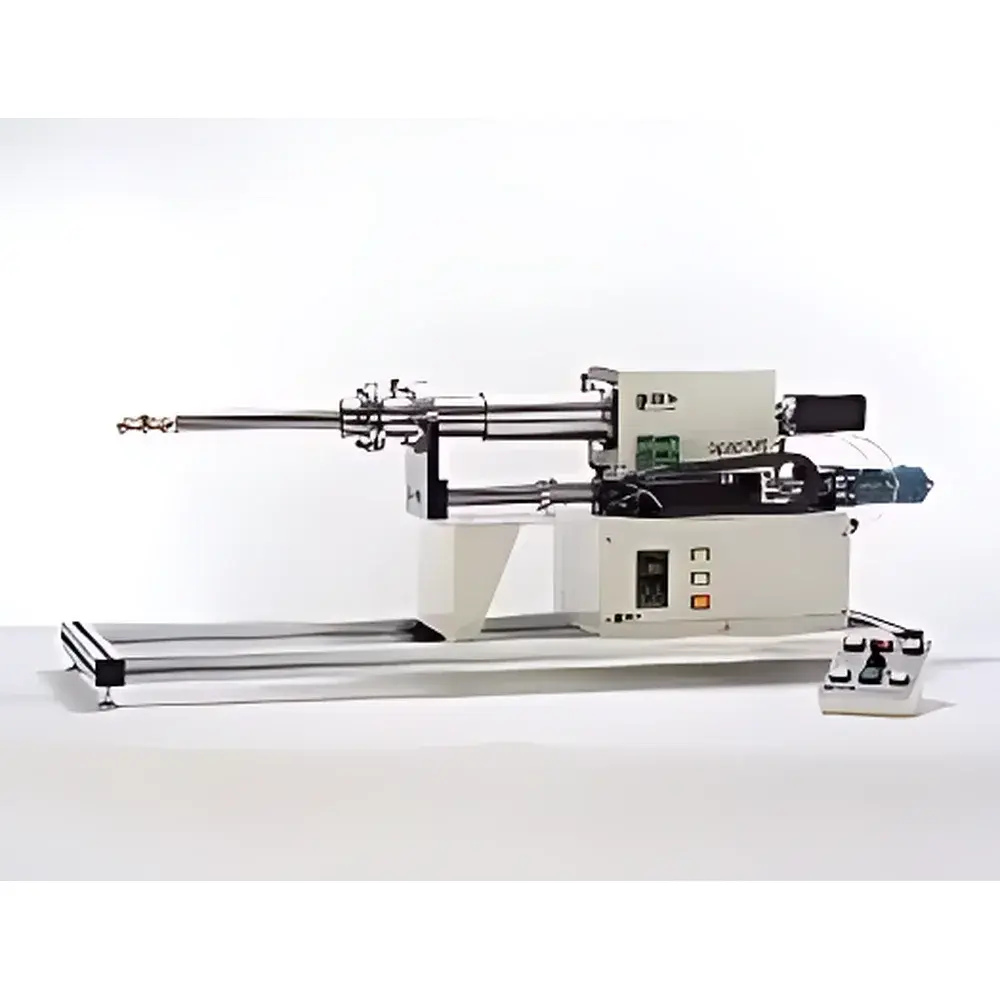
Hiden Spaci-MS Spatially Resolved Mass Spectrometer
| Brand | Hiden |
|---|---|
| Origin | Austria |
| Model | Spaci-MS |
| Inlet Channels | 16 |
| Axial Travel Range | 0–300 mm |
| Spatial Resolution | 0.1 mm |
Overview
The Hiden Spaci-MS Spatially Resolved Mass Spectrometer is the world’s first commercially available instrument engineered to deliver true three-dimensional chemical and thermal mapping within heterogeneous catalytic reaction environments. Unlike conventional mass spectrometers that analyze bulk effluent gases, the Spaci-MS employs a precision-machined, motorized micro-probe sampling system to perform spatially localized, real-time gas-phase analysis directly inside operating reactors. Its operational principle is based on controlled physical insertion of a differentially pumped capillary probe into defined axial (Z) and radial positions—enabling simultaneous acquisition of species concentration gradients and local temperature profiles with sub-millimeter positional fidelity. This capability addresses a longstanding analytical gap in heterogeneous catalysis research, where transient reaction dynamics, hotspot formation, and mass-transfer limitations cannot be resolved using off-line or exhaust-stream-only techniques.
Key Features
- 16-channel programmable inlet manifold enabling sequential or parallel sampling from discrete reactor zones without hardware reconfiguration
- Motor-driven Z-axis translation stage with 0–300 mm travel range and 0.1 mm positional repeatability, calibrated against NIST-traceable displacement standards
- Integrated Type-K thermocouple embedded coaxially within the sampling probe tip, providing synchronized temperature measurement at each spatial coordinate
- Differentially pumped quadrupole mass spectrometer (QMS) core with mass range up to 300 amu and detection limits < 1 ppm for common process gases (e.g., CO, CO₂, O₂, NOₓ, hydrocarbons)
- Real-time synchronization of position data, ion current signals, and thermocouple readings via deterministic low-latency USB 3.0 interface
- Ruggedized stainless-steel probe assembly rated for operation up to 800 °C and compatible with pressurized reactor systems (up to 10 bar gauge)
Sample Compatibility & Compliance
The Spaci-MS is validated for use in fixed-bed, monolith, and coated-wall catalytic reactors—including diesel oxidation catalysts (DOC), selective catalytic reduction (SCR) units, and steam methane reformers. Its probe geometry minimizes flow disturbance (< 2% velocity perturbation at 1 m/s crossflow), ensuring representative sampling under dynamic flow conditions. The system complies with ISO/IEC 17025 requirements for analytical equipment validation when operated within documented calibration and maintenance protocols. Data acquisition firmware supports audit trails and user-access logging in accordance with FDA 21 CFR Part 11 guidelines for regulated environments. All mechanical components meet ASME B31.3 process piping standards for high-temperature service.
Software & Data Management
Hiden’s proprietary SPACI-View software provides full instrument orchestration: automated probe positioning, multi-channel gas calibration, real-time spectral visualization, and 3D volumetric reconstruction of composition–temperature fields. Raw datasets are stored in HDF5 format with embedded metadata (timestamp, coordinates, pressure, temperature), enabling traceable post-processing in MATLAB, Python (via h5py), or commercial CFD platforms. Batch scripting supports unattended overnight profiling campaigns; data export modules generate ASTM E2934-compliant reports for peer-reviewed publication or regulatory submission. Optional GLP/GMP add-on licenses enable electronic signature workflows and change-controlled method storage.
Applications
- Mapping axial/radial distributions of intermediates and products in automotive aftertreatment catalysts during cold-start transients
- Quantifying oxygen storage capacity gradients across ceria–zirconia washcoats under cyclic redox conditions
- Validating computational fluid dynamics (CFD) and microkinetic models with experimental 3D concentration–temperature boundary conditions
- Diagnosing channel-to-channel non-uniformity in ceramic monolith reactors used in ammonia synthesis
- Studying coke deposition kinetics and spatial progression in fluid catalytic cracking (FCC) regenerators
- Characterizing thermal runaway propagation in lithium-ion battery thermal abuse experiments via in-situ gas evolution profiling
FAQ
What reactor geometries are compatible with the Spaci-MS probe?
The standard 1.2 mm OD probe is designed for insertion into tubular reactors ≥ 8 mm internal diameter; custom probes (0.8 mm and 1.6 mm OD) are available for narrow monolith channels or thick-walled fixed beds.
Can the Spaci-MS operate under vacuum or high-pressure conditions?
Yes—the differential pumping architecture maintains QMS vacuum integrity while supporting probe operation from 10⁻³ mbar to 10 bar absolute reactor pressure.
Is calibration required before each experiment?
A single multi-point gas standard calibration (using certified NIST-traceable mixtures) suffices for > 200 hours of continuous operation; drift correction is performed automatically using internal reference peaks.
How is spatial registration accuracy verified?
Positional accuracy is confirmed via laser interferometry during factory acceptance testing and can be re-verified in situ using machined reference fixtures with ±0.05 mm fiducial markers.
Does the system support third-party control integration?
Yes—TCP/IP and Modbus TCP APIs are provided for integration with PLC-based reactor control systems and SCADA platforms.
Related Products




