
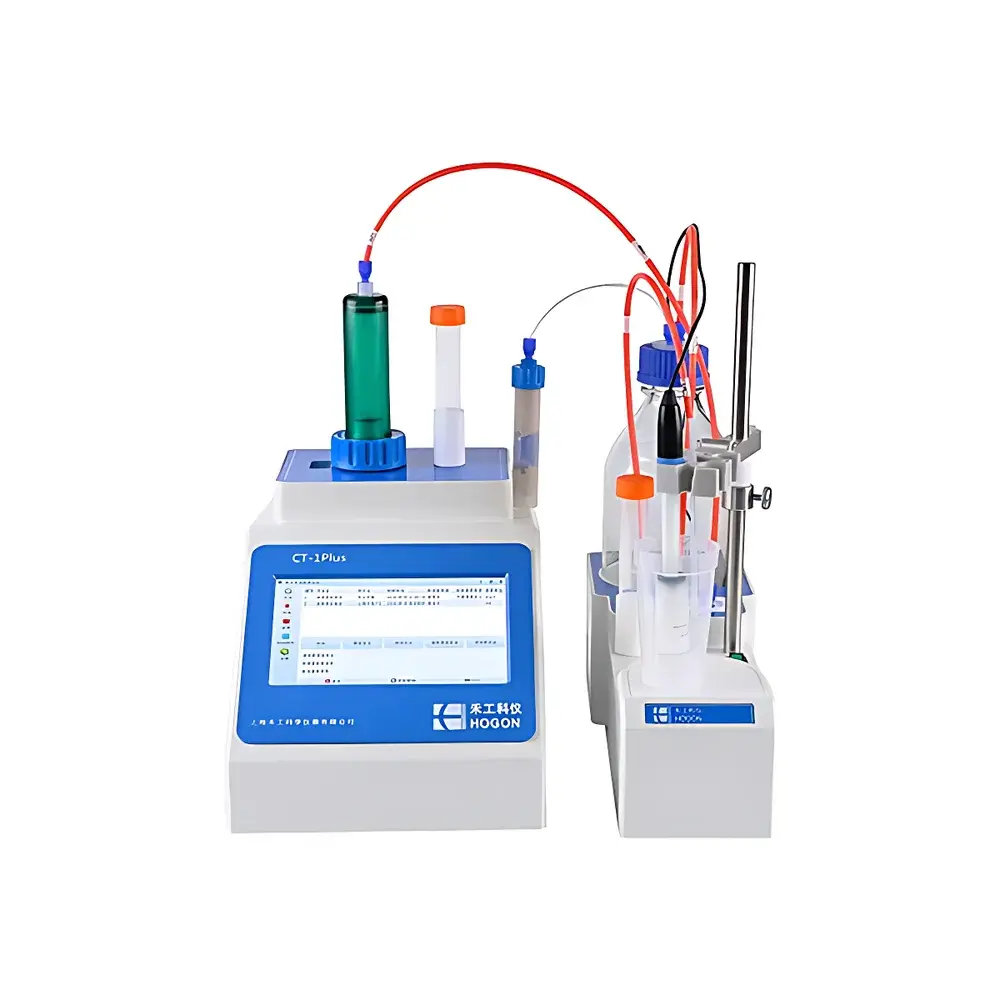
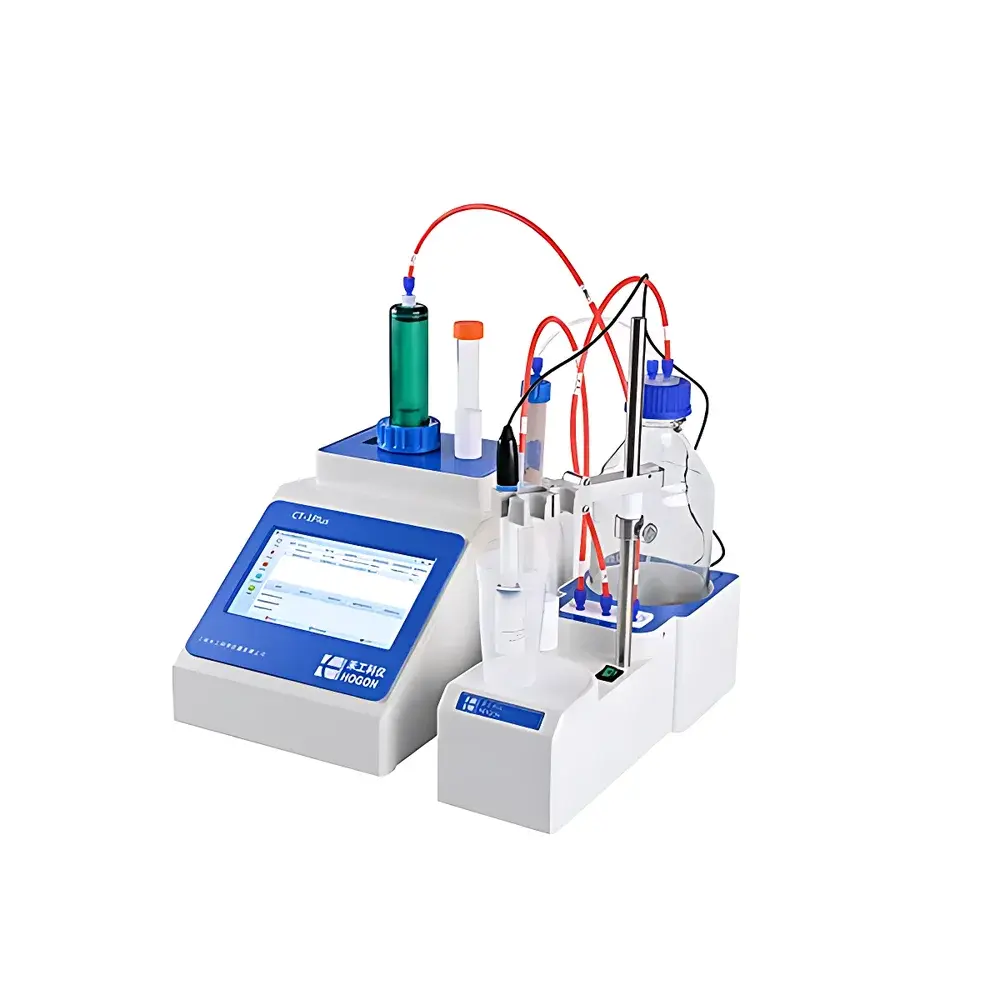
HOGON CT-1PLUS Polyether Polyol Hydroxyl Value Automatic Potentiometric Titrator
| Brand | HOGON |
|---|---|
| Origin | Shanghai, China |
| Manufacturer Type | Direct Manufacturer |
| Instrument Type | General-Purpose Automatic Potentiometric Titrator |
| Application Scope | Universal |
| Measurement Ranges | Potential: ±2000 mV |
| pH | 0–14 |
| Temperature | −5 to 125 °C |
| Meter Accuracy | ±0.3% of full scale |
| Meter Resolution | 0.1 mV (potential), 0.001 pH unit, 0.1 °C |
| Titration Accuracy | (±0.3 mV ±1 digit) over 3 h |
| Titration Resolution | ±2000 mV range, 0.1 mV resolution, ±0.2 mV absolute accuracy |
Overview
The HOGON CT-1PLUS Polyether Polyol Hydroxyl Value Automatic Potentiometric Titrator is a dedicated electrochemical analysis system engineered for the precise and standardized determination of hydroxyl value (OHV) in polyether polyols—critical raw materials in polyurethane synthesis, coatings, adhesives, and flexible/rigid foam manufacturing. Hydroxyl value, expressed in mg KOH/g, quantifies the milligrams of potassium hydroxide equivalent to the hydroxyl groups present per gram of sample. Accurate OHV measurement directly correlates with molecular weight estimation, functionality assessment, and reactivity prediction—parameters essential for formulation consistency, batch release, and regulatory compliance. The CT-1PLUS implements potentiometric titration based on the ASTM D4292–22 and ISO 14900:2021 protocols for hydroxyl value analysis, utilizing a non-aqueous back-titration method with tetrabutylammonium hydroxide (TBAOH) in acetonitrile medium. Its architecture integrates a high-precision burette drive, low-drift pH-102 composite electrode, and adaptive endpoint detection via first-derivative (dE/dV) analysis—ensuring robust endpoint recognition even in low-conductivity, viscous polyol matrices.
Key Features
- Optimized for ASTM D4292–22 and ISO 14900-compliant hydroxyl value determination in polyether and polyester polyols
- High-stability potentiometric measurement circuit with ±0.3% full-scale accuracy and 0.1 mV resolution
- Programmable titration parameters: minimum dispensing volume 10 µL, maximum 100 µL, stirrer speed 200 rpm, drop interval 1000 ms, derivative threshold 200 mV/mL
- Integrated temperature compensation (−5 to 125 °C) with 0.1 °C resolution for thermal drift correction during extended titrations
- Corrosion-resistant fluid path components compatible with acetonitrile, p-toluenesulfonyl isocyanate (p-TSI), and TBAOH solutions
- Self-calibrating electrode interface supporting automatic slope/offset verification prior to each sequence
Sample Compatibility & Compliance
The CT-1PLUS accommodates liquid and semi-viscous polyether polyols with hydroxyl values ranging from 5 to 112 mg KOH/g—covering common grades such as PO/EO copolymers, sorbitol-initiated polyols, and glycerin-based systems. Sample preparation follows standardized dissolution in anhydrous acetonitrile, derivatization with p-TSI at ambient temperature, quenching with controlled water addition (0.5 g), and final titration with certified 0.0850 mol/L TBAOH. All operational parameters—including reagent purity, solvent dryness, and electrode conditioning—are aligned with GLP documentation requirements. The instrument supports audit-ready data integrity through timestamped method logs, user authentication, and electronic signature capability—facilitating alignment with FDA 21 CFR Part 11 and ISO/IEC 17025 laboratory accreditation frameworks.
Software & Data Management
The embedded titration control software provides fully customizable method templates, real-time potential/pH vs. volume curve visualization, and automated OHV calculation using the formula: OHV = [(B − S) × M × 56.1] / W, where B = blank titrant volume (mL), S = sample titrant volume (mL), M = TBAOH molarity (mol/L), and W = sample mass (g). Raw data—including electrode potential traces, derivative plots, and endpoint confirmation flags—are stored in encrypted .csv and .tdf formats. Export options include PDF reports with embedded metadata (operator ID, calibration records, environmental conditions), compliant with internal QA review and external regulatory submission workflows. No cloud dependency; all data resides locally on the instrument’s industrial-grade SSD with optional USB backup.
Applications
- Quality control of polyether polyols in polyurethane pre-polymer synthesis
- Batch-to-batch consistency verification for foam manufacturers (slabstock, molded, spray)
- R&D support for functional polyol development (e.g., high-functionality, low-VOC, bio-based variants)
- Supplier qualification testing per contractual OHV tolerances (±1.5 mg KOH/g typical)
- Stability studies monitoring hydroxyl group degradation under thermal or oxidative stress
- Method transfer validation between central labs and production sites
FAQ
What standards does the CT-1PLUS comply with for hydroxyl value testing?
ASTM D4292–22, ISO 14900:2021, and GB/T 12008.3–2010 are natively supported through preloaded method templates and calculation logic.
Can the instrument be used for other titration applications beyond polyol OHV?
Yes—it functions as a general-purpose potentiometric titrator and supports acid-base, redox, precipitation, and complexometric titrations when configured with appropriate electrodes and reagents.
Is electrode maintenance documented within the software?
Yes—electrode history (calibration dates, slope values, storage conditions) is logged automatically and appears in every report footer.
How is traceability ensured for regulatory audits?
All actions generate immutable audit trails: method changes, calibration events, result modifications, and user logins—all time-stamped and digitally signed.
What is the typical analysis time per sample under standard conditions?
Approximately 5 minutes per test at 25 °C ambient temperature, including sample loading, derivatization, and titration—excluding manual prep steps.




