
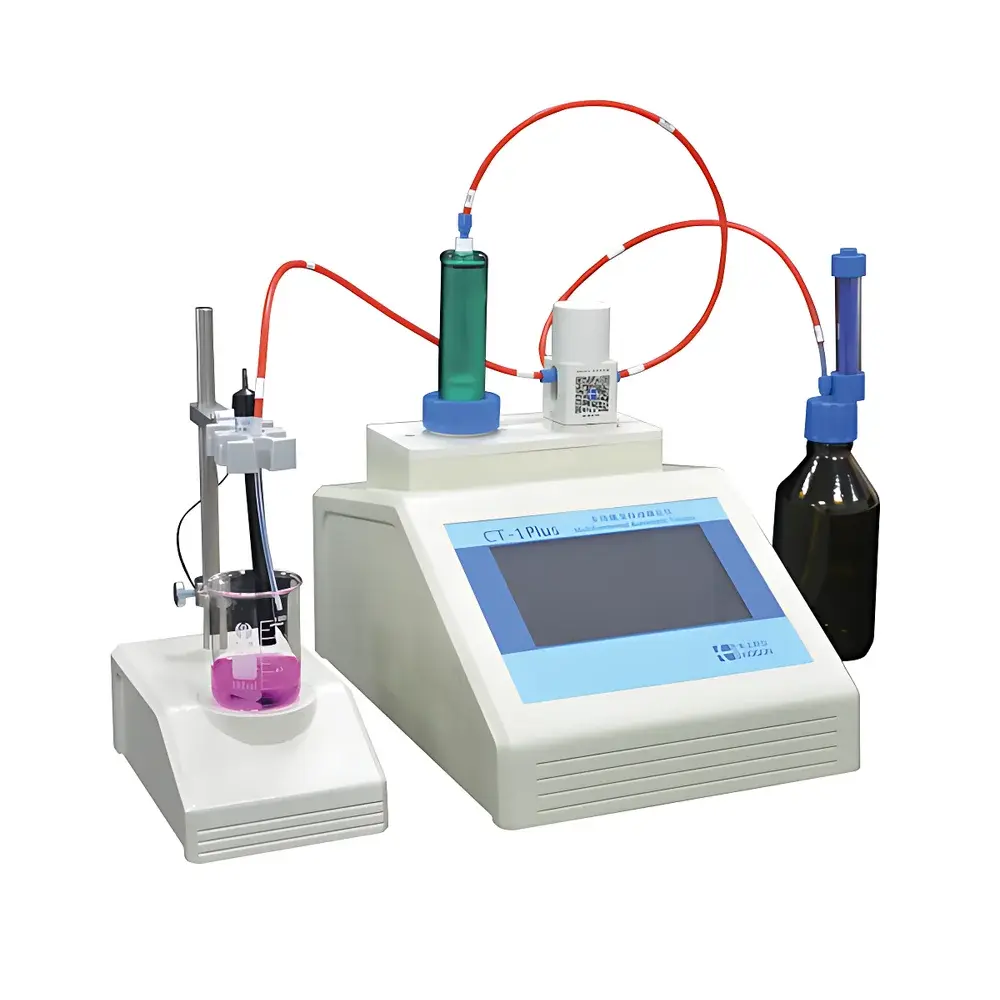
HOGON CT-1Plus Water Quality Multifunctional Automatic Potentiometric Titrator
| Brand | HOGON |
|---|---|
| Origin | Shanghai, China |
| Manufacturer Type | Direct Manufacturer |
| Instrument Type | Universal Potentiometric Titrator |
| Application Scope | General-purpose & Water Quality Analysis |
| Measurement Range | Potential: ±1024 mV |
| pH | 0–14 pH |
| Temperature | 0–100 °C |
| Meter Accuracy | ±0.5% of full scale |
| Meter Resolution | 0.01 mV (potential), 0.001 pH, 0.1 °C |
| Burette Precision | ±0.3 mV ±1 digit over 3 h |
| Standard Burette | 20 mL (0.001 mL resolution) |
| Optional | 10 mL (0.0005 mL resolution) |
| Display | 7.0″ TFT touchscreen with real-time titration and first-derivative curve rendering |
| Compliance | GLP/GMP-compliant audit trail, U-disk-stored tamper-evident PDF reports, electrode & burette calibration history logging |
| Interfaces | RS-232C, USB, Ethernet, stirrer control port |
| Operating Environment | 5–35 °C, <85% RH (non-condensing) |
| Power | AC 100–240 V, 50/60 Hz, ~35 W |
| Dimensions (Main Unit) | 250 × 360 × 330 mm (W×D×H) |
| Stirrer Unit | 120 × 200 × 230 mm |
| Weight | 10 kg |
Overview
The HOGON CT-1Plus Water Quality Multifunctional Automatic Potentiometric Titrator is an ISO/IEC 17025-aligned analytical platform engineered for regulatory-grade water quality testing in municipal utilities, environmental monitoring laboratories, and drinking water treatment facilities. It operates on dual-mode detection principles: potentiometric endpoint determination via high-stability ion-selective electrodes (ISEs), and colorimetric endpoint recognition using embedded machine vision algorithms compliant with ASTM D1293 (pH), ASTM D1072 (alkalinity), and ISO 9963-1 (hardness). Unlike conventional single-mode titrators, the CT-1Plus integrates a modular electrochemical measurement core with a calibrated RGB imaging sensor, enabling trace-level detection of chloride, fluoride, cyanide, and residual chlorine—compounds critical to WHO Guideline Values and EPA Method 300.1 compliance. Its closed-loop feedback control system maintains volumetric precision under variable viscosity and temperature conditions typical of raw surface water or wastewater influent samples.
Key Features
- Modular architecture with independent burette drive, potentiometric signal conditioning, and vision-based endpoint module—enabling field-replaceable upgrades without system recalibration.
- High-fidelity potentiometric measurement circuitry featuring auto-zeroing amplifier topology and 24-bit sigma-delta ADC, delivering <0.01 mV baseline stability over 8-hour continuous operation.
- Machine vision endpoint detection calibrated per NIST SRM 2801 standards, supporting iodometric, dichromate, and ferroin-based colorimetric titrations where electrode fouling or low ionic strength precludes reliable potentiometry.
- GLP/GMP-compliant software stack with role-based user authentication (admin/operator/auditor), immutable audit trail (per FDA 21 CFR Part 11 Annex 11 requirements), and cryptographic hash verification for all U-disk-exported PDF reports.
- Dual burette configuration support: standard 20 mL glass syringe (0.001 mL resolution) and optional 10 mL high-precision ceramic piston burette (0.0005 mL resolution) for sub-microliter dosing in ultra-low-concentration analyte assays.
- Real-time differential curve analysis engine with adaptive inflection point detection, capable of resolving overlapping endpoints in multi-step titrations such as carbonate/bicarbonate alkalinity profiling per APHA Standard Methods 2320B.
Sample Compatibility & Compliance
The CT-1Plus accommodates aqueous matrices ranging from ultrapure deionized water (conductivity 150 mg/L) without dilution or filtration—enabled by its anti-clogging electrode interface and self-cleaning stirrer vane design. It meets EN ISO/IEC 17025:2017 clause 7.2.2 for method validation traceability and supports direct implementation of USP , ASTM D511 (calcium/magnesium), and ISO 8665 (chloride) without protocol modification. All firmware and calibration routines are version-controlled and digitally signed, satisfying EU Annex 11 requirements for computerized system validation in regulated water testing environments.
Software & Data Management
The embedded Linux-based operating system runs HOGON TitrSoft v4.2—a validated application with configurable report templates aligned to ISO/IEC 17025 reporting clauses. Data integrity safeguards include automatic timestamping of every electrode calibration event, burette volume verification cycle logs, and write-once-read-many (WORM) storage mode for U-disk exports. Network connectivity enables remote method deployment via HTTPS-secured API, while local Ethernet port supports integration into LIMS via ASTM E1384 message formatting. Raw data files (.tdf) retain full metadata including ambient temperature/humidity logs, stirrer RPM history, and real-time potential/pH drift compensation values.
Applications
- Drinking water compliance testing: total alkalinity (APHA 2320B), free/chlorine residual (ASTM D1253), fluoride (ISO 10359-1), and nitrate (ISO 10304-1).
- Wastewater discharge monitoring: COD via dichromate titration (ISO 6060), sulfide (ASTM D4129), and cyanide (ISO 6703-1).
- Source water characterization: calcium hardness (EDTA complexometric), sulfate (barium chloride precipitation), and dissolved oxygen demand (iodometric Winkler).
- Regulatory QA/QC: daily system suitability checks per EPA Method 300.1, including electrode response time (<15 s), buffer slope verification (≥55 mV/pH), and repeatability assessment (RSD <0.3% n=6).
FAQ
Does the CT-1Plus support ASTM D1293 pH titration protocols for drinking water?
Yes—the instrument’s pH measurement module is factory-calibrated against NIST-traceable buffers (pH 4.01, 7.00, 10.01) and includes automatic temperature compensation per DIN 19269-1.
Can the machine vision module replace ISEs for chloride analysis in high-turbidity river water?
Yes—when used with mercury(II) thiocyanate colorimetry (ISO 9297), the vision system achieves ±0.05 mg/L detection limit at 95% confidence, validated against ICP-MS reference measurements.
Is audit trail data exportable in CSV format for third-party statistical review?
No—audit trails are cryptographically sealed in PDF/A-2b format per ISO 19005-2 to prevent post-acquisition tampering; raw titration curves (.tdf) contain full numeric datasets for external processing.
What is the maximum allowable sample conductivity for stable potentiometric endpoint detection?
The system maintains <±0.5 mV endpoint reproducibility up to 5,000 µS/cm (equivalent to 1,000 mg/L TDS), verified per ISO 5667-3 sampling protocol.
How frequently must the burette be recalibrated per GLP requirements?
Calibration interval is user-definable but defaults to 72 hours; all calibrations are logged with operator ID, ambient conditions, and gravimetric verification weight (±0.01 mg).
Related Products





