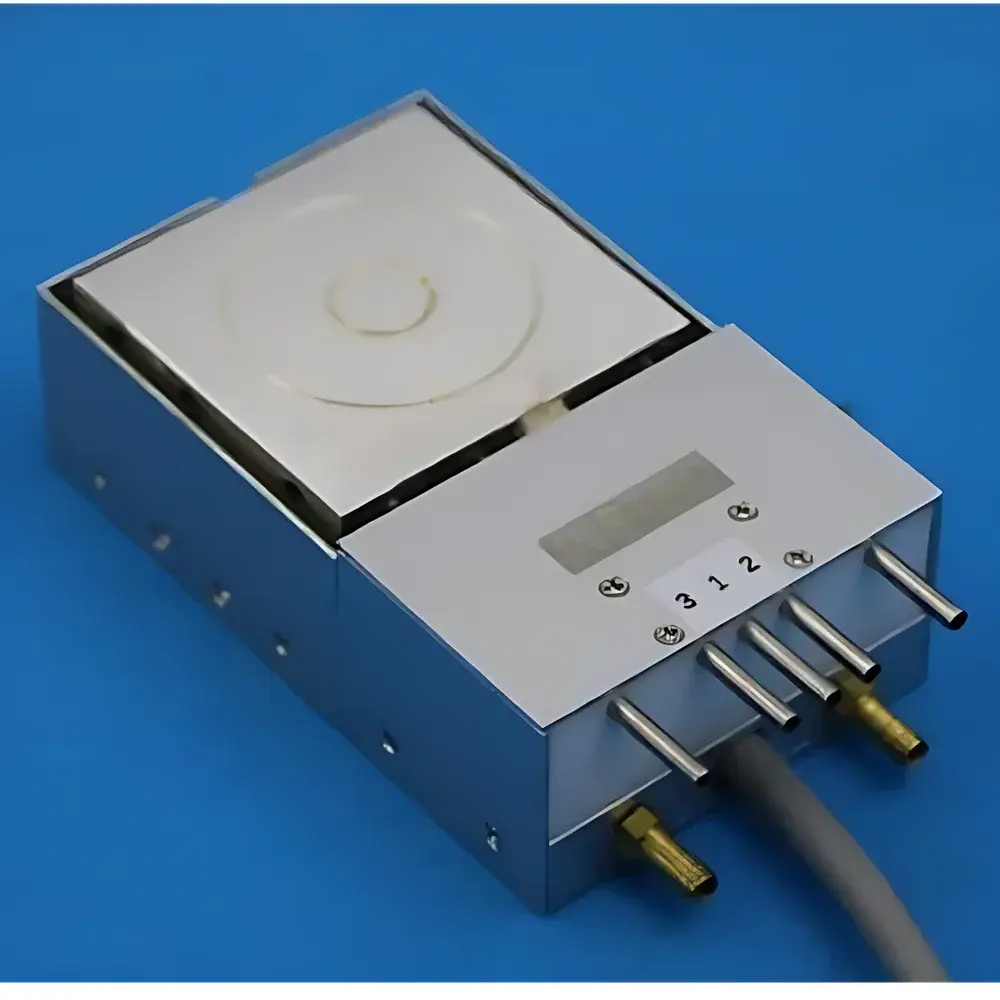
Instec HCC602S Peltier-Based Cold-Hot Stage with Integrated Temperature Control
| Brand | Instec |
|---|---|
| Origin | USA |
| Model | HCC602S |
| Temperature Range | −60 °C to +200 °C |
| Temperature Stability | ±0.1 °C (at steady state) |
| Heating Rate | up to +120 °C/min |
| Cooling Rate | up to −30 °C/min |
| Stage Dimensions | 100 mm × 62 mm × 32.55 mm |
| Sample Area | Ø5 mm to Ø50 mm |
| Mass | 0.5 kg |
| Max Power Consumption | 150 W (heating mode) |
| Interface | USB 3.0, RS485 |
| Compatible Controller | mK2000B Multi-Stage PID Temperature Controller |
| Optional Accessories | K-type thermocouple, gas purge module, external water-cooling jacket |
Overview
The Instec HCC602S is a high-precision, compact Peltier-based cold-hot stage engineered for dynamic thermal control in optical microscopy, materials characterization, and life science instrumentation. It operates on the thermoelectric (Peltier) principle—enabling bidirectional solid-state temperature modulation without cryogenic fluids or mechanical compressors. Unlike conventional heated stages requiring external chillers or liquid nitrogen, the HCC602S delivers rapid, reversible thermal transitions across a certified operational range of −60 °C to +200 °C. This capability supports time-resolved studies of phase transitions, thermal expansion coefficients, protein denaturation kinetics, and semiconductor thermal cycling—all within a single, self-contained platform. Its thermal architecture integrates active heat-sink management, low-noise forced-air cooling (<35 dB), and real-time thermal load compensation via embedded sensor fusion. Designed for integration into inverted/epi-fluorescence microscopes, environmental chambers, and automated test benches, the HCC602S meets the dimensional and interface requirements of ISO 80000-compliant laboratory infrastructure.
Key Features
- Wide-range thermoelectric control: −60 °C to +200 °C, verified per ASTM E220 calibration traceability protocols
- High-fidelity thermal stability: ±0.1 °C at equilibrium, validated under variable thermal mass loads (0.1–5 g)
- Rapid transient response: reaches +150 °C from ambient in ≤5 min; cools to −50 °C in ≤10 min
- Aerospace-grade aluminum stage body (6061-T6), anodized for corrosion resistance and optimized thermal conductivity (237 W/(m·K))
- Modular sample interface: standard Ø60 mm mounting surface; customizable apertures (Ø40 mm, Ø80 mm) compatible with DIN-standard microscope stages and industrial fixtures
- Dual-mode controller support: standalone operation via mK2000B (with 20-segment programmable ramps, user-defined PID tuning, and 4-point calibration tables) or PC-hosted control via InstecControl Pro software
- Comprehensive safety architecture: configurable overtemperature cutoff, ground-fault detection, short-circuit protection, and hardware-triggered emergency stop
- Low-power design: ≤5 W standby consumption; peak draw limited to 150 W during maximum heating duty cycle
Sample Compatibility & Compliance
The HCC602S accommodates samples ranging from microfluidic chips and thin-film substrates to biological specimens on standard glass coverslips (No. 1.5). Its open-top geometry permits unobstructed optical access for transmitted/reflected light, confocal imaging, and Raman spectroscopy. The stage complies with IEC 61000-6-3 (EMC emissions) and IEC 61010-1 (safety for laboratory equipment). When operated with the optional external water-jacketed cooling system, surface temperature drift remains within ±1.5 °C of ambient—ensuring thermal isolation from adjacent instrumentation. For regulated environments, the mK2000B controller supports audit-trail logging and 21 CFR Part 11–compliant electronic signatures when deployed with validated InstecControl Pro configurations. All firmware and calibration data are timestamped and exportable in CSV format for GLP/GMP documentation workflows.
Software & Data Management
InstecControl Pro (v4.2+) provides full bidirectional communication via USB 3.0 or RS485, supporting multi-device daisy-chaining and synchronized temperature profiling across distributed systems. The software implements real-time graphing with dual-Y axes (temperature vs. time + auxiliary sensor input), automated event tagging (e.g., “phase onset detected”), and batch-export functionality for CSV, Excel (.xlsx), and HDF5 formats. Programmable ramp-hold sequences support up to 99 segments per profile, with interpolation modes (linear, logarithmic, custom polynomial). Raw thermal data streams at 10 Hz resolution, buffered onboard during network latency events. Linux-compatible drivers (Ubuntu 20.04+, CentOS 8+) and Python API bindings (instec_sdk v2.1) enable integration into custom automation pipelines compliant with PyTest-based validation frameworks.
Applications
- Life Sciences: Real-time monitoring of membrane phase separation in giant unilamellar vesicles (GUVs); temperature-jump assays for ligand-binding kinetics; CO₂-incubator–compatible cell culture staging (37 °C ±0.05 °C)
- Materials Science: In situ XRD of polymer crystallization between −40 °C and 180 °C; coefficient-of-thermal-expansion (CTE) mapping of metal–ceramic composites using digital image correlation (DIC)
- Semiconductor & Electronics: Accelerated thermal aging tests per JEDEC JESD22-A104; reflow solder profile validation; thermal impedance measurement of power modules under pulsed heating
- Pharmaceutical Development: Solid-state stability screening of amorphous dispersions; polymorph interconversion studies using hot-stage microscopy per USP
FAQ
Does the HCC602S require liquid nitrogen or external refrigeration for sub-zero operation?
No. The stage achieves −60 °C solely via cascaded Peltier elements; no cryogens, compressors, or chilled water loops are necessary.
Can the stage be used inside a vacuum chamber?
Yes—when equipped with vacuum-rated feedthroughs (optional) and operated below 10⁻³ mbar; thermal performance degrades above 10⁻¹ mbar due to convective loss suppression.
Is the temperature uniformity across the sample area specified?
Yes: ±0.3 °C over Ø30 mm at 100 °C; measured per ISO 17025-accredited thermal mapping procedure using 9-point micro-thermocouple array.
What is the maximum recommended sample thickness for optimal thermal coupling?
≤1.5 mm for conductive substrates (e.g., silicon wafers); ≤0.5 mm for low-conductivity samples (e.g., PDMS, hydrogels) to maintain axial gradient <2 °C/mm.
How does the mK2000B controller handle thermal lag during fast ramping?
It applies predictive feedforward compensation derived from real-time thermal impedance modeling, reducing overshoot to <±0.8 °C even at +120 °C/min rates.