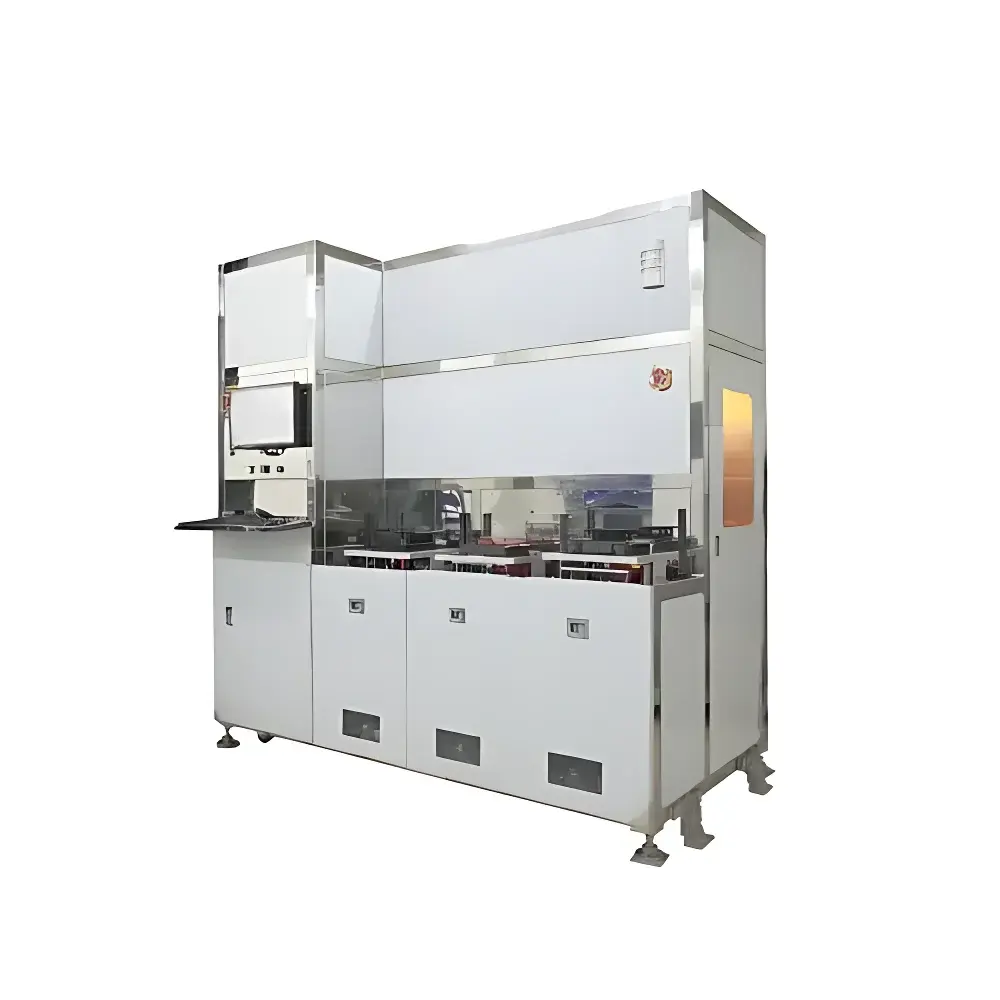
Kainova Tech KAM-201 EUV/OPT Reticle Pellicle Bonding Automation System
| Brand | Kainova |
|---|---|
| Origin | Taiwan |
| Manufacturer Type | Authorized Distributor |
| Product Category | Domestic (Taiwan-made) |
| Model | KAM-201 |
| Pricing | Upon Request |
| Reticle Handling Compatibility | EUV & Optical Reticles |
| Bonding Precision | ±0.1 mm |
| Post-Bonding Optical Distortion | <2 nm |
| Bonding Force Range | 0.035–0.4 kN |
| Cleanroom Particle Control | 0 EA for particles >100 nm |
| AMHS Integration | SEMI E84/E87 compliant |
| Vision-Based Alignment | Real-time image registration with dynamic parallelism compensation |
| AOI Inspection | Dedicated structured-light illumination for pellicle defect detection |
| Automated End-Effector Exchange | Yes |
| KAX-311 Reticle Transfer Module | Integrated rotational, flipping, and cassette exchange functions |
Overview
The Kainova Tech KAM-201 EUV/OPT Reticle Pellicle Bonding Automation System is a fully integrated, high-precision platform engineered for photomask fabrication and advanced lithography support in sub-7nm semiconductor manufacturing environments. It implements a dual-mode bonding architecture capable of processing both extreme ultraviolet (EUV) and optical (OPT) reticles under identical ultra-clean conditions—eliminating cross-contamination risk and reducing tool footprint in critical cleanroom bays. The system operates on a Couette-flow-aligned bonding principle, where controlled mechanical pressure, real-time gap monitoring via capacitive displacement sensors, and active parallelism correction at the bonding station ensure nanometer-level interfacial conformity between the reticle surface and pellicle membrane. This physical alignment methodology directly supports the stringent flatness requirements mandated by EUV lithography tools (e.g., ASML NXE series), where even sub-2nm optical deformation can induce pattern placement error (PPE) beyond ITRS specifications.
Key Features
- Six-axis ultra-high-purity robotic arm with ISO Class 1-compatible end-effectors and automated gripper exchange—enabling seamless handling of 6” and 9” reticles across multiple process stations without manual intervention.
- Integrated vision-guided alignment subsystem utilizing calibrated telecentric optics and sub-pixel edge detection algorithms to perform real-time positional and angular compensation prior to bonding—achieving ±0.1 mm placement accuracy relative to reticle fiducials.
- Active parallelism adjustment mechanism at the bonding station: motorized Z-axis actuators coupled with piezoelectric tilt stages dynamically maintain <0.5 µrad surface normal deviation during force application.
- Dedicated AOI station employing structured UV-LED illumination and high-dynamic-range CMOS imaging to detect pellicle defects—including pinholes, wrinkles, particulates (>100 nm), and tension non-uniformity—with traceable grayscale thresholding and metrology-grade reporting.
- AMHS interface compliant with SEMI E84 (Reticle Transport Standard) and E87 (Reticle Storage Standard), supporting direct integration into factory-wide automated material handling systems without protocol translation layers.
- Nitrogen-purged reticle cassette environment control (dew point ≤ −40°C, O₂ < 10 ppm) maintained throughout KAX-311 transfer module operations—ensuring pellicle integrity during exposure to ambient air is never compromised.
Sample Compatibility & Compliance
The KAM-201 accommodates standard 6” (152 mm) and 9” (229 mm) quartz reticles with chrome or EUV multilayer (Mo/Si) coatings. It supports pellicles with frame diameters from 125 mm to 240 mm and membrane thicknesses ranging from 1.5 µm to 4.0 µm. All wetted surfaces contacting reticles or pellicles are electropolished stainless steel (ASTM A967) or ceramic-coated aluminum per SEMI F27. The system meets ISO 14644-1 Class 1 (at 0.1 µm) cleanroom performance standards when operated inside a Class 100 (ISO 5) environment. Full compliance with SEMI S2/S8 safety and ergonomics guidelines is documented in the Factory Acceptance Test (FAT) report. Data integrity controls align with FDA 21 CFR Part 11 requirements for electronic records and signatures, including audit trails for all bonding parameter changes and AOI inspection logs.
Software & Data Management
The KAM-201 runs on Kainova’s proprietary K-OS v4.2 control platform, built on a deterministic real-time Linux kernel (PREEMPT_RT patchset). Process recipes—including bonding force profiles, dwell times, vacuum ramp rates, and AOI sensitivity thresholds—are stored in encrypted SQLite databases with SHA-256 checksum validation. Each bonding event generates a timestamped XML metadata package containing raw sensor data (capacitive gap, load cell output, thermal drift), vision alignment residuals, and AOI classification results. These packages are automatically exported via TLS 1.3-secured FTPS to enterprise MES systems (e.g., Applied Materials EnVision, Tokyo Electron TELiS) using SEMI E40/GEM-compliant communication protocols. Optional integration with JMP Pro or Python-based JupyterLab environments enables statistical process control (SPC) charting and PCA-driven anomaly detection across multi-lot datasets.
Applications
This system serves as a core automation node in mask shops supplying foundries operating at logic nodes ≤5 nm and memory fabs deploying EUV single-exposure patterning. Primary use cases include: (1) high-mix reticle re-pelliclization after defect repair or contamination events; (2) qualification of next-generation low-absorbing pellicles (LAPs) requiring sub-nanometer deformation control; (3) metrology correlation studies linking pellicle bond quality to scanner overlay performance; and (4) development of hybrid pellicle architectures integrating carbon nanotube or graphene membranes. Its modular design allows field-upgradeable integration of future modules—for example, inline ellipsometric thickness mapping or laser-induced forward transfer (LIFT) for localized pellicle adhesion enhancement.
FAQ
Does the KAM-201 support both EUV and optical reticles in the same recipe run?
Yes—the system identifies reticle type via integrated barcode/RFID scanning and auto-selects corresponding bonding parameters, alignment templates, and AOI inspection criteria without operator input.
What level of environmental control is maintained during pellicle bonding?
The bonding chamber maintains ISO Class 1 particle counts (0.1 µm) and humidity ≤0.1% RH via continuous nitrogen purge and dual-stage HEPA/ULPA filtration.
Can the system generate reports compliant with ISO/IEC 17025 for calibration traceability?
Yes—certified reference artifacts (NIST-traceable step height standards and force calibration kits) are used during quarterly system verification; full calibration certificates and uncertainty budgets are embedded in each inspection report.
Is remote diagnostics and predictive maintenance supported?
Yes—via optional Kainova Remote Insight (KRI) module, which streams anonymized subsystem health metrics (motor current harmonics, vacuum pump vibration spectra, thermal gradient maps) to cloud-based anomaly detection models trained on >12,000 hours of operational telemetry.
How is software validation performed for GMP-regulated environments?
K-OS v4.2 includes IQ/OQ documentation templates aligned with ASTM E2500-13 and Annex 11 guidance; installation and operational qualification protocols are executed jointly with customer QA teams prior to commissioning.