
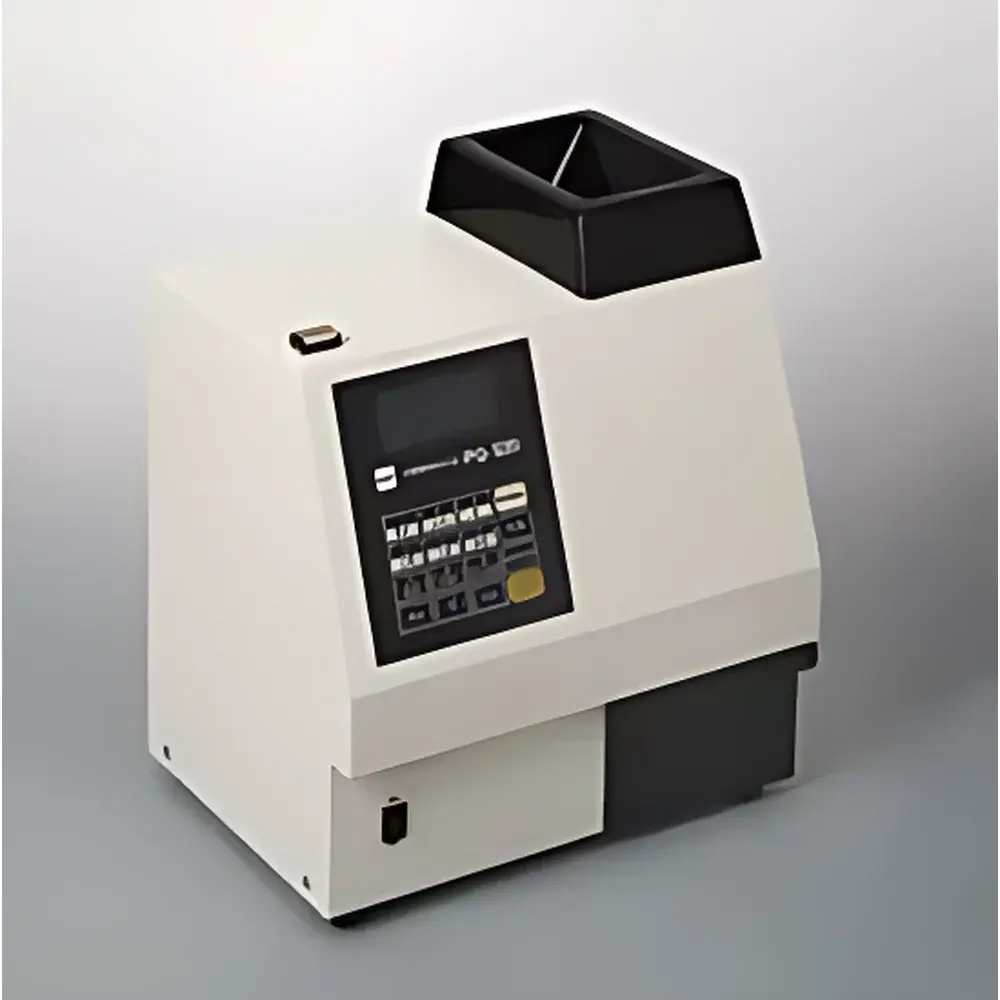
KETT PQ520 Capacitance-Based In-Line Grain Moisture Analyzer
| Brand | KETT |
|---|---|
| Origin | Japan |
| Model | PQ520 |
| Measurement Principle | Capacitance (with resistive correction) |
| Sample Types | Polished rice, brown rice, paddy rice, barley, wheat, rye kernels |
| Moisture Range | Polished/brown rice: 11–20% w.b. |
| Paddy rice | 11–35% w.b. |
| Barley/wheat | 10–40% w.b. |
| Rye kernels | 10–35% w.b. |
| Accuracy | ±0.5% (for samples ≤20% moisture, w.b.) |
| Measurement Time | <40 seconds per 100 grains (brown rice, average moisture display) |
| Temperature Compensation | Integrated thermistor-based automatic ambient temperature correction |
| Grain Count Setting | 10–1000 grains (user-selectable) |
| Display | Fluorescent segment display |
| Output Interfaces | RS-232C (printer), USB (PC data export) |
| Operating Environment | 5–40°C, ≤85% RH |
| Power Supply | AC 100 V, 50/60 Hz |
| Dimensions & Weight | 320 × 254 × 382 mm (W×D×H), 9.0 kg |
Overview
The KETT PQ520 is a high-throughput, capacitance-based in-line grain moisture analyzer engineered for precision batch monitoring in rice mills, cereal processing facilities, and agricultural commodity inspection laboratories. Unlike conventional oven-dry or near-infrared (NIR) spot-check instruments, the PQ520 employs a continuous, single-grain capacitive sensing architecture—augmented by resistive conductivity correction—to quantify moisture content on a per-grain basis. This dual-sensing methodology enables statistical characterization of moisture distribution across heterogeneous lots, directly addressing critical quality risks such as uneven drying, localized mold susceptibility, and post-storage moisture migration. The instrument operates under ASTM D4940 and ISO 712-compliant measurement principles for cereal moisture determination, with its capacitance transduction calibrated against gravimetric reference standards traceable to NIST-traceable protocols. Designed for integration into feed chutes or sampling stations, it delivers real-time process feedback without requiring sample grinding, heating, or chemical reagents—ensuring non-destructive, operator-independent analysis.
Key Features
- Capacitance-resistive hybrid sensing: Simultaneous dielectric permittivity and bulk conductivity measurement for enhanced accuracy across diverse grain morphologies and density variations.
- Single-grain resolution: Measures each kernel individually at up to 100 grains per cycle, enabling histogram-based moisture distribution analysis—not just mean values.
- Thermistor-integrated ambient temperature compensation: Automatically adjusts calibration curves in real time based on instrument housing temperature, eliminating manual correction tables.
- User-configurable grain count: Adjustable sample size from 10 to 1000 grains, supporting both rapid screening (e.g., 50-grain pre-sort check) and statistically robust lot assessment (e.g., 500+ grains per ISO 6649 compliance).
- Dedicated grain-type calibration sets: Preloaded firmware profiles for polished rice, brown rice, paddy, barley, wheat, and rye—each validated per AOAC 992.03 and JIS Z 8806 protocols.
- Industrial-grade interface suite: RS-232C port for direct thermal printer output (e.g., QC log reports); USB 2.0 interface for raw grain-by-grain data export to LIMS or statistical process control (SPC) software.
Sample Compatibility & Compliance
The PQ520 is validated for intact, unprocessed cereal kernels—including whole, hulled, and debranned forms—without preprocessing. It accommodates natural variations in kernel size, surface roughness, and husk moisture retention. Its measurement range aligns with regulatory thresholds defined in Codex Alimentarius STAN 152-1985 (moisture limits for stored cereals) and USDA FGIS standards for commercial grain grading. All calibration curves are developed using primary reference methods per ISO 712:2017 and verified through interlaboratory round-robin studies coordinated by the Japanese Grain Inspection Association (JGIA). The unit meets IEC 61000-4 electromagnetic compatibility requirements and carries PSE certification for use in industrial environments.
Software & Data Management
While the PQ520 operates as a standalone hardware analyzer with embedded firmware, its USB interface supports direct data streaming to Windows-based applications via KETT’s proprietary PQ-Link software (v3.2+). This application enables time-stamped batch logging, moisture distribution histogram generation, trend charting across shifts, and export to CSV or Excel formats compatible with FDA 21 CFR Part 11-compliant audit trails when deployed with validated electronic signature modules. Raw grain-level data includes individual kernel ID, measured capacitance/resistance pair, computed moisture value, and ambient temperature stamp—enabling root-cause analysis of outliers (e.g., cracked kernels, foreign material interference).
Applications
- Real-time moisture profiling during rice parboiling and drying line validation.
- Pre-shipment verification for export-grade paddy and milled rice (meeting ASEAN Rice Trade Framework moisture specifications).
- Quality gate monitoring at intake points in flour mills and malt houses.
- Research applications in post-harvest physiology, including studies on moisture equilibration kinetics and hygroscopic hysteresis in cereal starch matrices.
- Calibration transfer support for NIR online sensors via PQ520-derived ground-truth distribution datasets.
FAQ
Does the PQ520 require sample grinding or conditioning prior to measurement?
No. It analyzes whole, dry kernels directly—no milling, sieving, or temperature equilibration is necessary.
Can the instrument differentiate between surface moisture and internal moisture content?
It reports total moisture content on a wet-basis (% w.b.) per ISO 712; it does not resolve spatial moisture gradients within individual kernels.
Is firmware update capability available via USB?
Yes. Field-upgradable firmware (released biannually) supports new grain calibrations and improved outlier rejection algorithms.
What is the recommended recalibration frequency for routine QC use?
KETT recommends annual traceable recalibration using certified reference materials (CRM) supplied by JGIA or NIST-accredited providers.
Does the PQ520 comply with GLP or GMP documentation requirements?
When used with PQ-Link v3.2+ and validated PC systems, full audit trail, user access logs, and electronic signatures meet GLP Annex 11 and GMP Annex 11 expectations for regulated environments.






