
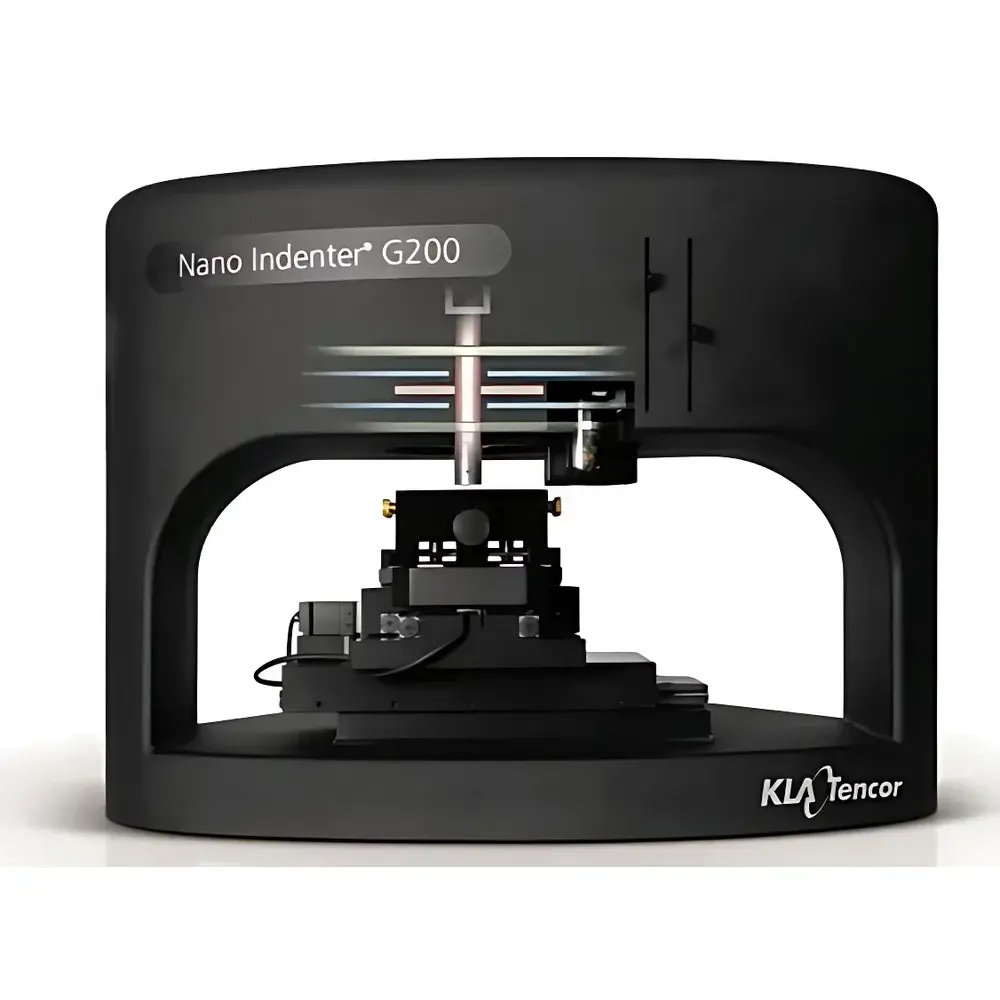
KLA Nano Indenter G200
| Brand | KLA |
|---|---|
| Origin | USA |
| Model | Nano Indenter G200 |
| Force Range | 10 nN – 10 N (with modular transducers) |
| Displacement Resolution | < 0.01 nm |
| Maximum Indentation Depth | > 500 µm |
| Testing Speed | Up to 1 indentation point per second |
Overview
The KLA Nano Indenter G200 is a fifth-generation in-situ nanomechanical testing system engineered for quantitative mechanical characterization at micro- and nanoscales. Based on electromagnetic actuation and closed-loop force–displacement control, it delivers high-fidelity data across an unprecedented load range—from 10 nN to 10 N—enabling rigorous measurement of hardness, elastic modulus, creep, stress relaxation, fracture toughness, and viscoelastic behavior. Its design eliminates parasitic lateral motion and minimizes frame compliance, ensuring traceable, reproducible results essential for R&D, process development, and quality assurance in advanced materials science. As the successor to the world’s first commercial nanoindenter (introduced in 1983), the G200 integrates over 35 years of proprietary instrumentation heritage, including industry-standard Continuous Stiffness Measurement (CSM) and Contact Stiffness Imaging (CSI), both codified in ISO 14577 and ASTM E2546.
Key Features
- Electromagnetically driven actuator enabling continuous, noise-immune force and displacement control across seven orders of magnitude (10 nN–10 N)
- Modular transducer architecture: XP (up to 500 mN), DCM II (sub-100 nN resolution, 0.1–300 Hz dynamic bandwidth), and High-Load Option (10 N) — all software-switchable within a single test sequence
- Displacement resolution 500 µm, supporting both ultra-shallow film analysis and bulk material probing
- CSM technology integrated as standard, providing real-time stiffness acquisition during loading/unloading for accurate modulus mapping and thin-film property extraction
- Automated area function calibration and frame stiffness correction—performed in seconds without external reference samples
- Compact footprint (< 0.5 m²) with vibration-isolated granite base and precision XYZ stage (±0.1 µm repeatability), optimized for integration into cleanrooms and metrology labs
Sample Compatibility & Compliance
The Nano Indenter G200 accommodates diverse specimen geometries—including wafers, polished cross-sections, freestanding membranes, fibers, and biological tissues—via motorized Z-height adjustment and high-magnification optical navigation. It supports standardized test protocols compliant with ISO 14577 (Metallic and non-metallic coatings), ASTM E2546 (Nanoindentation), and USP (Mechanical Properties of Pharmaceutical Materials). All hardware and firmware are designed to meet GLP/GMP documentation requirements, with full audit trail support, electronic signatures, and 21 CFR Part 11–compliant user access controls embedded in NanoSuite™. Calibration certificates are NIST-traceable, and inter-laboratory reproducibility has been validated through round-robin studies coordinated by the International Nanoindentation Round Robin (INRR).
Software & Data Management
NanoSuite™ is a fully integrated, object-oriented software platform developed exclusively for nanomechanical testing. It provides real-time calculation and visualization of hardness, reduced modulus, contact depth, and plastic work ratio during indentation. Key capabilities include:
- Batch-mode scripting for unattended multi-location testing with adaptive dwell time and load ramping
- 2D/3D property mapping with overlay alignment to SEM or optical images
- Custom channel definition: users define new derived parameters (e.g., H/E ratio, Tabor parameter) and embed them directly into acquisition workflows
- Automated sampling rate adaptation based on signal dynamics—ensuring optimal data density without oversampling
- PDF report generation with embedded metadata (operator, timestamp, environmental conditions, calibration history)
- API access for MATLAB and Python integration, enabling offline modeling, finite element validation, and machine learning–driven feature extraction
Applications
The Nano Indenter G200 serves as a primary metrology tool across semiconductor manufacturing (gate stack modulus, BEOL interconnect reliability), thin-film development (DLC, TiN, Al₂O₃ coatings), advanced packaging (lead-free solder joint mechanics), structural ceramics (grain boundary toughness), polymer composites (fiber–matrix interface strength), and biomaterials (hydrogel stiffness gradients, mineralized tissue elasticity). Its CSM mode enables quantitative depth-profiling of graded interfaces; its high-speed option (1 ind/s) supports statistical mapping of heterogeneous microstructures; and its high-load module facilitates comparative benchmarking against macro-scale mechanical tests (e.g., correlation with tensile yield strength). Applications extend to failure analysis labs performing cross-sectional nanoindentation of delaminated interfaces and academic groups investigating size effects in nanocrystalline metals.
FAQ
Does the Nano Indenter G200 comply with ISO 14577 for certified hardness and modulus reporting?
Yes—its CSM implementation, calibrated transducers, and traceable area functions satisfy all clauses of ISO 14577 Parts 1–3 for instrumented indentation testing.
Can I switch between XP and DCM II modules during a single experiment?
Yes—transducer selection is fully automated via NanoSuite™; no manual hardware changes or recalibration are required.
Is remote operation supported for distributed lab environments?
Yes—NanoSuite™ includes secure client-server architecture enabling real-time monitoring and control over enterprise networks or VPNs.
How does the system handle ambient vibration in non-dedicated metrology spaces?
The DCM II module operates at resonance frequencies (>1 kHz) far above typical building vibrations (10–100 Hz), while the XP and High-Load modules incorporate active damping algorithms and low-pass filtering optimized per test regime.
What level of technical support is available in Asia-Pacific regions?
KLA maintains regional application laboratories in Shanghai and Singapore, staffed by certified nanomechanics specialists offering on-site training, method development, and GLP-compliant validation services.



