
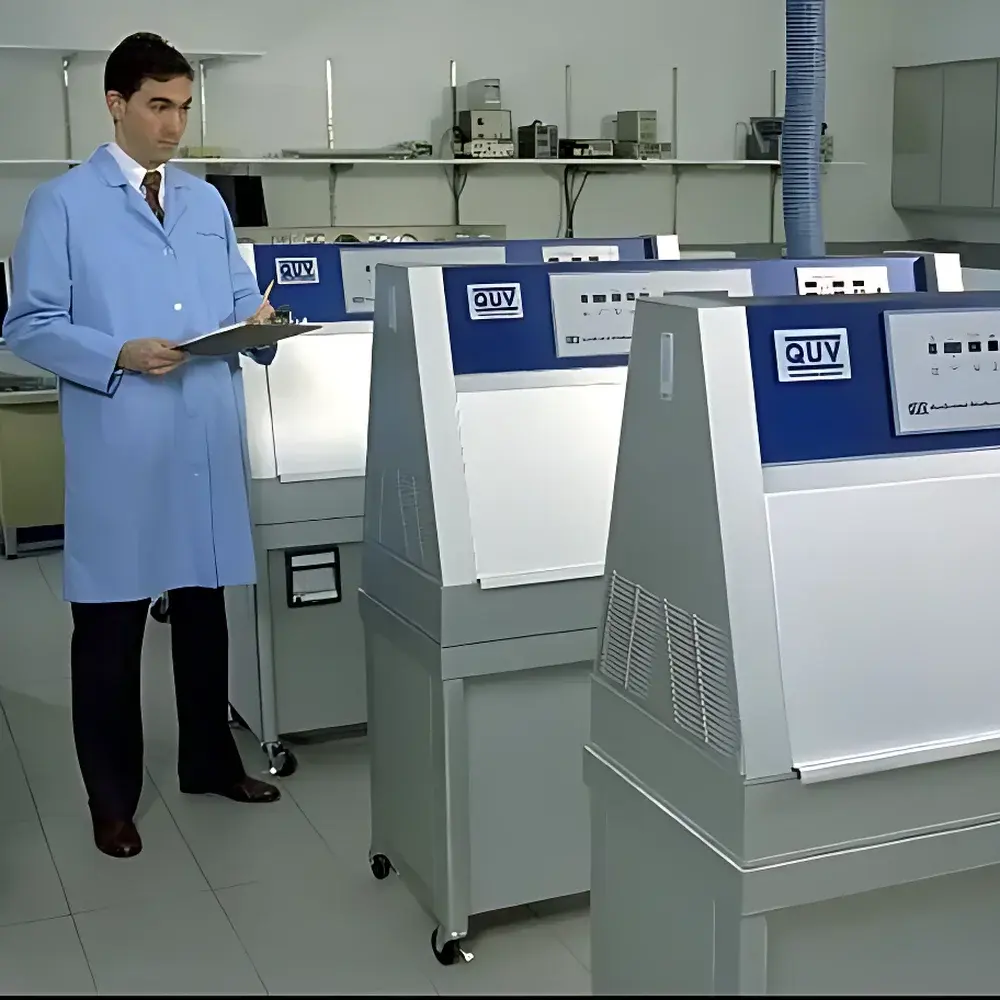
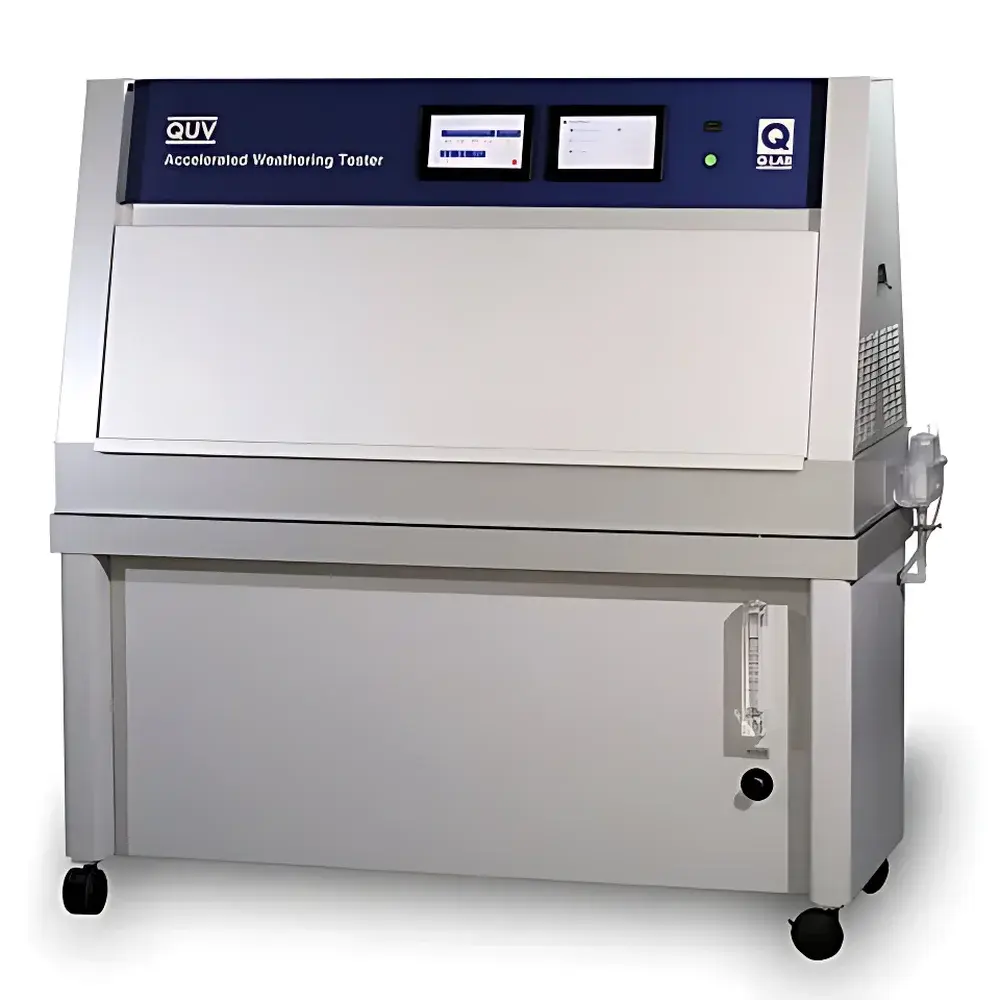
Q-LAB QUV/cw Cold-White Fluorescent UV Weathering Tester
| Brand | Q-LAB |
|---|---|
| Origin | USA |
| Model | QUV/cw |
| Test Duration | 1–5000 h |
| Irradiance Range | 10 W/m² |
| UV Wavelength | 340 nm |
| Light Source | Cold-white fluorescent lamps |
| Irradiance Control System | SOLAR EYE® Visible-light monitoring and feedback control |
| Condensation System | Tap-water-based |
| Temperature Control | Black panel temperature and chamber air temperature (exact ranges available upon request) |
| Compliance | Preloaded ISO and ASTM test protocols (e.g., ISO 4892-3, ASTM G154) |
| Data Logging | Built-in Ethernet-enabled recorder with automatic timestamped event logging, alarm history, and diagnostic traceability |
| Calibration Support | AutoCal®-compatible |
Overview
The Q-LAB QUV/cw Cold-White Fluorescent UV Weathering Tester is an industry-standard accelerated aging instrument engineered for evaluating material degradation under indoor lighting conditions—particularly those dominated by cool-white fluorescent illumination. Unlike UV-B or UV-A xenon or mercury-vapor sources, the QUV/cw utilizes proprietary cold-white fluorescent lamps emitting a broad visible spectrum peaking near 435 nm, with a defined UV component centered at 340 nm. This spectral profile closely replicates the photobiological and photochemical stress imposed on products displayed in retail environments, office spaces, museums, and archival storage facilities. The system operates on the principle of controlled photodegradation: photons absorbed by polymer matrices, pigments, adhesives, or coatings initiate bond scission, oxidation, and chromophore disruption—processes accelerated through precise regulation of irradiance, condensation moisture, and thermal cycling. Its design adheres to fundamental principles of photochemical kinetics, where reaction rates scale exponentially with photon flux density (irradiance) and are modulated by temperature-dependent secondary reactions—hence the dual emphasis on SOLAR EYE®-governed irradiance stability and black-panel temperature precision.
Key Features
- SOLAR EYE® Visible-Light Irradiance Control: Monitors and dynamically adjusts lamp output based on real-time visible-light intensity—not UV—ensuring consistent photostimulus across lamp batches, aging cycles, and ambient temperature fluctuations. Maintains ±5% irradiance reproducibility over time per ISO 4892-3 Annex A.
- Cold-White Fluorescent Lamp Architecture: Uses standardized T8 or T12 cold-white fluorescent tubes (not UV-specific), enabling direct correlation to real-world indoor exposure scenarios where UV content is incidental rather than dominant.
- Tap-Water Condensation System: Generates realistic dew-point cycling without requiring deionized water or external humidification infrastructure—reducing operational overhead while maintaining compliance with ASTM G154 Cycle 4 (condensation-only) and ISO 4892-3 Method A.
- AutoCal®-Enabled Calibration Interface: Supports traceable irradiance verification using the CR-10/cw meter, fulfilling metrological requirements for GLP-compliant laboratories and internal audit readiness.
- Embedded Ethernet & Data Integrity: Integrates IEEE 802.3-compliant Ethernet port for remote monitoring, firmware updates, and secure data export. All logged parameters—including black-panel temperature, chamber humidity, irradiance setpoint deviations, and fault events—are timestamped and stored with CRC-32 checksum validation.
- Self-Diagnostic Controller: Continuously validates sensor integrity, actuator response, and thermal equilibrium. Triggers automatic safe shutdown upon detection of out-of-spec conditions (e.g., >±3°C black-panel deviation, lamp failure, condensate overflow) and archives full diagnostic logs for root-cause analysis.
Sample Compatibility & Compliance
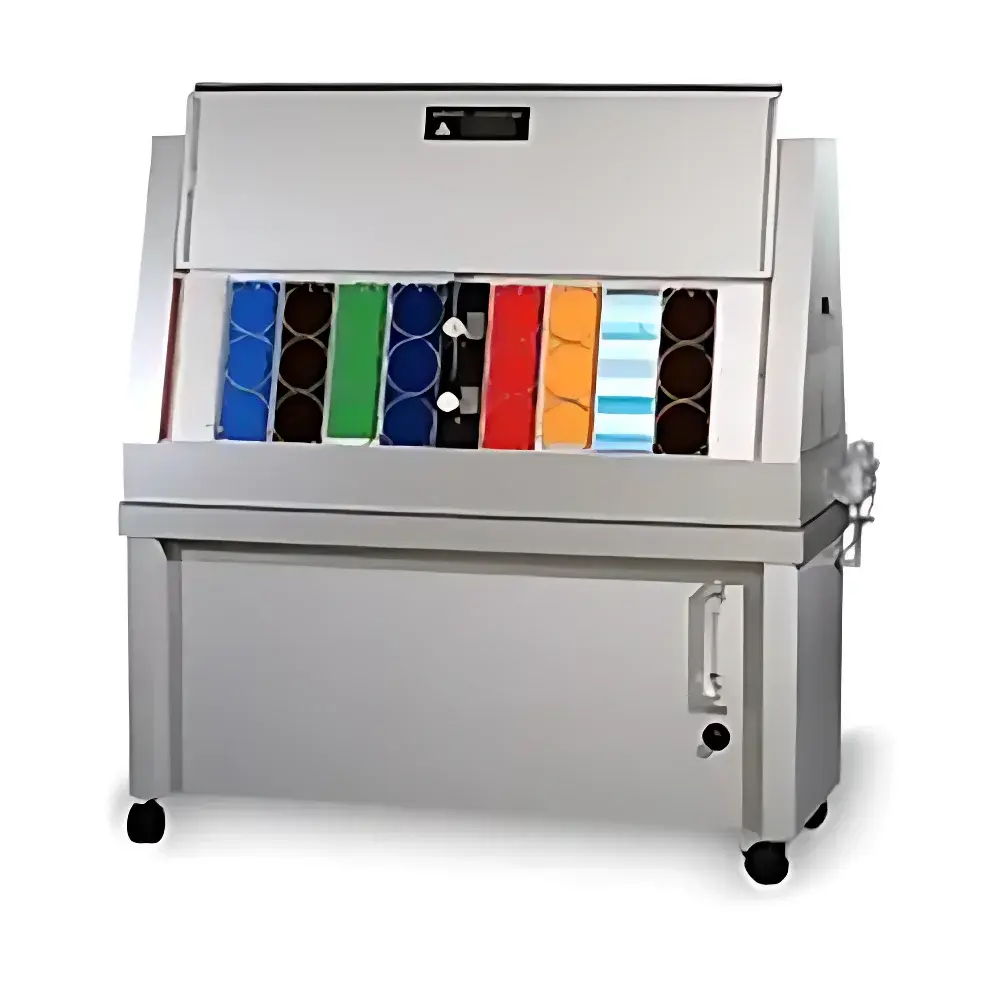
The QUV/cw accommodates standard 75 mm × 150 mm (3″ × 6″) flat specimens mounted directly onto interlocking sample racks that form the chamber’s inner wall. This configuration ensures uniform irradiance distribution and eliminates shadowing artifacts. Specimen thickness up to 13 mm is supported without airflow obstruction. The system natively supports ISO 4892-3 (Method A, Cycles 1–4), ASTM G154 (Cycles 1–6), and JIS D 0205—all preloaded into its controller memory. It meets essential regulatory expectations for environmental simulation instrumentation, including traceability per ISO/IEC 17025, data retention alignment with FDA 21 CFR Part 11 (when paired with validated LIMS integration), and mechanical safety compliance per IEC 61010-1. Optional CR-10/cw irradiance meter enables NIST-traceable calibration documentation required for accredited testing labs.
Software & Data Management
No proprietary software installation is required: the QUV/cw operates as a headless embedded device with a web-accessible interface via standard HTTP/HTTPS. Users configure test programs, review real-time sensor graphs (irradiance, black-panel temp, condensation status), and download CSV-formatted datasets directly from any networked browser. All data—including alarm timestamps, maintenance alerts, and controller self-test results—are retained onboard for ≥30 days. For enterprise integration, the unit supports Modbus TCP protocol for SCADA connectivity and generates Syslog-compliant event streams compatible with centralized IT monitoring platforms. Audit trails include user login/logout records, parameter modification history, and firmware version logs—satisfying GLP audit requirements for change control and data integrity verification.
Applications
- Evaluation of ink fade resistance in point-of-purchase signage and packaging under retail fluorescent lighting
- Stability assessment of museum-grade conservation materials exposed to gallery lighting
- Photostability screening of pharmaceutical blister packaging films containing photosensitive APIs
- Colorfastness validation of textile labels and apparel trims used in office uniforms
- Adhesion durability testing of laminated architectural films subjected to prolonged indoor UV exposure
- Accelerated qualification of LED fixture housings against yellowing and gloss loss in commercial interiors
FAQ
What distinguishes the QUV/cw from other QUV models like QUV/se or QUV/spary?
The QUV/cw is uniquely configured for indoor fluorescent exposure simulation using cold-white lamps and visible-light irradiance control. In contrast, QUV/se employs UV-B lamps for outdoor-spectrum acceleration, while QUV/spary adds water spray functionality for wet/dry cycling per ASTM D4329.
Is ISO 4892-3 calibration included with the base unit?
Preloaded test protocols are provided, but formal ISO-compliant irradiance calibration requires optional CR-10/cw meter and annual recalibration traceable to NIST standards—available through authorized Q-LAB service partners.
Can the QUV/cw operate unattended for extended durations?
Yes. It supports continuous 24/7 operation with automatic fault recovery, scheduled shutdown, and battery-backed real-time clock ensuring accurate long-term test timing up to 5000 hours.
Does the tap-water condensation system meet corrosion resistance requirements for metal specimens?
The condensate collection tray and drain path are constructed from 316 stainless steel; however, for highly sensitive metallic substrates, users should verify compatibility with their specific alloy and consider supplemental deionized water use per ASTM G154 Annex B guidance.
How is temperature measured and controlled in the QUV/cw?
Black-panel thermometers (BPT) mounted behind specimen surfaces provide direct measurement of radiant heating effects; chamber air temperature is monitored separately. Both are regulated via PID-controlled heaters and proportional cooling circuits—no refrigeration compressor is used.



