
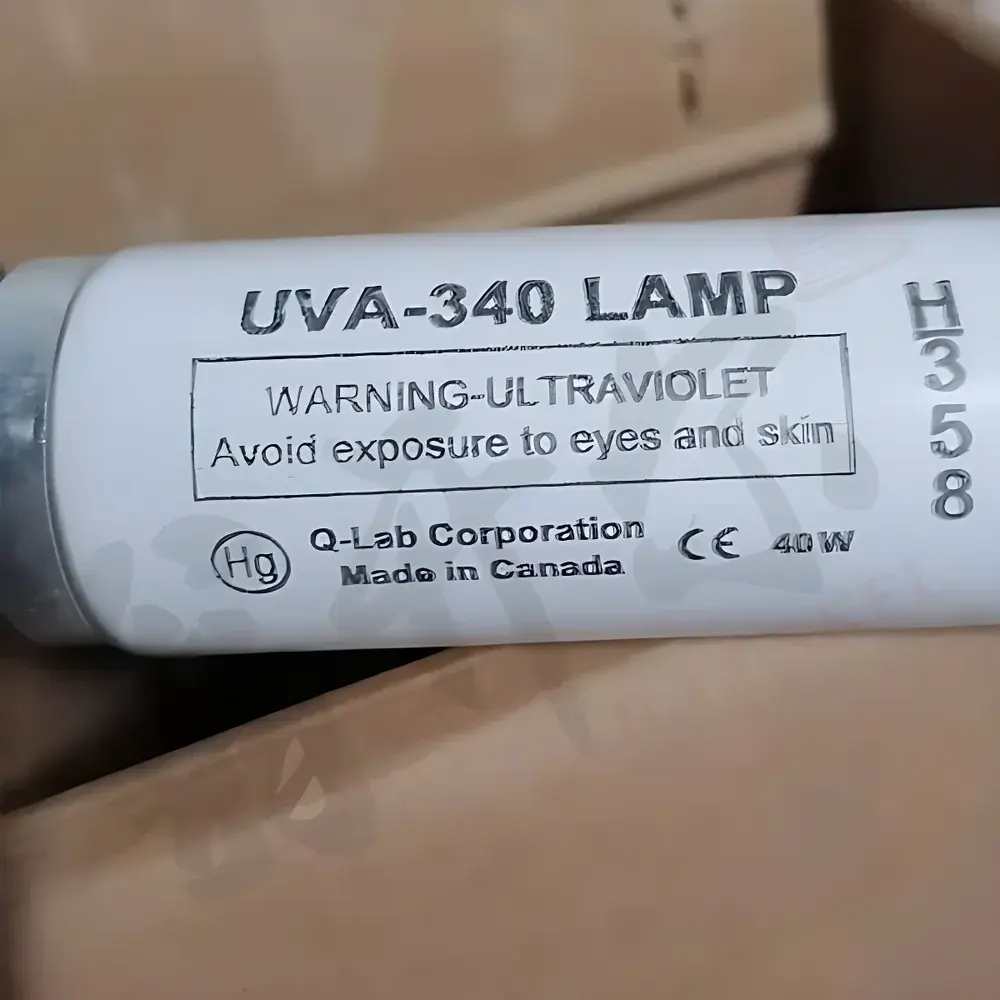
Q-LAB UVA-340 and UVA-351 Fluorescent UV Lamps for QUV Accelerated Weathering Test Chambers
| Brand | Q-LAB |
|---|---|
| Origin | USA |
| Model | UVA-340 |
| UV Wavelength Range | 295–365 nm |
| Black Panel Temperature Range | 45–80 °C |
| Lamp Power | 1800 W |
| Test Duration | 1–3000 h |
| Compliance | ASTM G154, ISO 4892-3, SAE J2020, IEC 61215, GB/T 14522 |
| Sample Compatibility | Plastics, Coatings, Textiles, Inks, Automotive Interior Materials |
| Software Integration | Q-LAB’s UV Control Software (v5.0+) with Audit Trail & 21 CFR Part 11 Compliance Options |
Overview
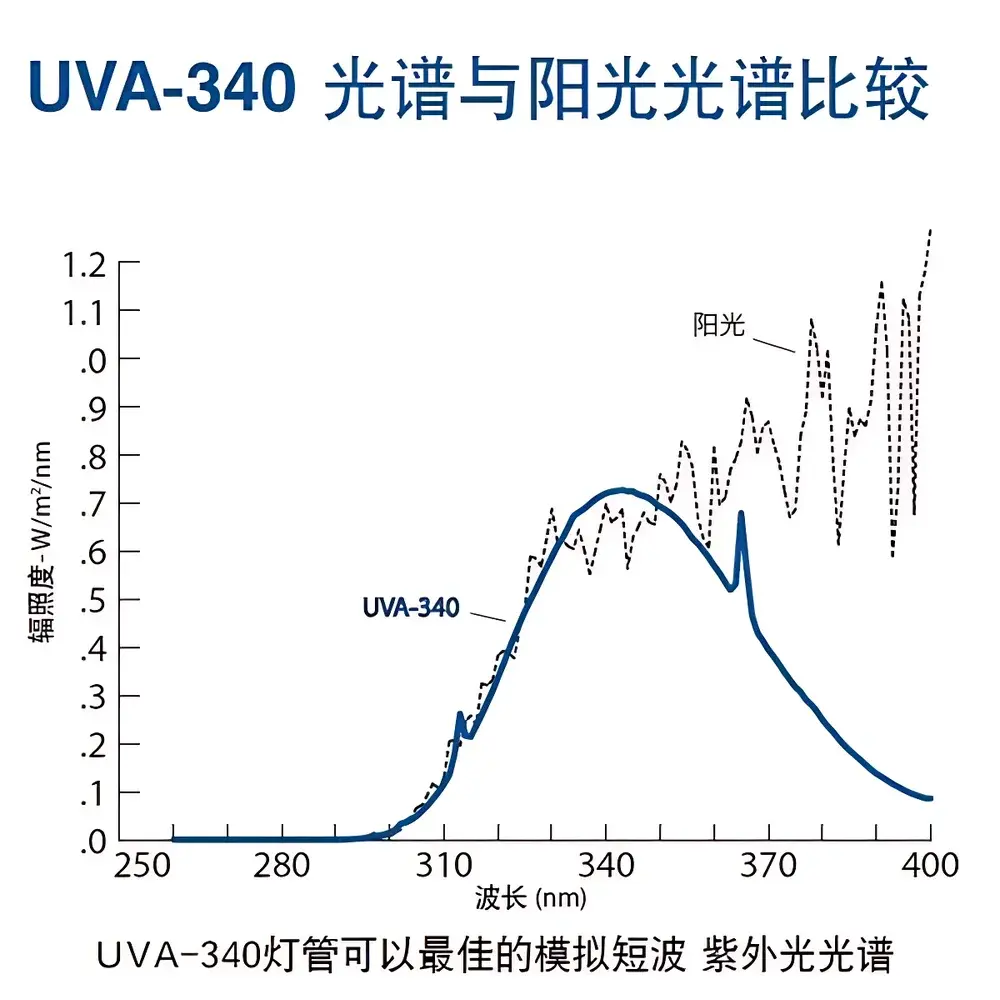
The Q-LAB UVA-340 and UVA-351 fluorescent UV lamps are engineered replacement light sources for QUV accelerated weathering test chambers—industry-standard instruments used to evaluate material degradation under controlled ultraviolet radiation, temperature, and condensation cycles. These lamps operate on the principle of fluorescent photolysis simulation: they emit narrow-band UV radiation that replicates critical spectral regions of natural sunlight. The UVA-340 lamp is calibrated to reproduce the solar UV spectrum from 295 nm to 365 nm—the most photochemically aggressive portion of terrestrial sunlight—and is widely referenced in ASTM G154 and ISO 4892-3 as the benchmark for outdoor exposure correlation. The UVA-351 lamp filters out wavelengths below 320 nm to emulate UV transmission through standard window glass, making it suitable for indoor or automotive interior applications per SAE J2020 and ISO 11341. Both lamp types maintain spectral stability over their service life due to proprietary phosphor formulation and rigorous batch-certification protocols—including spectral irradiance mapping, output decay profiling, and lifetime validation at 1.70 W/m²/nm (UVA-340+ specification). Each lamp is manufactured in Q-LAB’s ISO 9001-certified facility in Westlake, Ohio, and shipped with a Certificate of Conformance detailing spectral output, electrical characteristics, and calibration traceability.
Key Features
- Optimized spectral match: UVA-340 delivers peak irradiance at 340 nm with full-width half-maximum (FWHM) centered within ±2 nm tolerance; UVA-351 suppresses sub-320 nm emission to simulate filtered solar UV.
- Consistent photometric performance: All lamps undergo pre-shipment irradiance verification at 340 nm using NIST-traceable spectroradiometers; output deviation ≤ ±5% across nominal lifetime.
- Thermal robustness: Designed for continuous operation at black panel temperatures up to 80 °C; compatible with QUV’s water-cooled reflector system and condensation humidity control.
- Interchangeable form factor: Identical physical dimensions and electrical interface (G13 base, 1800 W nominal input) ensure seamless integration into QUV/cw, QUV/se, and QUV/sp models.
- Regulatory-ready documentation: Includes lot-specific spectral data sheets, RoHS/REACH compliance statements, and optional 21 CFR Part 11 audit trail support when paired with Q-LAB’s UV Control Software v5.0+.
Sample Compatibility & Compliance
These lamps are validated for use with polymeric substrates including thermoplastics (e.g., ABS, PC, PP), organic coatings (acrylics, polyurethanes), textile fibers (polyester, nylon), pigment systems, and automotive interior composites. Testing configurations comply with international standards governing UV exposure methodology: ASTM G154 (Cycle A1/A2/B1), ISO 4892-3 (Method A/B/C), SAE J2020 (for dashboard materials), IEC 61215 (photovoltaic module qualification), and GB/T 14522 (Chinese national standard for paint and coating aging). When installed in QUV chambers equipped with calibrated irradiance sensors and black panel temperature controllers, test data meet GLP and GMP documentation requirements—including electronic signature, change history, and user-access logging—when configured with Q-LAB’s compliant software suite.
Software & Data Management
Lamp operation is fully integrated with Q-LAB’s UV Control Software (v5.0 and later), which provides real-time monitoring of irradiance setpoints, black panel temperature, and cycle timing. The software supports automated lamp life tracking via cumulative UV dose calculation (J/m²), alerts for irradiance drift beyond ±10%, and export of timestamped CSV reports compliant with ISO/IEC 17025 laboratory accreditation criteria. Optional 21 CFR Part 11 modules enable electronic signatures, role-based access control, and immutable audit trails—essential for regulated industries including medical device packaging validation and pharmaceutical excipient stability studies.
Applications
UVA-340 lamps are recommended for outdoor durability assessment of exterior automotive parts, architectural coatings, agricultural films, and UV-stabilized plastics where direct solar exposure correlation is required. UVA-351 lamps are specified for evaluating colorfastness and gloss retention in textiles, instrument panel overlays, and inkjet-printed signage intended for indoor or behind-glass environments. Both lamp types support comparative formulation screening, QC release testing, and failure mode analysis in R&D laboratories conducting accelerated aging per IEC 60068-2-5 and MIL-STD-810H Method 505.5.
FAQ
What is the rated service life of UVA-340 and UVA-351 lamps under standard QUV operating conditions?
Typical operational lifespan is 1,500–2,000 hours at nominal irradiance (0.89 W/m²/nm @ 340 nm); actual endurance depends on chamber cycling parameters and cooling efficiency.
Are these lamps compatible with non-Q-LAB UV test chambers?
No—they are engineered exclusively for QUV series chambers and require precise thermal management, reflector geometry, and control firmware integration.
How often should irradiance sensors be recalibrated when using these lamps?
Q-LAB recommends annual recalibration of broadband and narrowband UV sensors using NIST-traceable reference standards, especially prior to critical qualification runs.
Do UVA-340 and UVA-351 lamps require warm-up time before reaching stable output?
Yes—full spectral stabilization occurs within 15 minutes of ignition; Q-LAB software enforces mandatory stabilization delay before initiating timed exposure cycles.
Can irradiance be adjusted during a test cycle?
Yes—UV Control Software allows dynamic irradiance ramping between user-defined setpoints, enabling multi-stage stress profiles aligned with real-world environmental transitions.



