
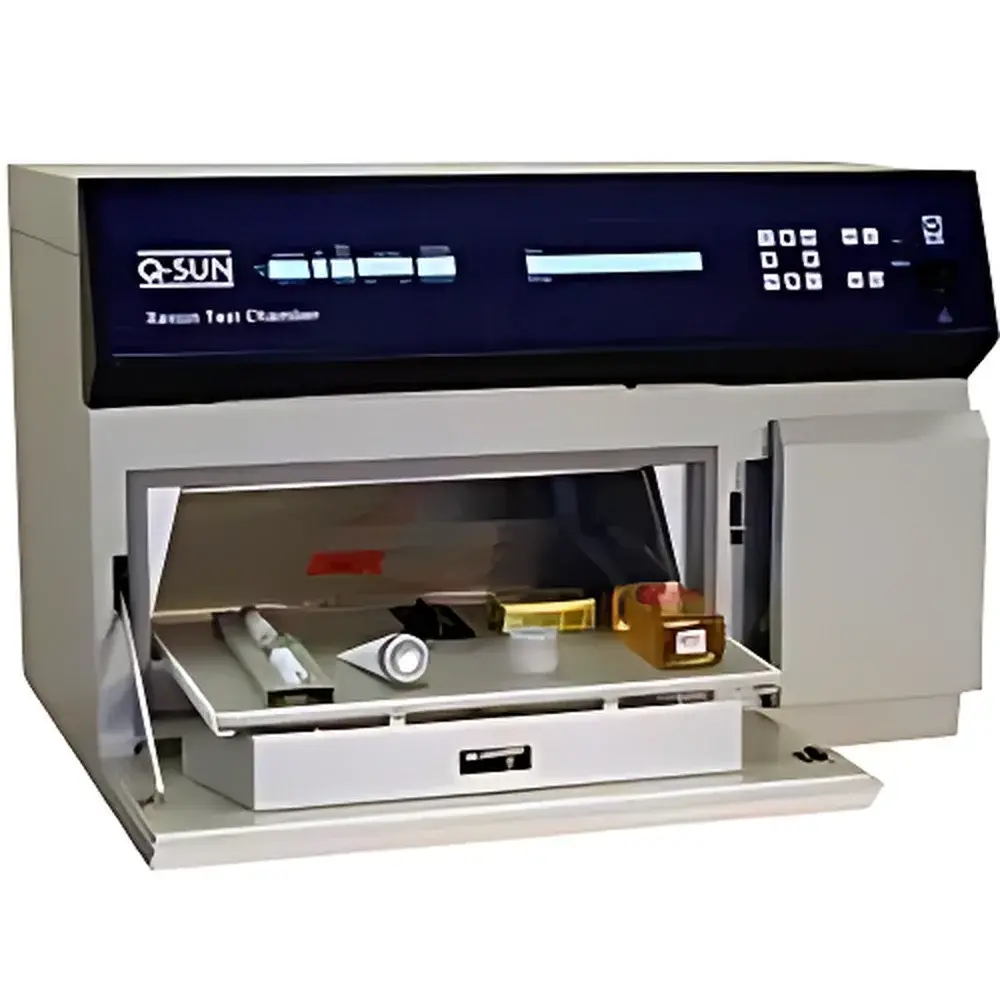
Q-LAB Xe-1 Xenon Arc Weathering Test Chamber
| Brand | Q-LAB |
|---|---|
| Origin | USA |
| Model | Q-LAB Xe-1 |
| Xenon Lamp Power | 1800 W |
| Dimensions (Sample Tray) | 251 mm × 457 mm |
| Max Sample Capacity | 17 pcs of 51 mm × 102 mm |
| Lamp Type | Air-Cooled Xenon Arc Tube |
| Lamp Lifetime | 1500 hours |
| Irradiance Control | SOLAR EYE Spectral Radiometer (340 nm, 420 nm or TUV) |
| Temperature Control | Black Panel Thermometer (35–103 °C), optional Air Temperature Sensor |
| Optional Accessories | Water Spray System (Xe-1-S/Xe-1-SC), Refrigerated Cooling Unit (Xe-1-BC/Xe-1-SC) |
| Compliance | ASTM G155, ISO 4892-2, SAE J2527, AATCC TM16, ISO 11341, GB/T 16422.2 |
Overview
The Q-LAB Xe-1 Xenon Arc Weathering Test Chamber is a compact, benchtop-grade accelerated weathering instrument engineered for precise simulation of solar radiation, thermal stress, and moisture exposure under controlled laboratory conditions. Utilizing a single air-cooled 1800 W xenon arc lamp, the Xe-1 reproduces the full solar spectrum—from UV-B (295 nm) through visible to near-infrared—with spectral fidelity unmatched by fluorescent or metal halide alternatives. Its optical architecture incorporates Q-LAB’s proprietary filter system—including Daylight, Window Glass, and Window-IR options—to accurately emulate terrestrial sunlight under direct exposure or behind architectural glazing. Unlike water-cooled systems, the air-cooled lamp design reduces operational complexity, eliminates coolant maintenance, and improves long-term reliability while maintaining stable irradiance output over its rated 1500-hour service life. The chamber operates on a closed-loop control strategy integrating real-time SOLAR EYE radiometry, black panel temperature monitoring, and programmable humidity cycles—enabling reproducible, standards-compliant aging protocols aligned with ASTM G155, ISO 4892-2, and SAE J2527.
Key Features
- Air-cooled 1800 W xenon arc lamp with 1500-hour rated lifetime and no requirement for external cooling water circuits
- SOLAR EYE irradiance feedback control system with selectable monitoring wavelengths: 340 nm (UV-A critical for polymer degradation), 420 nm (broadband visible/UV), or TUV (total ultraviolet)
- Black panel thermometer as standard temperature sensor (35–103 °C range); optional air temperature sensor available for ambient-condition correlation
- Horizontal sample tray (251 mm × 457 mm) supporting up to 17 standardized 51 mm × 102 mm specimens or irregular 3D parts via modular fixtures
- Integrated Ethernet port enabling remote monitoring, data logging, and GLP/GMP-compliant audit trails
- Five-language controller interface (English, French, Spanish, Italian, German) with self-diagnostic routines, service reminders, and automatic safety shutdown
- Optional water spray system (Xe-1-S / Xe-1-SC) delivering calibrated deionized water mist during light or dark cycles per ASTM D4329
- Optional refrigerated cooling unit (Xe-1-BC / Xe-1-SC) extending operational low-temperature capability to 19 °C for thermally sensitive materials such as pharmaceuticals and cosmetics
Sample Compatibility & Compliance
The Xe-1 accommodates flat, curved, and three-dimensional samples without reorientation requirements, making it suitable for textiles, coatings, automotive interior trim, medical device packaging, and cosmetic formulations. Its horizontal loading geometry ensures uniform irradiance distribution across the entire sample plane—critical for colorimetric stability and gloss retention assessments. All configurations comply with internationally recognized weathering standards including ASTM G155 (practice for operating xenon arc apparatus), ISO 4892-2 (plastics—methods of exposure to laboratory light sources), SAE J2527 (automotive exterior materials), and AATCC TM16 (textile colorfastness). Filter selection directly determines compliance scope: Daylight filters support outdoor durability validation; Window Glass filters align with indoor fade testing per ISO 105-B02; Window-IR filters enable infrared-sensitive material evaluation. Q-LAB’s filter materials are engineered for spectral stability—no recalibration or replacement is required during normal operation except for Window-IR filters, which are scheduled for periodic exchange based on cumulative irradiance dose.
Software & Data Management
The embedded controller supports automated test sequencing, real-time parameter logging, and configurable alarm thresholds. Every unit ships with factory-installed Ethernet connectivity, allowing integration into centralized laboratory information management systems (LIMS) or enterprise quality databases. Optional “Virtual Strip” PC software enables continuous acquisition of irradiance, black panel temperature, chamber humidity, and cycle timing data directly from the instrument to Windows-based workstations. Exported datasets conform to CSV and XML formats for statistical analysis in JMP, Minitab, or custom Python/R pipelines. For regulated environments, the system supports 21 CFR Part 11-compliant electronic signatures when paired with validated authentication modules. Audit trail functionality records all operator actions, parameter changes, calibration events, and fault conditions with timestamped, non-erasable entries—meeting GLP and GMP documentation requirements for pharmaceutical, aerospace, and medical device qualification studies.
Applications
The Q-LAB Xe-1 serves as a primary tool for predictive durability assessment across multiple industrial sectors. In coatings and pigments, it quantifies chalking, cracking, and hue shift under simulated South Florida or Arizona exposures. For automotive suppliers, it validates dashboard material resistance to UV-induced embrittlement and surface haze per OEM-specific protocols. Textile laboratories use it to benchmark colorfastness of dyed fabrics against AATCC TM16 Level 3–7 exposure schedules. Packaging engineers assess UV barrier performance of laminated films used in pharmaceutical blister packs. Cosmetic formulators rely on its low-temperature refrigerated configuration (Xe-1-BC) to evaluate photostability of active ingredients without thermal artifact interference. Academic researchers employ its spectral flexibility to isolate wavelength-dependent degradation mechanisms in organic photovoltaics and biodegradable polymers.
FAQ
What is the difference between black panel temperature and chamber air temperature control?
Black panel temperature measures the surface temperature of an insulated metal plate exposed to the same irradiance as test specimens—reflecting actual thermal load on materials. Air temperature reflects ambient chamber conditions and is less representative of real-world thermal stress.
Is deionized water mandatory for the water spray option?
Yes. Conductivity must remain below 5 µS/cm to prevent mineral deposition on optics and specimen surfaces, ensuring repeatable wetting dynamics per ASTM D4329.
How often must the Window-IR filter be replaced?
Replacement is scheduled at 1000 MJ/m² UV dose (measured at 340 nm), typically corresponding to 12–18 months of continuous operation depending on irradiance setpoint and lamp age.
Can the Xe-1 be integrated into an existing LIMS or MES infrastructure?
Yes—via native Ethernet TCP/IP communication using Modbus TCP or HTTP REST API protocols, supporting bidirectional data exchange and remote firmware updates.
Does the Xe-1 meet FDA 21 CFR Part 11 requirements out of the box?
The base controller provides foundational audit trail and user access controls; full Part 11 compliance requires deployment of Q-LAB’s validated Virtual Strip software with digital signature and electronic record archiving modules.



