
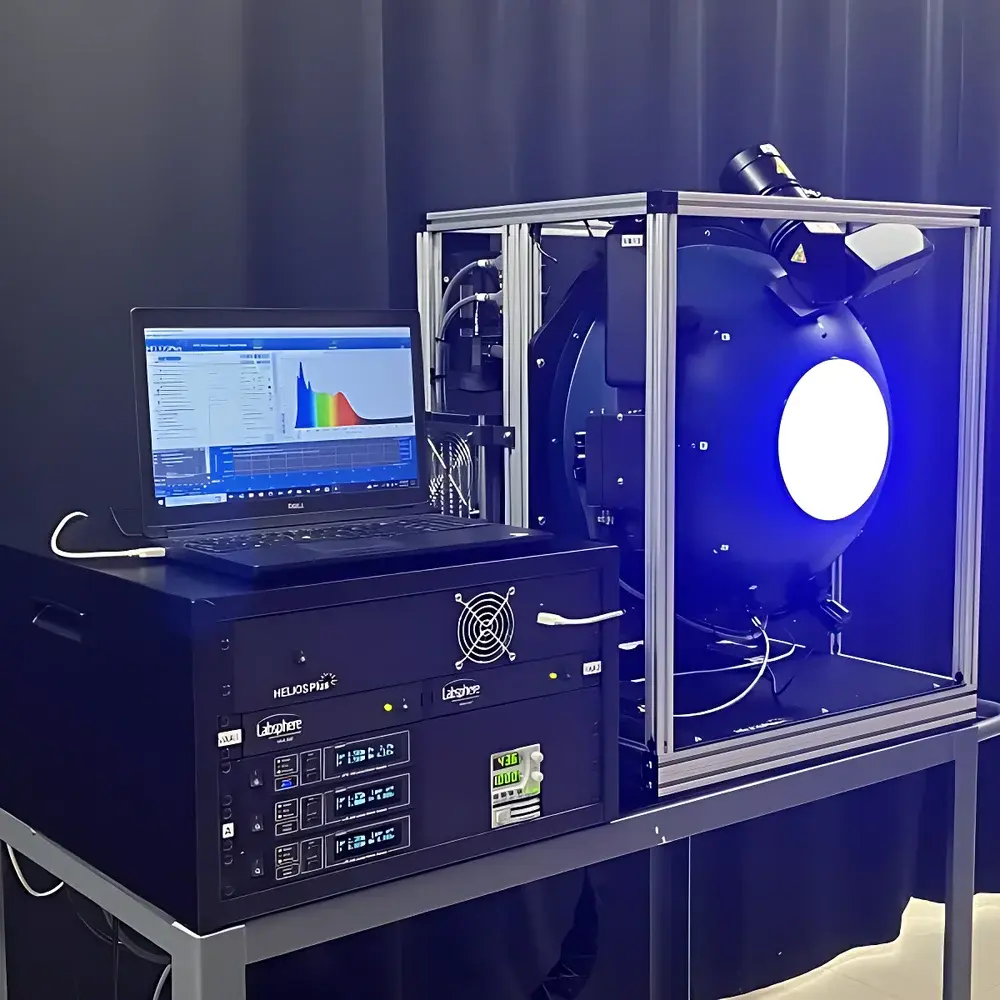
Labsphere Blue Sun Uniform Solar Simulator with Hyperspectral Imaging Calibration Capability
| Brand | Labsphere |
|---|---|
| Origin | USA |
| Model | Blue Sun |
| Light Source Type | Xenon-based broadband solar simulator |
| Illumination Mode | External illumination |
| Spectral Range | 400–2500 nm |
| Output Stability | <0.5% RMS over 8 hours |
| Spectral Smoothness | <1.5% spectral gradient in visible range |
| Calibration Interval | ≥12 months (under recommended operating conditions) |
| Lifetime | ≥2000 hours (xenon arc lamp, typical) |
Overview
The Labsphere Blue Sun Uniform Solar Simulator is an engineered reference light source designed specifically for radiometric and spectral calibration of hyperspectral and multispectral imaging systems under laboratory-controlled conditions. It employs a stabilized, water-cooled xenon short-arc lamp coupled with a proprietary integrating sphere and advanced spectral shaping optics to deliver spatially uniform irradiance across a 400–2500 nm spectral band—covering UV-Vis-NIR-SWIR regions critical for Earth observation, remote sensing, and ocean color science. Unlike conventional solar simulators optimized for photovoltaic testing (e.g., AM1.5G compliance), the Blue Sun prioritizes high photon flux in the blue-to-green region (400–550 nm) and exceptional temporal stability, enabling traceable calibration of detectors whose quantum efficiency peaks in this range. Its design addresses the longstanding challenge of spectral mismatch between natural sunlight and artificial sources during sensor characterization—particularly for airborne and satellite-borne push-broom imagers requiring long-duration, repeatable exposure protocols.
Key Features
- High-spatial-uniformity output (>98% uniformity over Ø150 mm field, measured per ISO 9050)
- Long-term irradiance stability: <0.5% RMS fluctuation over continuous 8-hour operation, verified via NIST-traceable photodiode monitoring
- Smooth spectral profile with minimal gradients (<1.5% deviation from ideal solar spectrum in 400–700 nm, per ASTM E927-20)
- Modular optical path supporting collimated or divergent beam configurations for integration into custom test benches
- Integrated shutter and programmable intensity control (0–100% in 0.1% steps) for dynamic exposure sequencing
- Compliant with Class AAA requirements per IEC 60904-9:2020 for spatial uniformity and temporal stability (spectral match not rated for PV applications)
Sample Compatibility & Compliance
The Blue Sun is compatible with flat-panel sensors, line-scan cameras, focal plane arrays (FPAs), and monochromator-coupled radiometers used in laboratory-grade spectral validation. Its external illumination architecture enables non-contact, non-invasive calibration without mechanical coupling—critical for preserving optical alignment integrity of flight-ready instruments. The system meets essential regulatory and standards-based requirements for metrological traceability: all factory calibrations are performed using NIST-traceable spectroradiometers (e.g., Ocean Insight QE Pro, calibrated at NIST-accredited labs). Data logs include full spectral irradiance curves, spatial uniformity maps, and stability time-series reports—supporting GLP-compliant documentation workflows. While not certified for FDA 21 CFR Part 11, its software export functionality enables audit-ready CSV and HDF5 file generation suitable for internal QA/QC and third-party verification.
Software & Data Management
The Blue Sun operates via Labsphere’s SpectraSuite™ Control Suite (v4.2+), a Windows-based application providing real-time irradiance monitoring, scheduled calibration runs, and automated report generation. The software supports synchronized triggering with external frame grabbers and integrates with Python APIs (via PyVISA) for custom automation in MATLAB or LabVIEW environments. All spectral data are stored with embedded metadata—including lamp hour count, ambient temperature, and integration sphere reflectance history—to ensure reproducibility across instrument lifecycles. Export formats include CIE XYZ, sRGB, and radiometric units (W·m⁻²·nm⁻¹), facilitating direct import into ENVI, PCI Geomatica, and SNAP for sensor response modeling and vicarious calibration workflows.
Applications
- Radiometric calibration of airborne and spaceborne hyperspectral imagers (e.g., AVIRIS-NG, PRISMA, EnMAP)
- Vicarious calibration site validation and ground reference target characterization
- Flat-field correction for scientific CMOS and CCD imaging systems used in ocean color remote sensing (e.g., SeaWiFS, PACE pre-launch testing)
- Spectral response function (SRF) measurement of multi-band filter wheels and tunable Fabry–Pérot systems
- Stability benchmarking of radiometric transfer standards in national metrology institutes
- Development and validation of atmospheric correction algorithms requiring known input spectra
FAQ
Is the Blue Sun compliant with AM0 or AM1.5G solar spectra?
No—it is not spectrally matched to AM0 or AM1.5G standards. It is optimized for high blue-region throughput and stability, not photovoltaic spectral matching.
Can the system be configured for collimated output?
Yes; optional collimation optics kits (f/8 and f/10) are available to produce beam divergence <1.5 mrad over Ø100 mm exit aperture.
What maintenance is required for long-term stability?
Lamp replacement every ~2000 hours; annual verification of integrating sphere coating reflectance (BaSO₄-based) using reference spectroradiometry.
Does it support automated calibration sequences with external cameras?
Yes—via TTL trigger input/output and GenICam-compliant SDK for synchronization with industrial camera platforms.
Is spectral recalibration required after lamp replacement?
Yes; a full spectral irradiance recalibration is mandatory post-lamp change and must be performed by an authorized Labsphere service engineer or accredited metrology lab.






