
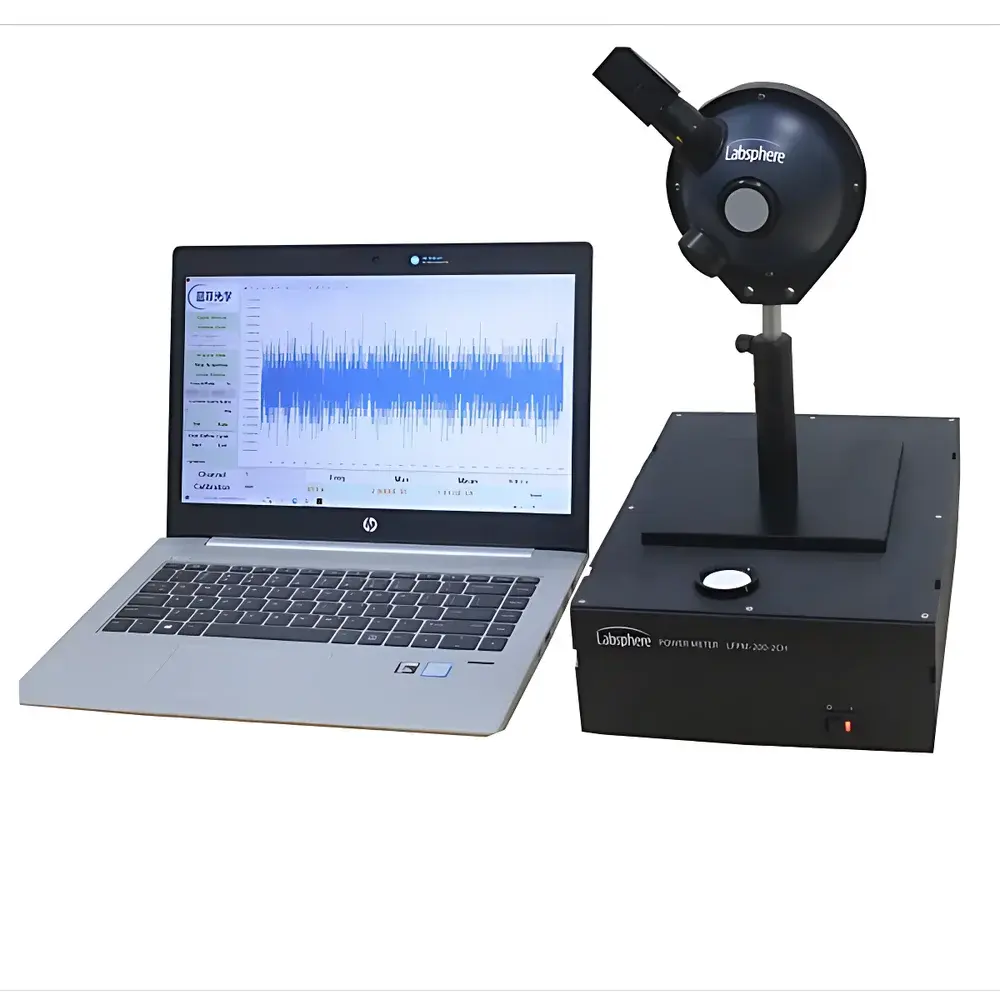
Labsphere LFPMS Laser Power Measurement System
| Brand | Labsphere |
|---|---|
| Origin | Shanghai, China |
| Manufacturer Type | Authorized Distributor |
| Product Origin | Domestic (China) |
| Model | LFPMS |
| Pricing | Available Upon Request |
| Power Range | 100 nW – 100 W |
| Wavelength Range | 350 nm – 1800 nm |
| Calibration Traceability | National Institute of Metrology (NIM), China |
| Integrating Sphere Diameters | 2″ (5 cm), 4″ (10 cm), 6″ (15 cm), 8″ (20 cm) |
| Input Aperture | 0.5″ (12.7 mm) for LFPMS-020 |
| Coating Reflectance | ≥98% (Spectralon®-type diffuse reflectance coating) |
Overview
The Labsphere LFPMS Laser Power Measurement System is a precision-engineered optical metrology platform designed for absolute total power measurement of divergent laser beams—particularly those emitted from fiber-coupled lasers, laser diodes, VCSELs, and other broadband or quasi-monochromatic sources. Operating on the principle of integrating sphere photometry, the LFPMS captures and homogenizes incident radiant flux across a highly reflective, spectrally neutral interior surface (≥98% reflectance over 350–1800 nm), enabling spatially uniform detection independent of beam profile, divergence angle, or pointing stability. This physical architecture eliminates sensitivity to beam alignment drift and eliminates the need for real-time beam profiling prior to power quantification—critical for production line verification, R&D calibration labs, and ISO/IEC 17025-accredited testing environments. The system’s traceable calibration to the National Institute of Metrology (NIM), China ensures compliance with national metrological standards and supports uncertainty budgets required under GLP and GMP frameworks.
Key Features
- Four scalable integrating sphere options (2″, 4″, 6″, and 8″ diameters) optimized for distinct power density regimes—from low-power nanowatt-level characterization to high-power industrial laser validation.
- Standardized input apertures: 0.5″ (12.7 mm) for the LFPMS-020 variant; 1″ (25.4 mm) for all larger configurations—enabling compatibility with common fiber connectors (e.g., FC/PC, SMA905) and free-space collimated beams.
- High-stability thermopile or photodiode-based detectors, selected per dynamic range and wavelength sensitivity requirements—ensuring linear response across the full 100 nW–100 W span.
- Modular hardware architecture: Optional integration of calibrated attenuators, spectral filters, or external spectrometers (e.g., Ocean Insight, Avantes) via standardized mechanical and electrical interfaces.
- Open-architecture software control: Native support for C#, C++, and serial command protocols—facilitating seamless integration into automated test systems (ATE), PLC-controlled manufacturing cells, or custom LabVIEW/Python-based data acquisition workflows.
Sample Compatibility & Compliance
The LFPMS accommodates continuous-wave (CW) and pulsed laser sources with repetition rates up to 10 kHz (subject to detector selection), provided average power remains within specified limits. It supports both free-space and fiber-delivered beams without requiring beam conditioning optics. All sphere variants comply with ASTM E275–22 (Standard Practices for Describing and Measuring Performance of Integrating Spheres) and align with ISO 11554 (Laser and laser-related equipment — Test methods for laser beam parameters). NIM-traceable calibration certificates include expanded uncertainties (k=2) and full spectral responsivity data per user-specified wavelength points (e.g., 405 nm, 635 nm, 808 nm, 980 nm, 1064 nm, 1550 nm). System documentation meets FDA 21 CFR Part 11 audit trail requirements when deployed with validated software modules.
Software & Data Management
The included LFPMS Control Suite provides real-time power monitoring, auto-ranging, zero-drift compensation, and time-resolved logging at up to 100 Hz sampling rate. Raw detector voltage, calculated power (W), and statistical metrics (mean, std dev, min/max over user-defined intervals) are exportable in CSV, TXT, or HDF5 formats. For enterprise deployment, the SDK enables deterministic command-response sequencing—including remote calibration factor updates, aperture selection, and detector gain switching—without GUI dependency. All software binaries undergo static code analysis and are digitally signed; version history, change logs, and validation reports are supplied upon request for regulated environments.
Applications
- Factory acceptance testing (FAT) of fiber laser modules prior to shipment.
- Stability monitoring of diode-pumped solid-state (DPSS) lasers during burn-in cycles.
- Calibration transfer between primary standards (e.g., cryogenic radiometers) and working standards in national metrology institutes.
- Quantitative verification of laser safety interlock thresholds per IEC 60825-1:2014.
- Power normalization in multi-wavelength optical coherence tomography (OCT) source characterization.
- Thermal load modeling for high-power laser processing heads using time-integrated energy measurements.
FAQ
Is the LFPMS compatible with pulsed lasers?
Yes—when configured with appropriate peak-power-rated detectors and optional pulse-synchronous triggering, the LFPMS supports average power measurement of pulsed sources with pulse widths ≥10 ns and repetition rates ≤10 kHz.
Can I perform in-house recalibration?
Users may select custom calibration wavelengths and apply proprietary attenuation factors; however, full NIM-traceable recalibration must be performed by an accredited lab or Labsphere’s Shanghai service center.
What is the maximum allowable beam divergence angle?
The system accepts full-cone divergence angles up to ±60° for the 2″ sphere and ±45° for larger spheres—verified per ANSI Z80.10 beam geometry guidelines.
Does the system support USB or Ethernet communication?
Standard configuration uses RS-232/RS-485 serial interface; USB-to-serial and Ethernet-to-serial gateways are supported via third-party adapters compliant with RFC 2217.
Are spectral correction files provided for non-standard wavelengths?
Yes—upon request, Labsphere supplies interpolated spectral responsivity curves derived from NIM-measured reference data, enabling accurate power calculation at any wavelength within 350–1800 nm.





