
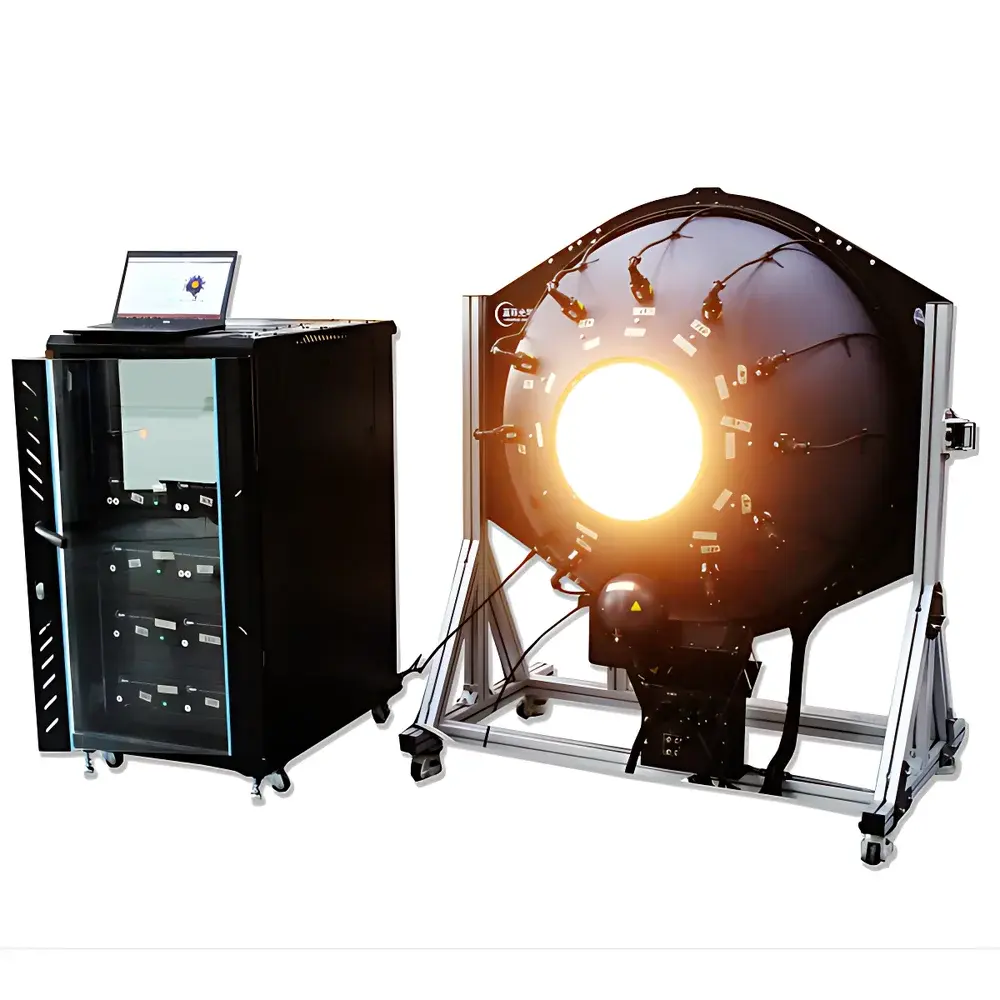
LabSphere LFUSS Integrating Sphere Uniform Light Source
| Brand | LabSphere |
|---|---|
| Model | LFUSS |
| Coating | Spectraflect® or Spectralon® |
| Internal Diameter Options | 15 cm – 200 cm |
| Spectral Range | 350–2500 nm |
| Calibrated Radiance Range | 0–40,000 nit |
| Uniformity | ≥98% |
| Stability | ±0.1% |
| Light Source Type | Tungsten-halogen (150 W external + multiple internal options: 35/75/100/150 W) |
| Illumination Method | Internal illumination |
| Motorized Attenuator | ≥35,000 steps |
| Calibration Traceability | NIST and NIM (China National Institute of Metrology) |
| Operating Temperature | 20–40 °C |
| Detector Type | Silicon photodiode |
| Validated Spectral Calibration Range | 360–1100 nm |
| Color Temperature | 2856 ± 50 K |
| Aperture Configurations | Dual detector ports + variable source access ports |
| Software Compatibility | LabSphere Uniform Source Measurement Software (customizable) |
Overview
The LabSphere LFUSS Integrating Sphere Uniform Light Source is an engineered optical calibration system designed for high-fidelity radiometric and photometric characterization of imaging sensors, display panels, spectroradiometers, and camera systems. Based on the fundamental principle of diffuse multiple-scattering within a highly reflective spherical cavity, the LFUSS leverages either LabSphere’s proprietary Spectraflect® coating or the industry-standard Spectralon® material to achieve near-Lambertian emission and exceptional spatial uniformity. Its spectral coverage spans 350–2500 nm, with traceable radiance calibration over the photopic and extended NIR range (360–1100 nm), enabling quantitative validation across visible, NIR, and short-wave infrared domains. The system employs tungsten-halogen lamps—comprising a 150 W external lamp and selectable internal lamps (35 W, 75 W, 100 W, or 150 W)—to deliver stable, continuous-spectrum output with tightly controlled color temperature (2856 ± 50 K). Radiance is precisely modulated via a motorized, high-resolution attenuator (≥35,000 steps), ensuring repeatable irradiance levels from sub-milinit to 40,000 nit. All LFUSS units are supplied with NIST-traceable and/or NIM-traceable calibration reports for radiance, uniformity, and color temperature—fully compliant with ISO/IEC 17025 requirements for accredited calibration laboratories.
Key Features
- High spatial uniformity: ≥98% radiance uniformity across the output port, verified per ISO 13665 and ASTM E308 methodologies
- Exceptional short- and long-term stability: ±0.1% radiance drift over 8 hours under constant thermal conditions (20–40 °C ambient)
- Modular sphere architecture: Available in standard internal diameters from 40 inch (102 cm) to 120 inch (305 cm), with custom sizes up to 200 cm supported
- Dual detector ports: Enable simultaneous spectral monitoring and real-time feedback control without interrupting primary measurement
- Motorized precision attenuation: Fully programmable, backlash-free optical density control with <0.001 OD resolution
- Interchangeable lamp configurations: External 150 W halogen base lamp plus four internal lamp options for optimized spectral power distribution and thermal management
- Robust mechanical interface: Precision-machined flange mounts and alignment fiducials ensure repeatable, tool-free installation of cameras, spectrometers, or integrating sphere accessories
- Comprehensive documentation: Each unit ships with full calibration certificates including spectral radiance, spatial uniformity, and chromaticity test reports
Sample Compatibility & Compliance
The LFUSS is compatible with flat-panel displays (LCD, OLED, microLED), scientific CMOS and CCD imagers, aerial survey cameras, automotive ADAS sensors, and photometric goniometers. Its output port geometry and radiance profile meet the geometric constraints defined in CIE Publication 127:2007 for LED measurement and ISO 9241-307 for display luminance uniformity testing. The system supports GLP-compliant operation through audit-trail-enabled software logging and timestamped calibration metadata. All calibration data adhere to the traceability hierarchy specified in ISO/IEC 17025:2017, with direct linkage to NIST Standard Reference Materials (SRMs) and China’s National Institute of Metrology (NIM) standards. The halogen-based spectral output satisfies the CIE illuminant A reference spectrum requirements for photometric evaluation.
Software & Data Management
LabSphere Uniform Source Measurement Software provides intuitive GUI-based control of lamp power, attenuator position, and thermal stabilization sequencing. It supports automated uniformity mapping using synchronized detector scans, real-time radiance trending, and batch export of calibrated spectral radiance data in HDF5 and CSV formats. The software architecture complies with FDA 21 CFR Part 11 requirements for electronic records and signatures when configured with user authentication, audit trail logging, and role-based access control. Custom API integration (Python, MATLAB, LabVIEW) enables seamless incorporation into automated test benches for production line sensor validation or R&D metrology workflows.
Applications
- Radiometric calibration of satellite Earth observation sensors and hyperspectral imagers
- Photometric validation of automotive head-up displays (HUDs) and instrument cluster backlights
- Uniformity verification of medical endoscopic camera systems per IEC 62304
- Characterization of quantum efficiency and linearity in scientific-grade CMOS image sensors
- Development and verification of display aging models under controlled irradiance stress
- Reference source for inter-laboratory comparison studies coordinated by NMIs and national metrology institutes
FAQ
What spectral ranges are covered by the factory calibration?
Factory radiance calibration is performed from 360 nm to 1100 nm; extended spectral characterization (up to 2500 nm) is available upon request with additional calibration services.
Can the LFUSS be integrated into an automated production test cell?
Yes—the system supports Ethernet/IP and RS-232 command protocols, and its software SDK enables deterministic timing control for high-throughput sensor screening applications.
Is Spectralon® coating suitable for high-power halogen operation?
Spectralon® is rated for continuous operation at radiant flux densities up to 500 mW/cm² at the sphere wall; all LFUSS configurations are thermally modeled to remain within this limit under nominal operating conditions.
How often is recalibration recommended?
Annual recalibration is recommended for ISO/IEC 17025 compliance; however, stability monitoring using built-in reference detectors allows extension to 18 months in controlled laboratory environments with documented environmental logs.
Are custom port configurations available?
Yes—custom aperture layouts, auxiliary baffle placements, and fiber-optic coupling interfaces can be implemented during manufacturing or as retrofitted upgrades.




