
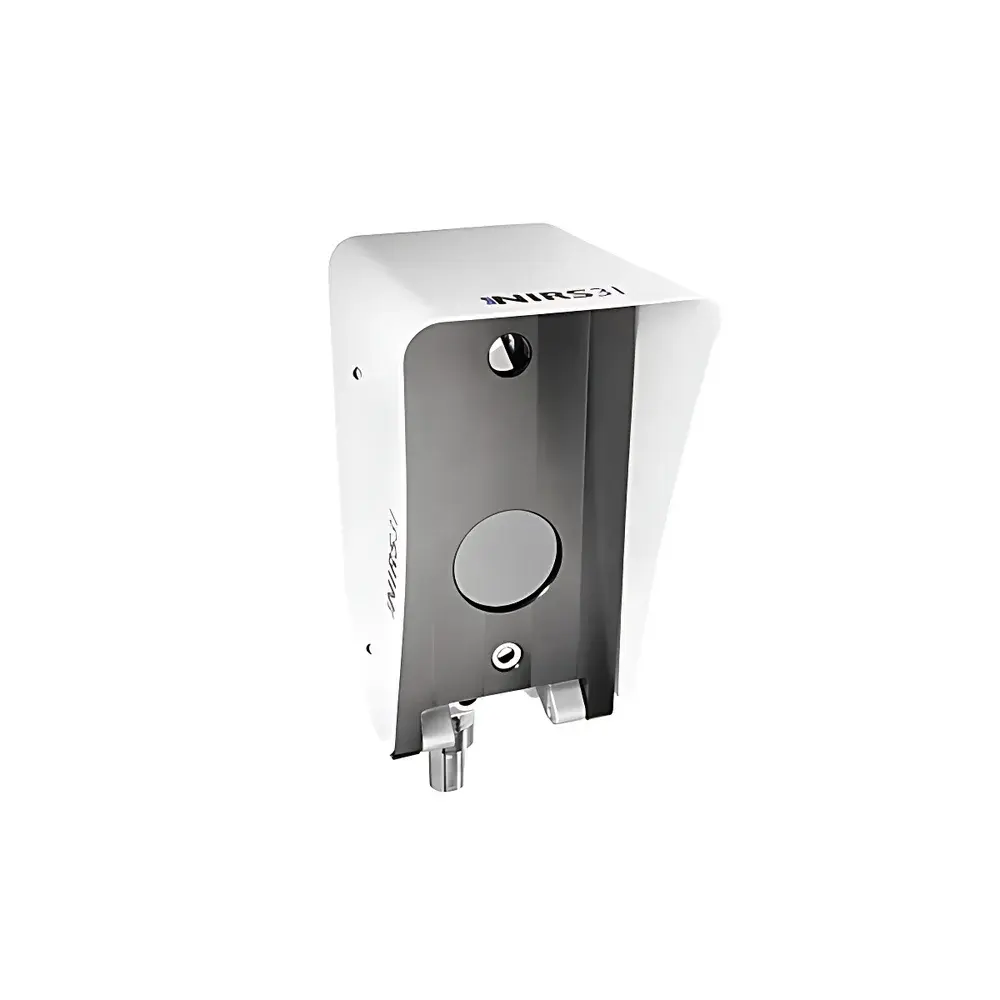
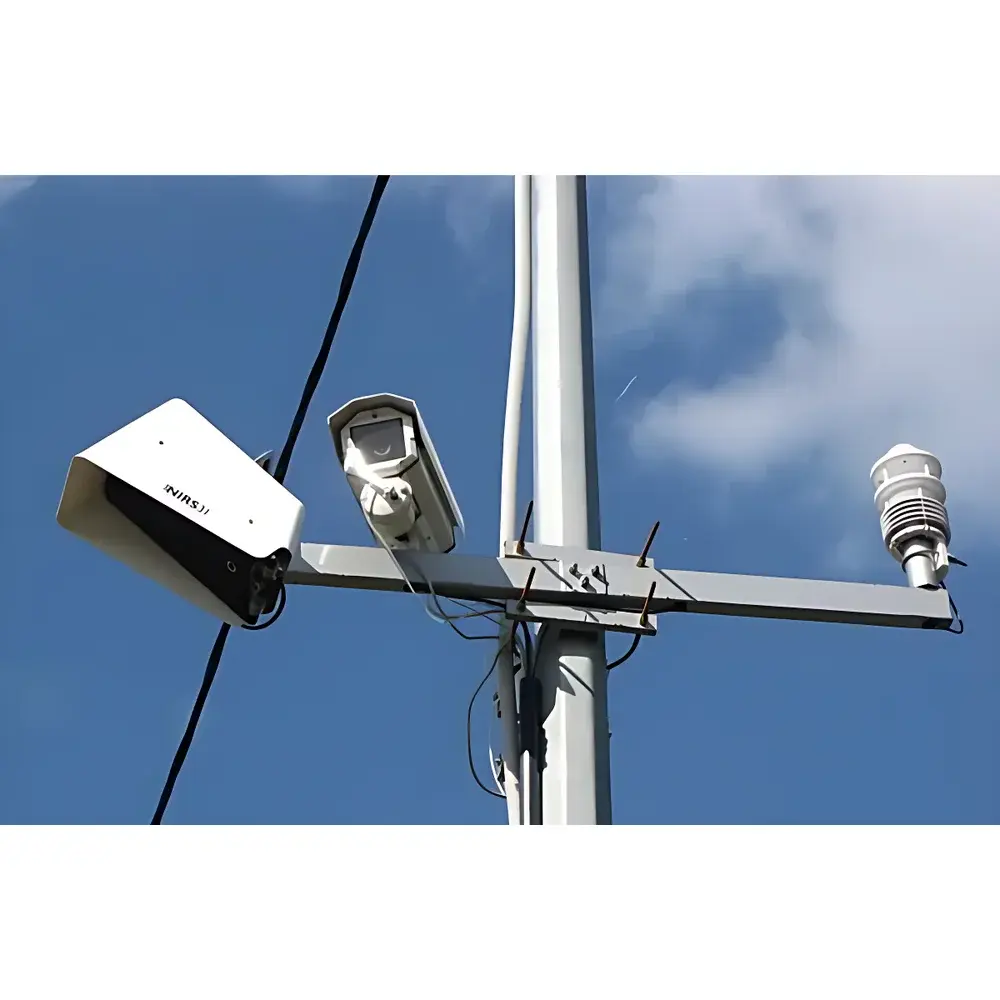
Lufft NIRS31-UMB Remote Sensing Road Surface Sensor
| Brand | Lufft |
|---|---|
| Origin | Germany |
| Model | NIRS31-UMB |
| Measurement Principle | Near-Infrared Spectroscopy (NIRS) + Infrared Pyrometry |
| Output Parameters | Surface Temperature, Water Film Height, Ice/Snow Thickness, Ice Fraction, Freezing Point Depression, Salt Concentration, Friction Coefficient Estimate, Surface Condition Classification |
| Communication Protocol | UMB (Universal Measurement Bus), SDI-12, Modbus RTU, ASCII |
| Mounting | Non-intrusive overhead installation (typical height: 3–8 m) |
| Compliance | EN 13103, WMO Guide to Meteorological Instruments and Methods of Observation, ASTM E1967 (for pavement friction estimation), ISO/IEC 17025 traceable calibration support |
Overview
The Lufft NIRS31-UMB is a non-contact, overhead-mounted remote sensing road surface sensor engineered for continuous, real-time monitoring of critical pavement state parameters in intelligent transportation systems and all-weather road safety infrastructure. Operating on dual physical principles—near-infrared spectroscopy (NIRS) and infrared pyrometry—the sensor captures spectral reflectance signatures across the 1,100–2,500 nm range to quantify water film height, ice/snow presence and thickness, ice fraction, salt concentration (via freezing point depression analysis), and surface condition classification (dry, wet, damp, icy, snowy, slushy). Simultaneously, an integrated high-stability infrared pyrometer delivers calibrated surface temperature measurements with ±0.5 °C accuracy under varying ambient conditions. Designed for permanent deployment on bridge structures, gantries, or mast poles at heights of 3–8 meters, the NIRS31-UMB eliminates the need for road cutting, embedded probes, or mechanical contact—ensuring zero traffic disruption and long-term structural integrity of paved surfaces.
Key Features
- Non-intrusive optical measurement: No pavement penetration, no maintenance-related lane closures, no risk of sensor damage from de-icing chemicals or snowplows.
- Patented freezing point depression algorithm: Derives effective ice point temperature and dissolved salt concentration (NaCl-equivalent) from spectral absorption features near 1,450 nm and 1,940 nm, enabling quantitative anti-icing decision support.
- Single-source, multi-band optical architecture: A single broadband NIR emitter coupled with precision interference filters enables simultaneous acquisition of multiple spectral channels—reducing thermal drift, improving signal-to-noise ratio, and extending calibration stability.
- Robust environmental housing: IP66-rated aluminum enclosure with heated optical window (standard) and optional active anti-fogging; operational range from −40 °C to +70 °C.
- Multi-protocol digital interface: Native UMB (Universal Measurement Bus) output with backward compatibility to SDI-12, Modbus RTU, and ASCII serial protocols—enabling seamless integration into legacy and modern SCADA, CMS, and IoT edge platforms.
- Self-diagnostic capability: Continuous internal health monitoring of LED intensity, detector response, window contamination level, and thermal reference stability—with configurable alarm thresholds and diagnostic log export.
Sample Compatibility & Compliance
The NIRS31-UMB is validated for use on asphalt, concrete, and steel bridge decks under natural illumination and low-light conditions. Its spectral analysis engine accounts for substrate-specific reflectance baselines via factory-calibrated reference libraries and supports site-specific adaptation through field-based spectral training routines. The sensor meets functional requirements defined in EN 13103 (Road Weather Information Systems – Performance Requirements and Testing), aligns with WMO observational standards for road surface state reporting, and supports traceable calibration procedures compliant with ISO/IEC 17025. For regulatory reporting in public infrastructure projects, raw spectral data and processed outputs can be configured to satisfy audit trails required under EU Directive 2010/40/EU (ITS Framework) and national road authority specifications.
Software & Data Management
Sensor configuration, firmware updates, and spectral diagnostics are managed via Lufft’s open UMB-ConfigTool and supported by third-party middleware including Campbell Scientific LoggerNet, Siemens Desigo CC, and AWS IoT Core ingestion pipelines. All measured parameters—including time-stamped spectral raw data (16-bit), derived quantities, and quality flags—are timestamped with UTC-synchronized GPS or NTP input. Data logging intervals are user-configurable from 1 second to 30 minutes. Optional cloud connectivity enables automated upload to centralized traffic management dashboards with configurable alerting (e.g., “ice fraction > 80%”, “freezing point < −2 °C”) and historical trend analysis. Full data export supports CSV, NetCDF, and JSON formats, and metadata adheres to OGC SensorML v2.0 for interoperable discovery and semantic annotation.
Applications
- Automated winter road maintenance dispatch: Triggering gritter deployment based on real-time salt concentration and predicted icing onset.
- Bridge deck freeze-thaw monitoring: Detecting early-stage ice formation beneath thin water films where conventional thermistors fail.
- Railway switch and platform safety systems: Providing friction-relevant surface state data for train braking distance modeling.
- Smart city mobility platforms: Feeding dynamic road condition feeds into navigation APIs (e.g., HERE, TomTom) and V2X broadcast messages (SAE J2735).
- Highway concessionaire performance reporting: Generating auditable, standards-aligned KPIs for road safety compliance and maintenance SLA verification.
- Research-grade pavement–atmosphere interaction studies: Capturing diurnal spectral evolution of surface moisture phase transitions under controlled meteorological conditions.
FAQ
How does the NIRS31-UMB distinguish between thin water films and black ice?
It analyzes differential absorption at 1,450 nm (strong H₂O absorption) and 1,940 nm (enhanced sensitivity to solid-phase crystalline structure), combined with surface temperature and emissivity-corrected pyrometry—enabling discrimination down to sub-millimeter water layers and transparent ice layers.
Can it operate reliably under heavy rain or snowfall?
Yes—its optical design includes dynamic rain/snow compensation algorithms that detect transient obscuration events and suppress false surface state classifications during precipitation; validation testing per IEC 60529 confirms sustained operation under simulated 100 mm/h rainfall.
Is spectral calibration traceable to national metrology institutes?
Factory calibration uses NIST-traceable blackbody sources and certified reflectance standards; on-site verification kits with portable reference targets support periodic field validation in accordance with ISO 9001 and ISO/IEC 17025 quality management frameworks.
What mounting height tolerance is acceptable for accurate thickness estimation?
Optimal range is 3–6 m above pavement; at 8 m, snow thickness uncertainty increases by ≤15% due to beam divergence—configurable correction factors are provided in the UMB protocol specification.
Does it require external power beyond its 12–30 VDC input?
No auxiliary power is needed; integrated heating and electronics operate entirely within the specified DC input range, with typical consumption of 3.2 W (standby) to 6.8 W (active measurement + heater).




