
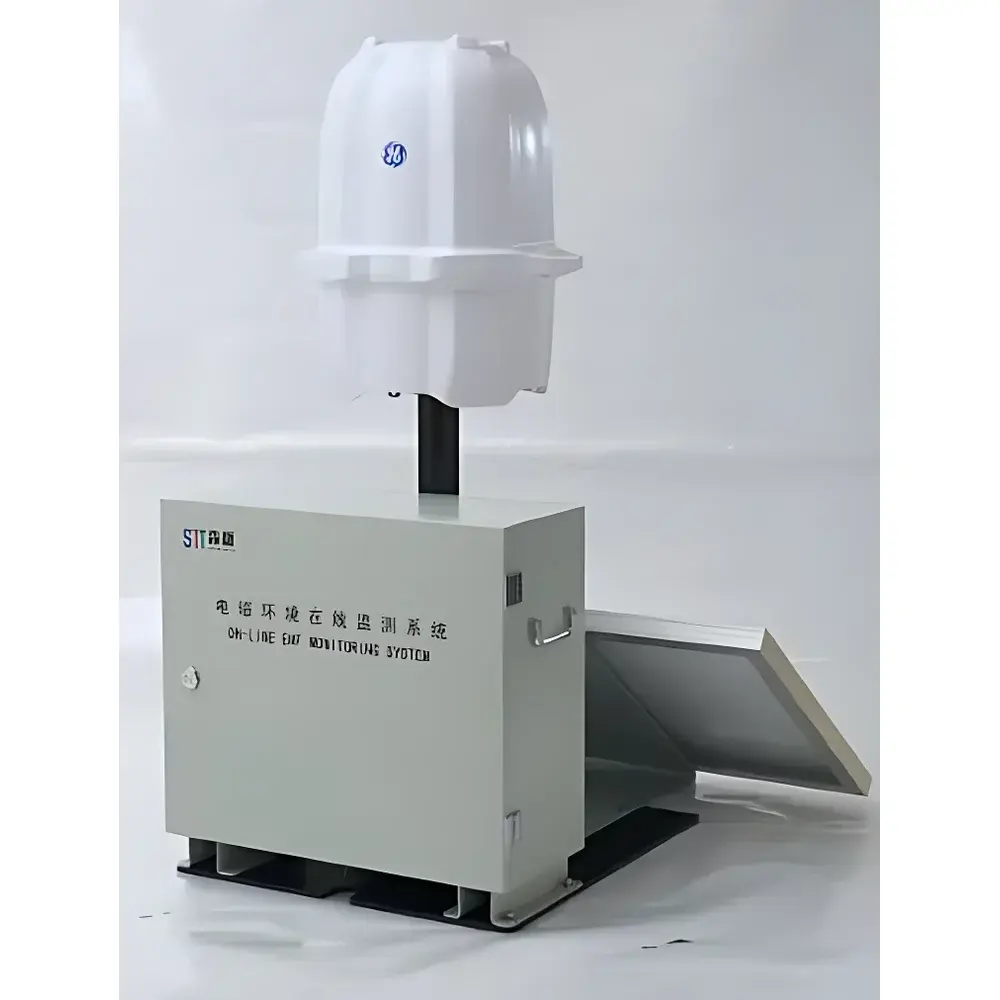
OS-Detection Online Radiation Monitoring System
| Brand | STT-Senfu Technology |
|---|---|
| Origin | Beijing, China |
| Manufacturer | STT |
| Product Type | Environmental Gamma Radiation Dose Rate Monitor |
| Model Series | OS Series |
| Detector Type | Spherical High-Pressure Ionization Chamber (Argon-filled, 23.8 atm) |
| Dose Rate Range | 0–1 Sv/h (0–100 R/h) |
| Energy Response | 70 keV–10 MeV |
| Zero Drift | ±0.5 μR/h |
| Gain Drift | ±3% below 35 μR/h |
| Calibration Accuracy | ±3.5% |
| Sampling Interval | 5 s |
| Response Time | <10 s |
| Operating Temperature | −40 °C to +55 °C (battery-free operation) |
| Relative Humidity | 0–100% RH |
| Ingress Protection | IP66 |
| Power Consumption | 4 W |
| Data Storage | 1 GB internal memory (≥10 million records) |
| Communication Interfaces | 3× USB, RS-232, RJ-45 Ethernet |
| Angular Dependence | <5% (85% field-of-view, upward incidence) |
| Certifications | CE, WEEE, IEC 60846-1:2014, ETL, RoHS |
Overview
The OS-Detection Online Radiation Monitoring System is a purpose-built, continuous environmental gamma radiation dose rate monitoring platform engineered for long-term, unattended operation in national regulatory networks and critical infrastructure sites. It implements the high-pressure ionization chamber (HPIC) measurement principle—where gamma photons ionize argon gas under elevated pressure (23.8 atm), generating charge proportional to ambient dose equivalent rate (H*(10)). This physics-based detection method delivers intrinsic linearity, minimal energy dependence, and exceptional long-term stability—attributes validated over 35 years of deployment in U.S. Department of Energy environmental surveillance programs. As specified in China’s *Technical Specification for the Construction of the National Radiation Environmental Monitoring Network* (HJ 61–2021), HPIC-based systems are mandated at national reference stations to ensure metrological traceability and inter-site data comparability across heterogeneous geographic and climatic conditions.
Key Features
- Ultra-wide dose rate coverage spanning nine orders of magnitude—from natural background (1 nGy/h) to severe accident-level exposure (1 Gy/h)—enabling seamless transition from routine surveillance to emergency response without sensor reconfiguration.
- Spherical HPIC geometry ensures isotropic angular response (<5% deviation over 85% solid angle for upward incidence; <10% for low-angle downward incidence), minimizing directional bias in open-field installations.
- Robust thermal and humidity tolerance: fully operational from −40 °C to +55 °C with no battery dependency, and 0–100% relative humidity resistance—validated for deployment in Arctic monitoring posts, desert border stations, and coastal nuclear facility perimeters.
- High-fidelity signal conditioning architecture achieves ±0.5 μR/h zero drift and gain stability of ±3% below 35 μR/h—meeting IEC 60846-1:2014 Class A performance criteria for environmental dosimetry.
- 10-year factory warranty on the HPIC detector assembly reflects proven mechanical integrity and material aging resistance; field units in continuous service since the early 1990s demonstrate >20-year functional lifetimes under GLP-compliant maintenance protocols.
Sample Compatibility & Compliance
The OS-Detection system is optimized exclusively for ambient gamma radiation and cosmic ray neutron-induced photon fields—exhibiting negligible response to alpha, beta, or low-energy X-ray emissions. Its 70 keV–10 MeV energy response curve is normalized to ICRU tissue-equivalent fluence-to-dose conversion coefficients, ensuring compliance with ISO 4037-3:2019 reference radiation fields. All units undergo individual calibration against NIM-traceable 137Cs and 60Co standard sources, with documented uncertainty budgets conforming to ISO/IEC 17025:2017. The system meets electromagnetic compatibility requirements per EN 61000-6-2/6-4 and carries CE, ETL, and RoHS declarations—supporting integration into EU and North American regulatory infrastructures governed by EURATOM Directive 2013/59 and U.S. NRC Regulatory Guide 4.15.
Software & Data Management
Embedded firmware supports dual-mode operation: autonomous logging (5-second sampling interval, ≥10 million records stored locally in non-volatile 1 GB memory) and real-time telemetry via TCP/IP (RJ-45) or serial (RS-232) interfaces. Optional STT-RadNet™ software provides FDA 21 CFR Part 11–compliant audit trails, electronic signatures, and role-based access control for data export, alarm configuration (threshold, rate-of-change, duration), and spectral trend analysis. Raw H*(10) values are timestamped with GPS-synchronized UTC and archived in CSV/NetCDF formats compatible with national data centers (e.g., China’s NMEMS, EPA RadNet).
Applications
- National radiation environmental monitoring networks requiring metrologically harmonized, cross-platform comparable datasets.
- Perimeter monitoring at nuclear power plants, fuel cycle facilities, and radioactive waste repositories—supporting IAEA Safety Standards Series No. RS-G-1.8.
- Border and port radiation detection systems integrated with CBRN threat assessment platforms.
- Emergency response coordination centers requiring real-time dose rate mapping during radiological incidents.
- Long-term ecological research stations measuring natural background variability and anthropogenic contributions.
- Calibration laboratories performing secondary standard verification under ISO/IEC 17025 accreditation.
FAQ
What is the primary metrological advantage of the high-pressure ionization chamber over scintillation or GM-based detectors?
The HPIC offers superior energy independence, near-zero temperature coefficient, and absence of dead-time effects—critical for maintaining accuracy across environmental dose rates ranging from 0.01 µSv/h to 1 Sv/h without range switching or correction algorithms.
Does the system support remote calibration verification?
Yes—via built-in check source holder (optional 241Am or 133Ba) and automated daily self-test routines that log chamber current stability, HV supply ripple, and ADC linearity deviations.
How is data integrity ensured during extended network outages?
All measurements are buffered in redundant flash memory partitions; upon connection restoration, time-stamped records auto-resynchronize with central servers using RFC 5905-compliant NTP handshaking.
Is the OS-Detection system suitable for indoor installation in radiotherapy vaults?
No—it is designed specifically for outdoor environmental monitoring; its energy response and angular characteristics are optimized for sky-shine and terrestrial gamma fields—not controlled clinical beam geometries.
Can the system interface with SCADA or ICS platforms?
Yes—Modbus TCP and OPC UA drivers are available as certified add-ons, enabling direct integration with industrial control systems compliant with IEC 62443-3-3 security profiles.







