
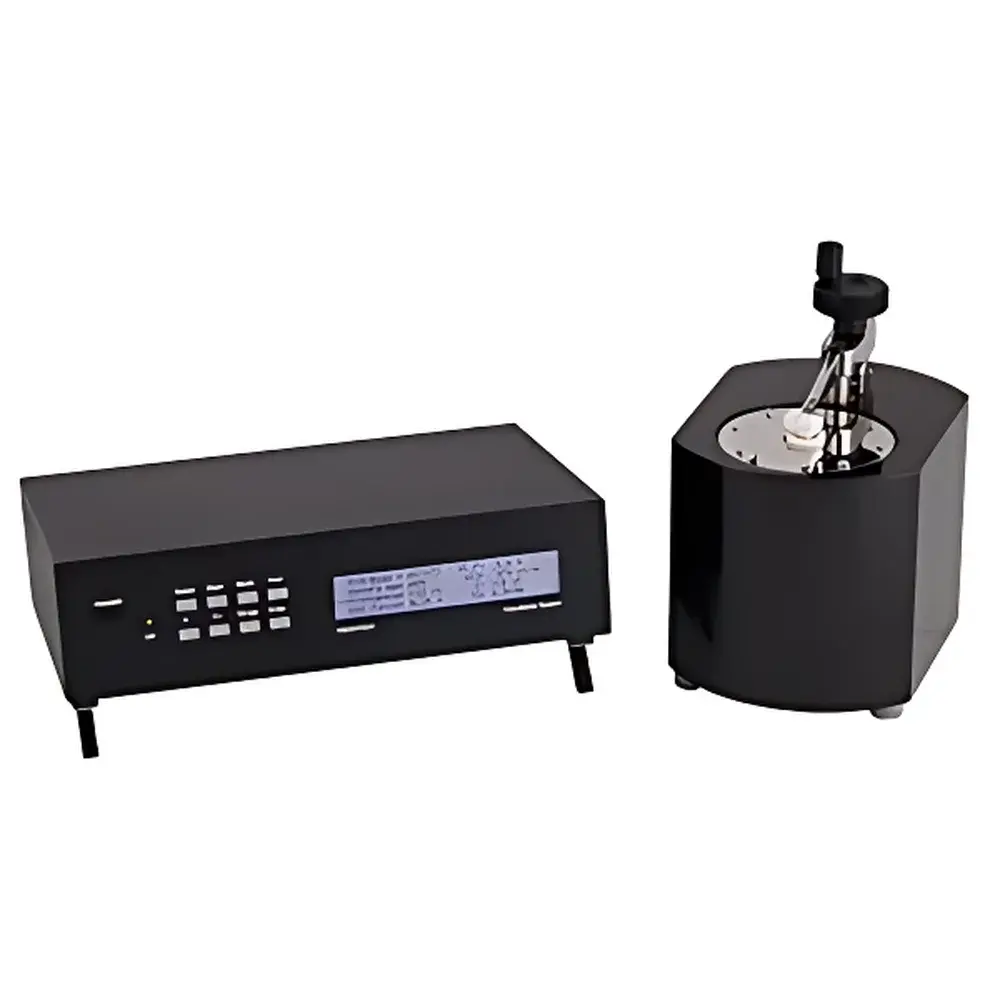
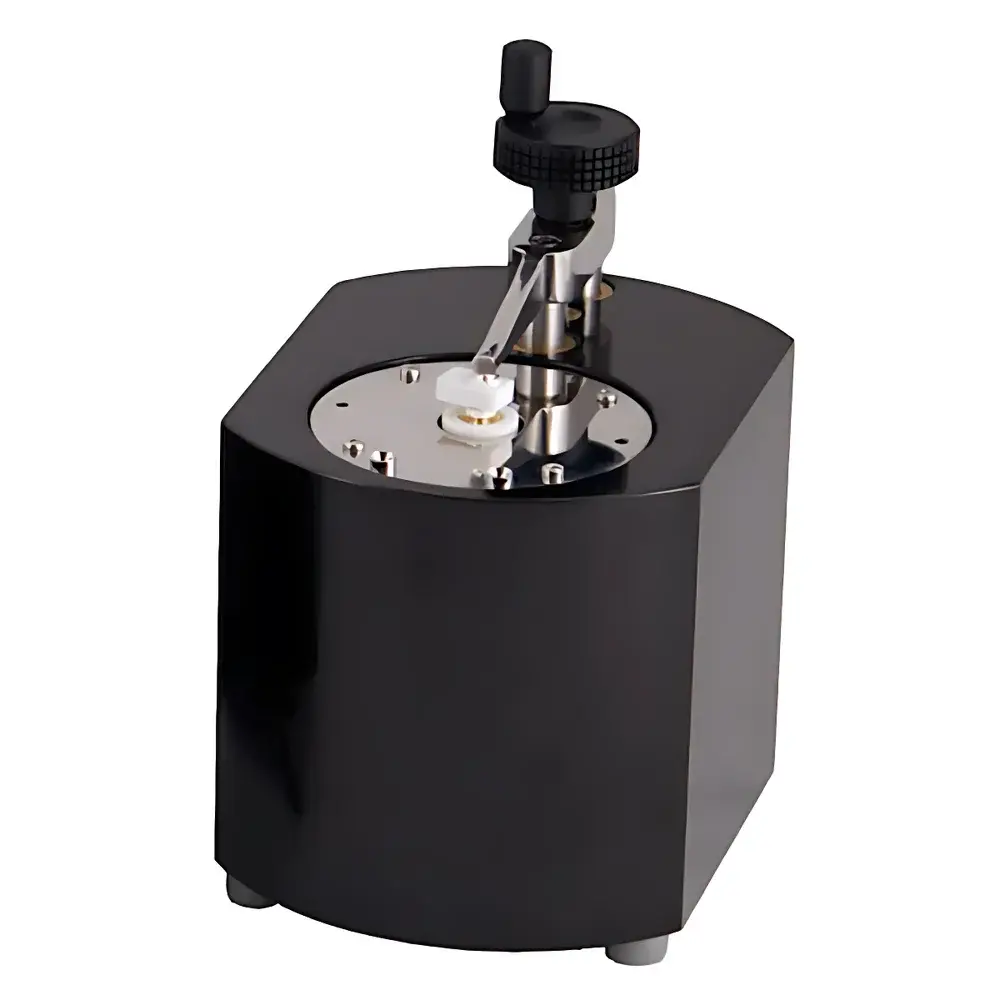
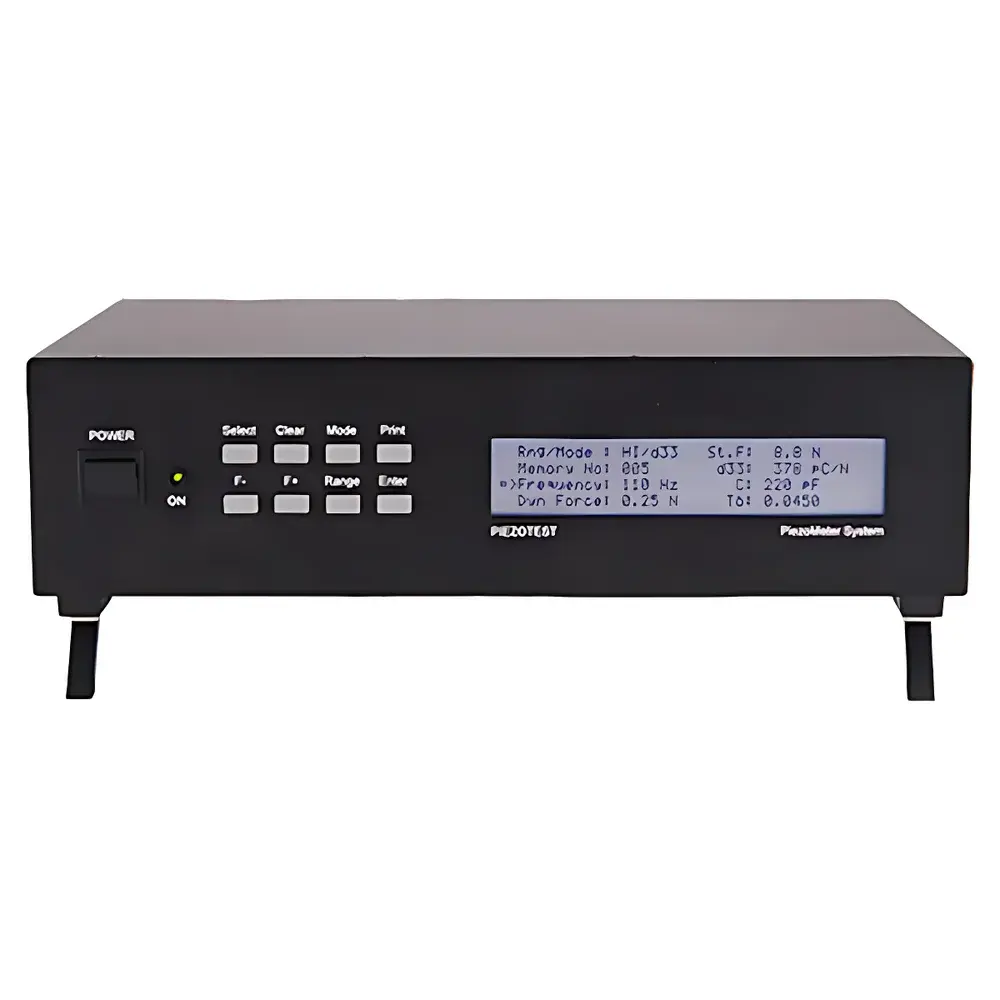
Piezotest PM200 Thin-Film d₃₃ Piezoelectric Coefficient Tester
| Brand | Piezotest |
|---|---|
| Origin | Singapore |
| Model | PM200 |
| Price Range | USD 30,000–50,000 |
| d₃₃ Measurement Range | 0–10,000 pC/N |
| Resolution | 0.01 pC/N (lowest range) |
| Test Frequencies | 30–300 Hz (1 Hz step, calibrated at 110 Hz) |
| Static Force Range | 0–10 N |
| Dynamic Force Range | 0.05–0.5 N |
| Capacitance Range | 10 pF–0.1 µF |
| Loss Tangent (tanδ) Range | 0.0000–0.2000 |
| Max Sample Diameter | 136 mm |
| Max Sample Thickness (Polarization Direction) | 50 mm |
| Max Sample Mass | 1 kg |
| Compliance | ASTM D790, IEC 62047-18, ISO 20482 (referenced for piezoelectric characterization) |
Overview
The Piezotest PM200 Thin-Film d₃₃ Piezoelectric Coefficient Tester is a precision metrology instrument engineered for quantitative evaluation of direct piezoelectric coefficients—primarily d₃₃—in thin-film and bulk piezoelectric materials. It operates on the quasi-static Berlincourt method (IEC 62047-18), applying controlled dynamic mechanical excitation to induce charge displacement, which is measured via low-noise charge amplification and synchronized lock-in detection. Unlike optical or resonance-based methods, the PM200 delivers traceable, contact-mode measurements under defined static preload and calibrated dynamic force—ensuring high reproducibility across heterogeneous material systems including sol-gel-derived PZT films, PVDF-based polymers, AlN-on-Si stacks, and single-crystal relaxor ferroelectrics. Its modular architecture supports standardized testing per ASTM D790 (dielectric and piezoelectric property correlation) and aligns with quality assurance frameworks required in medical transducer development, MEMS actuator qualification, and aerospace-grade sensor validation.
Key Features
- Multi-range d₃₃ measurement capability: four selectable sensitivity ranges (0–10, 1–100, 10–1000, 100–10,000 pC/N), each with optimized signal-to-noise ratio and resolution down to 0.01 pC/N in the lowest range
- Integrated polarization direction identification module—detects poling axis orientation prior to d₃₃ acquisition to prevent sign inversion errors in anisotropic films
- Digitally tunable test frequency from 30 Hz to 300 Hz (1 Hz resolution); factory-calibrated reference frequency at 110 Hz ensures compliance with IEC 62047-18 harmonized test conditions
- Independent dual-force control system: static force (0–10 N, ±0.2% FS) applied via precision micrometer-driven loading column; dynamic force (0.05–0.5 N, adjustable amplitude & phase) generated by electromagnetic shaker with closed-loop feedback
- Simultaneous multi-parameter acquisition: real-time concurrent measurement of d₃₃, d₃₁, d₁₅ (with optional adapters), capacitance (10 pF–0.1 µF, ±0.5% reading), and dielectric loss tangent (tanδ = 0.0000–0.2000, ±0.0002)
- Dedicated embedded controller with 7-inch capacitive touchscreen interface—enables standalone operation without PC connection; all test parameters, raw waveforms, and calculated outputs (g₃₃, g₃₁, ε₃₃T, etc.) displayed in real time
- Onboard software calibration suite compliant with ISO/IEC 17025 traceability requirements—supports user-performed verification using NIST-traceable charge standards and certified reference materials
Sample Compatibility & Compliance
The PM200 accommodates planar piezoelectric specimens up to 136 mm in diameter and 50 mm in thickness along the polarization axis, with maximum mass tolerance of 1 kg. It is validated for use with ceramic monoliths (e.g., PZT-5H, BaTiO₃), sputtered or ALD-deposited thin films (e.g., AlN, ZnO, ScAlN), polymer films (PVDF, PVDF-TrFE), composites (PZT-polymer), and single crystals (LiNbO₃, quartz). All mechanical and electrical interfaces conform to IEC 61000-4 immunity standards. Data integrity meets FDA 21 CFR Part 11 requirements when operated with optional audit-trail-enabled software modules. Test reports include full metadata (temperature, humidity, operator ID, calibration certificate ID, timestamp) and are exportable in CSV, XML, and PDF/A-1b formats suitable for GLP/GMP-regulated environments.
Software & Data Management
The PM200’s native software—PiezoLab v4.2—runs on Windows 10/11 (64-bit) and provides full instrument control, automated sequence scripting, statistical process monitoring (SPC), and batch reporting. Raw charge vs. force waveforms are stored with 16-bit resolution at ≥10 kS/s sampling rate. Derived parameters—including g₃₃ (= d₃₃/ε₀εᵣ), electromechanical coupling coefficients (k₃₃), and temperature-dependent d₃₃ drift profiles—are computed using built-in physical models aligned with IEEE Std 176-1987. Audit trails record every parameter change, calibration event, and user login. Exported datasets embed digital signatures and SHA-256 hash values for long-term archival integrity per ISO 15489-1.
Applications
- Qualification of piezoelectric thin films for ultrasound transducers (medical imaging, intravascular catheters)
- Process development feedback for reactive sputtering, sol-gel spin-coating, and MOCVD deposition lines
- Reliability assessment of piezoelectric MEMS devices under thermal cycling and mechanical fatigue protocols
- Fundamental research on domain engineering in relaxor-PT single crystals and ferroelectric superlattices
- Regulatory submission support for Class II/III ultrasound devices requiring ISO 13485-compliant material characterization data
- Inter-laboratory round-robin studies coordinated under IEEE UFFC Society working groups
FAQ
What standards does the PM200 comply with for d₃₃ measurement?
The PM200 implements the quasi-static Berlincourt method per IEC 62047-18 and supports correlation testing per ASTM D790 and ISO 20482 for piezoelectric ceramics and thin films.
Can the PM200 measure d₃₃ on curved or non-planar substrates?
No—it requires flat, parallel surfaces normal to the poling direction. Curved samples must be sectioned or mounted on planar carriers with verified mechanical decoupling.
Is NIST-traceable calibration included with purchase?
Yes—a full calibration certificate with uncertainty budget (k=2) covering d₃₃, capacitance, and force sensors is supplied at shipment; annual recalibration services are available through Piezotest’s Singapore service center.
Does the system support automated temperature-controlled testing?
Not natively—but the PM200’s analog I/O port allows integration with third-party environmental chambers (e.g., Linkham LTS420) via programmable logic controllers for isothermal d₃₃ profiling.
How is data security handled during GLP audits?
With optional Secure Mode enabled, all user actions generate immutable audit logs; electronic signatures comply with 21 CFR Part 11 Subpart B requirements, and data exports include cryptographic hashes for tamper detection.



