
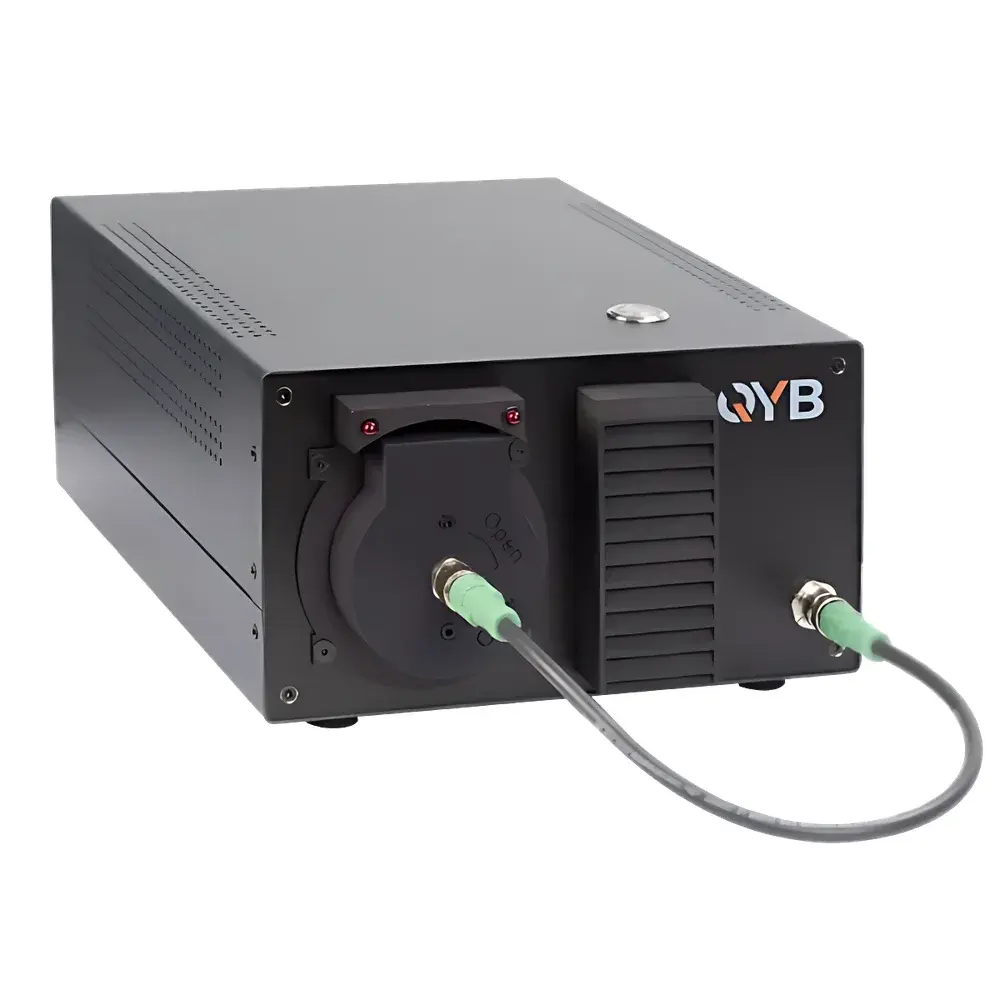
QYB LuQY Pro Absolute PLQY/ELQY Quantum Yield & Quasi-Fermi Level Splitting Measurement System
| Brand | QYB / Quantum Yield Berlin |
|---|---|
| Origin | Germany |
| Manufacturer Type | Authorized Distributor |
| Origin Category | Imported |
| Model | LuQY Pro |
| Measurement Mode | DC |
| Photon Excitation Wavelength | 532 nm |
| Max Laser Power | 140 mW |
| Tunable Excitation Intensity | 4 µA – 40 mA (equivalent to 0.001–10 “suns”) |
| Excitation Spot Size Options | 0.1 cm² / 1 cm² |
| Spectral Range | 550–1050 nm |
| Minimum Detectable Quantum Yield | 1×10⁻⁶ |
| Integration Time | 1 ms – 35 min |
| Spectral Sampling Interval | 1 nm |
| SNR | 600:1 |
| Voltage Source Range | ±10 V |
| Current Source/Measurement Range | ±150 mA |
| Voltage Accuracy | ±10 mV |
| Voltage Sensing Accuracy | ±50 µV |
| Current Sensing Accuracy | ±100 nA / ±1 µA / ±10 µA |
| Sample Holder Max Dimensions | 30 mm × 30 mm × 10 mm |
| Max Subcell Count | 6 |
| Dimensions | 220 mm × 390 mm × 120 mm |
| Weight | 6.1 kg |
Overview
The QYB LuQY Pro Absolute PLQY/ELQY Quantum Yield & Quasi-Fermi Level Splitting Measurement System is a benchtop, glovebox-compatible instrument engineered for quantitative optoelectronic characterization of emerging photovoltaic and light-emitting devices—primarily perovskite solar cells, perovskite/silicon tandems, organic photovoltaics (OPV), and LEDs. It implements a rigorously calibrated, absolute photon-counting methodology based on integrating sphere spectroscopy coupled with synchronized electroluminescence (EL) and photoluminescence (PL) excitation under controlled DC bias or monochromatic laser illumination (532 nm). The system directly determines absolute external quantum yields (EQEEL and EQEPL) without reliance on reference standards during measurement, enabling traceable quantification of radiative recombination efficiency. Critically, it computes the quasi-Fermi level splitting (QFLS)—a thermodynamic proxy for the maximum achievable open-circuit voltage (Voc)—via two complementary algorithms: one requiring only emission spectra (suitable for high-bandgap emitters with low Stokes shift), and another incorporating user-provided absorption or EQE data to refine QFLS accuracy for low-bandgap or spectrally broad emitters. This dual-path approach ensures metrological robustness across diverse material systems.
Key Features
- Traceable absolute quantum yield measurement certified against Fraunhofer ISE CalLab PV Cells (photon flux calibration) and NIST-traceable broadband lamps (spectral responsivity calibration)
- Integrated DC current–voltage source and high-precision electrometer (±50 µV voltage sensing, ±100 nA current sensing) for simultaneous electrical stimulation and spectral acquisition
- Automated, software-controlled excitation intensity sweep from 0.001 to 10 “suns” (equivalent photon flux), with real-time feedback on sample temperature stability
- Dual-spot-size optical excitation (0.1 cm² and 1 cm²) enabling normalization to device active area and cross-comparison with standard test conditions (STC)
- High-sensitivity back-thinned CCD spectrometer (550–1050 nm, 1 nm sampling, SNR > 600:1) with integration time adjustable from 1 ms to 35 minutes
- Compact footprint (220 × 390 × 120 mm) and inert-gas compatible design for in-situ operation inside nitrogen- or argon-filled gloveboxes
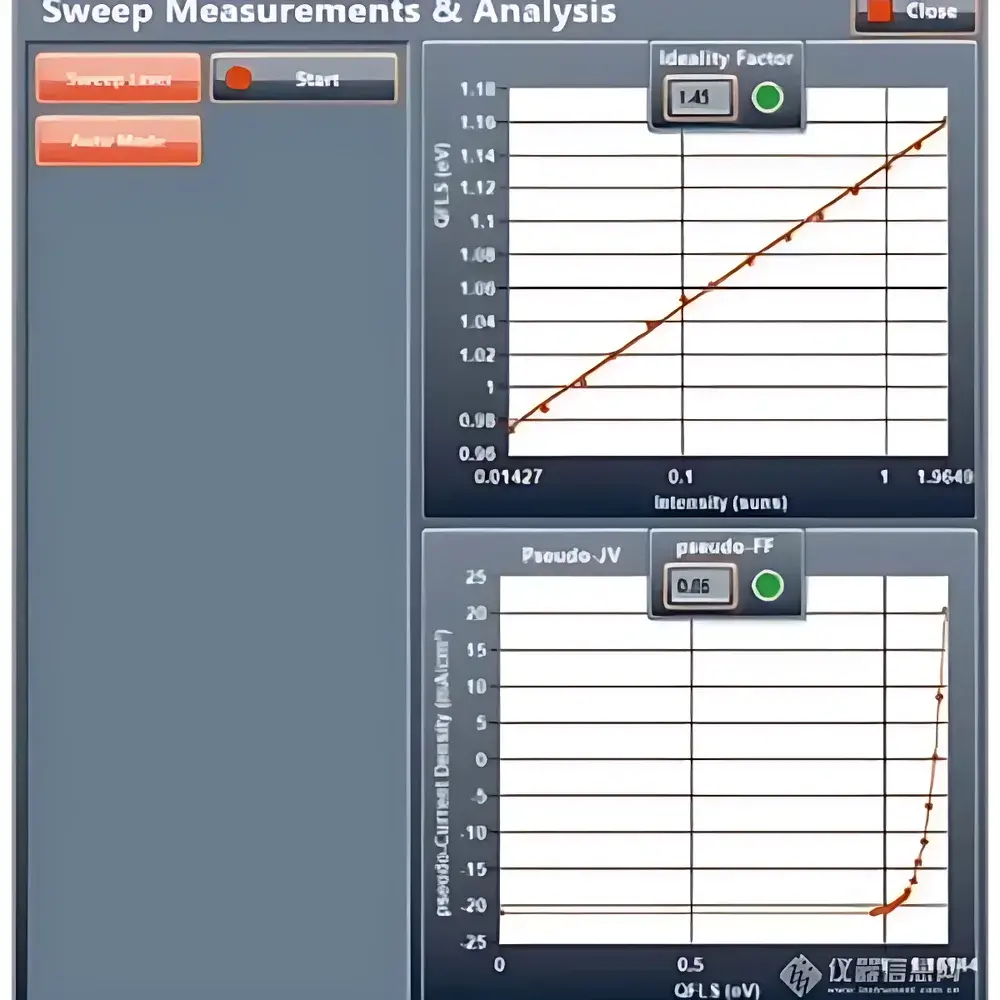
- Direct computation of iVoc, ideality factor (n), pseudo-J–V curves, and QFLS from raw spectral and electrical datasets—no post-processing required
Sample Compatibility & Compliance
The LuQY Pro accommodates rigid and flexible thin-film devices up to 30 mm × 30 mm × 10 mm, including encapsulated and unencapsulated perovskite subcells, tandem stacks, OLED pixels, and solution-processed LEDs. Its modular sample holder supports rapid exchange and custom fixture integration. All optical and electrical calibrations adhere to ISO/IEC 17025 principles, with documentation supporting GLP and GMP-aligned lab workflows. While not a regulatory compliance tool per se, its traceable measurements satisfy technical requirements for ASTM E2848 (standard test method for reporting photovoltaic nonconcentrator solar cell efficiency), IEC 60904-8 (spectral mismatch correction), and USP –related photonic validation protocols where radiative recombination metrics inform material stability assessment. Data provenance—including timestamped calibration logs, instrument configuration snapshots, and raw spectral files—is preserved in accordance with FDA 21 CFR Part 11 audit trail expectations when used in regulated R&D environments.
Software & Data Management
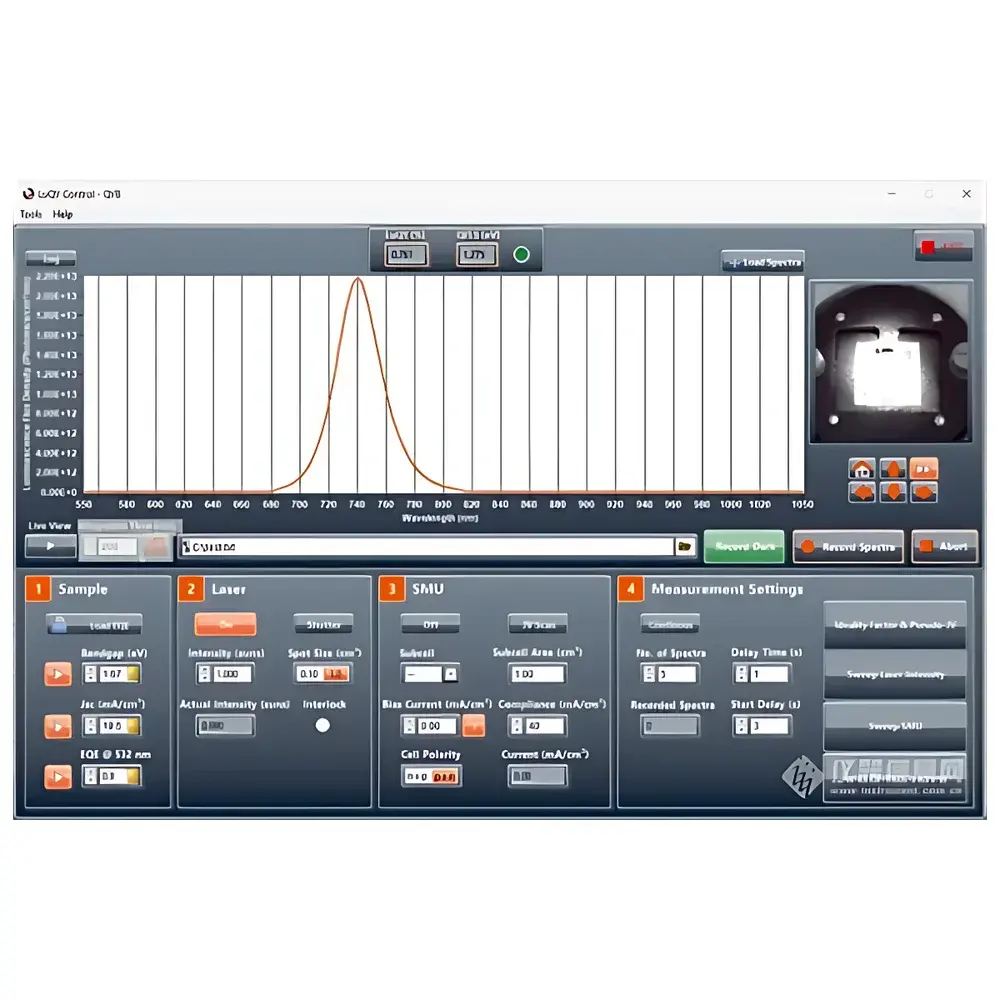
The LuQY Pro operates via SMUl (Spectro-Metrology Unified) software—a Windows-based platform designed for reproducible, parameterized experiments. The interface features a split-screen layout: the upper pane displays real-time emission spectra, live camera feed of the sample region, and dynamically updated values for EQEPL/EQEEL, QFLS, and iVoc; the lower pane manages sample metadata, excitation parameters (laser power, bias voltage/current), and analysis settings. SMUl embeds two QFLS calculation engines—“Direct QFLS” (emission-only, optimized for wide-bandgap materials) and “Refined QFLS” (absorption-augmented, requiring user-input EQE or absorption spectra)—and automatically selects the higher-confidence method based on spectral shape and available inputs. All datasets are saved in HDF5 format with embedded metadata (wavelength arrays, integration times, calibration coefficients), ensuring FAIR (Findable, Accessible, Interoperable, Reusable) data handling. Export options include CSV, MATLAB .mat, and industry-standard JPK/SPM formats for third-party analysis.
Applications
- Quantifying non-radiative voltage losses in perovskite single-junction and tandem solar cells via QFLS–Voc gap analysis
- Evaluating passivation efficacy by correlating PLQY enhancement with QFLS increase under varied surface treatments
- Screening charge transport layers (HTL/ETL) through comparative ELQY under fixed injection conditions
- Assessing operational stability by tracking time-resolved PLQY decay under continuous 1-sun-equivalent illumination
- Validating EQE-derived optical bandgaps against QFLS-derived effective bandgaps in low-dimensional perovskites
- Characterizing radiative efficiency limits in near-infrared emitting perovskites for tandem bottom cells
FAQ
Does the LuQY Pro require external reference standards for each measurement?
No. Absolute photon flux calibration is performed once using certified reference solar cells (Fraunhofer ISE) and NIST-traceable lamps; subsequent measurements are fully self-referencing.
Can the system measure devices under inert atmosphere without breaking vacuum?
Yes. Its compact dimensions and sealed optical path allow direct integration into standard gloveboxes (O2/H2O < 0.1 ppm) without modification.
What is the minimum detectable PLQY, and under what conditions is it achieved?
The system achieves 1×10⁻⁶ PLQY detection limit at 532 nm excitation with 1 cm² spot size, 30 s integration time, and optimal signal averaging—verified per ISO 17025 uncertainty budgeting.
How does the software handle samples with strong parasitic absorption below the bandgap?
SMUl’s Refined QFLS algorithm accepts user-supplied absorption spectra to correct for sub-bandgap losses, thereby improving QFLS accuracy in mixed-phase or defect-rich films.
Is the LuQY Pro compatible with automated wafer-level mapping?
While not a motorized stage system, its API supports external motion controller integration (e.g., Thorlabs Kinesis) for scripted XY scanning; custom fixtures for 6-subcell arrays enable batch characterization.
Related Products




