
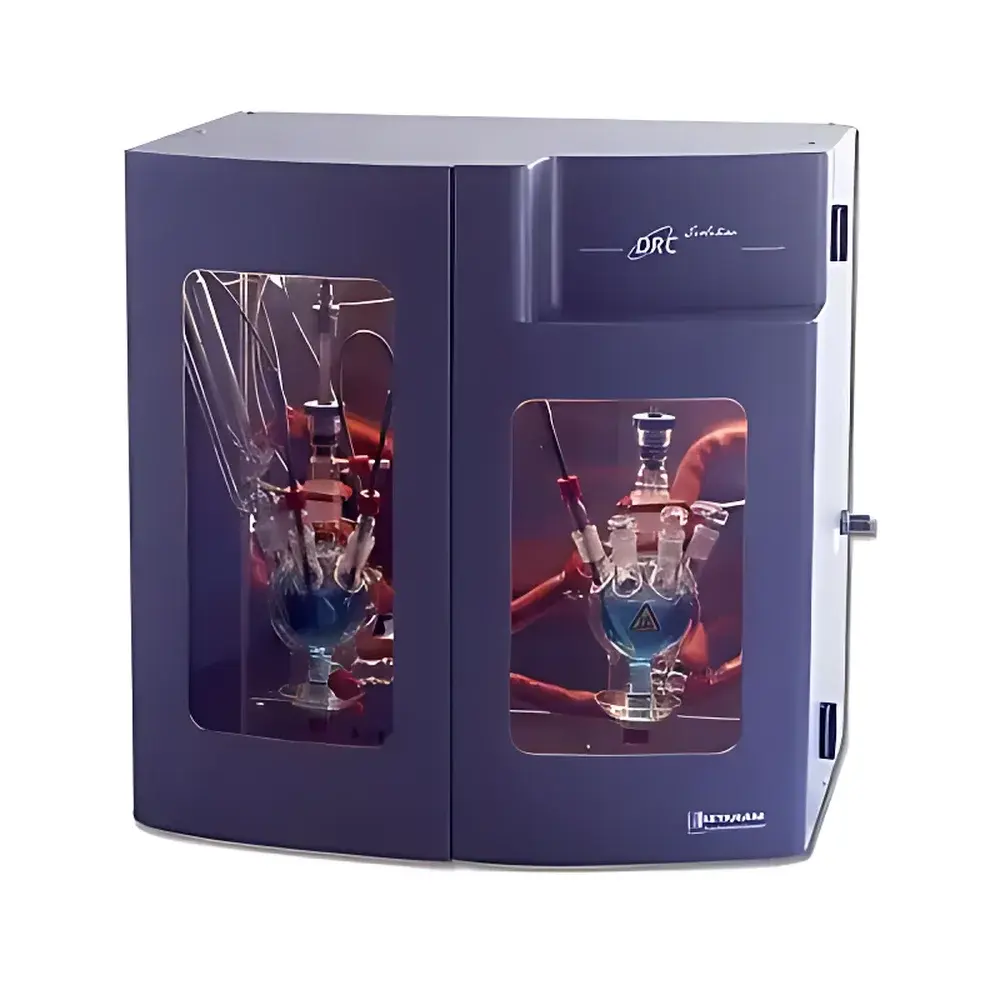
Setaram DRC Differential Reaction Calorimeter
| Brand | Setaram |
|---|---|
| Origin | France |
| Model | DRC |
| Type | Laboratory-scale differential reaction calorimeter with dual-jacketed vessels, isothermal operation mode, and real-time ΔT monitoring via platinum resistance thermometers |
| Measurement Principle | Differential temperature-based heat flow quantification using Joule-effect calibration |
| Key Outputs | Reaction enthalpy (ΔHᵣₓₙ), mixing enthalpy (ΔHₘᵢₓ), adiabatic temperature rise (ΔTₐd), time-to-maximum-rate (tₘₐₓ), heat capacity (Cₚ), kinetic profiling |
| Compliance | Designed for GLP-compliant thermal safety assessment per ISO 11358, ASTM E698, and ICH Q1A(R2) guidelines |
| Software | CALISTO™ v5.0 with 21 CFR Part 11–compliant audit trail, raw data export (CSV, ASCII), and customizable reporting templates |
| Sample Compatibility | Liquid–liquid, liquid–gas, and heterogeneous slurries (max. working volume: 500 mL per vessel) |
| Temperature Control | Dual-circulating bath integration (±0.02 °C stability) |
| Sensor Resolution | ±0.001 °C ΔT detection limit |
Overview
The Setaram DRC Differential Reaction Calorimeter is a precision-engineered laboratory instrument designed for quantitative thermal characterization of exothermic and endothermic chemical processes under controlled isothermal conditions. Operating on the principle of differential temperature measurement between an active reaction vessel and a reference vessel—both equipped with double-jacketed walls and independently regulated circulating fluid baths—the DRC enables direct, real-time acquisition of heat flow profiles as a function of time. This architecture implements a micro-differential calorimetric model, where the temperature difference (ΔT) across matched platinum resistance thermometers (Pt100) is continuously recorded and converted into heat release/absorption rates via Joule-effect calibration. Unlike adiabatic or heat-flow DSC systems, the DRC maintains near-isothermal boundary conditions while preserving high sensitivity to transient thermal events, making it especially suited for process safety evaluation, reaction kinetics modeling, and thermodynamic parameter extraction in early-stage chemical development.
Key Features
- Dual-vessel configuration with independent jacketed temperature control ensures robust baseline stability and minimizes thermal lag during rapid reactions.
- Real-time visual observation window allows direct monitoring of phase behavior, gas evolution, precipitation, and mixing homogeneity without compromising system integrity.
- High-resolution ΔT sensing (±0.001 °C) coupled with calibrated electrical power input enables traceable quantification of reaction enthalpies with <±3% uncertainty (per ISO 11358-2 validation protocols).
- Modular design supports integration with external dosing pumps, pH sensors, and FTIR probes for multi-parameter reaction surveillance.
- Thermal inertia compensation algorithms correct for vessel wall and medium heat capacity effects, yielding accurate Cp and cumulative enthalpy integrals.
- Compliant with mechanical and electrical safety standards EN 61010-1 and IEC 61326-1 for laboratory use in regulated environments.
Sample Compatibility & Compliance
The DRC accommodates a broad range of chemically aggressive and volatile systems—including corrosive acid/base mixtures, catalytic hydrogenations, nitration sequences, polymerization initiations, and gas-liquid absorption processes—within its 500 mL maximum working volume per vessel. Its inert wetted materials (316L stainless steel, PTFE-sealed joints, borosilicate glass viewport) ensure compatibility with organic solvents, halogenated media, and aqueous electrolytes. The system is routinely deployed in support of regulatory submissions requiring documented thermal hazard assessment, aligning with OSHA 29 CFR 1910.119 (Process Safety Management), EU REACH Annex VII thermal screening requirements, and FDA guidance on reactive chemical hazards in API manufacturing. All calibration records, raw thermogram files, and metadata are stored with immutable timestamps and user authentication logs per 21 CFR Part 11 Annex 11 expectations.
Software & Data Management
CALISTO™ v5.0 serves as the native acquisition and analysis platform for the DRC. It provides synchronized control of temperature setpoints, pump triggers, and data logging at up to 10 Hz sampling frequency. The software implements automated peak detection, baseline subtraction, and integral computation for ΔH, tmax, and dQ/dt maxima. Reporting modules generate PDF/Excel outputs compliant with internal QA review workflows and external auditor requests. Audit trail functionality captures every operator action—including parameter edits, file exports, and calibration events—with digital signature verification. Raw data reside in vendor-neutral ASCII format, enabling third-party kinetic modeling (e.g., Kinetics Neo, Thermokinetics) and long-term archival in LIMS environments.
Applications
- Thermal runaway screening for nitration, oxidation, and diazotization reactions in fine chemical synthesis.
- Scale-up support through determination of heat transfer coefficients (U·A) and accumulation ratios (σ) in semi-batch operations.
- Validation of computational thermodynamic models (e.g., COSMO-RS, UNIFAC) using experimentally derived mixing and reaction enthalpies.
- Reaction mechanism elucidation via Arrhenius parameter extraction from variable-temperature calorimetric runs.
- Quality-by-Design (QbD) implementation for pharmaceutical intermediates, including Design Space definition for critical process parameters (CPPs).
- Environmental fate studies involving hydrolysis or photolysis enthalpies in OECD 301/310 test frameworks.
FAQ
What distinguishes the DRC from conventional DSC instruments?
The DRC operates under isothermal conditions with active temperature control of both reaction and reference vessels, whereas standard DSC relies on programmed heating ramps and measures heat flow relative to a non-reactive baseline. This makes the DRC uniquely capable of capturing slow, low-power reactions over extended durations with superior signal-to-noise ratio.
Can the DRC be used for gas-evolving reactions?
Yes—the vessel headspace is rated to 10 bar(g) and includes dedicated ports for pressure transducers, gas chromatography sampling loops, and vent-line condensers, supporting safe evaluation of CO₂, H₂, Cl₂, or NOx generation kinetics.
Is remote operation supported?
CALISTO™ supports secure client-server deployment over local networks; however, cloud-based or internet-accessible control is disabled by default to maintain data sovereignty and cybersecurity compliance per ISO/IEC 27001.
How often does the system require recalibration?
Joule-effect calibration is performed before each experimental campaign using certified resistors; full thermal calibration against NIST-traceable standards is recommended annually or after major maintenance.
Does the DRC meet GMP documentation requirements?
Yes—CALISTO™ generates 21 CFR Part 11–compliant electronic records, including electronic signatures, change history, and version-controlled SOP-linked method files suitable for FDA and EMA inspections.



