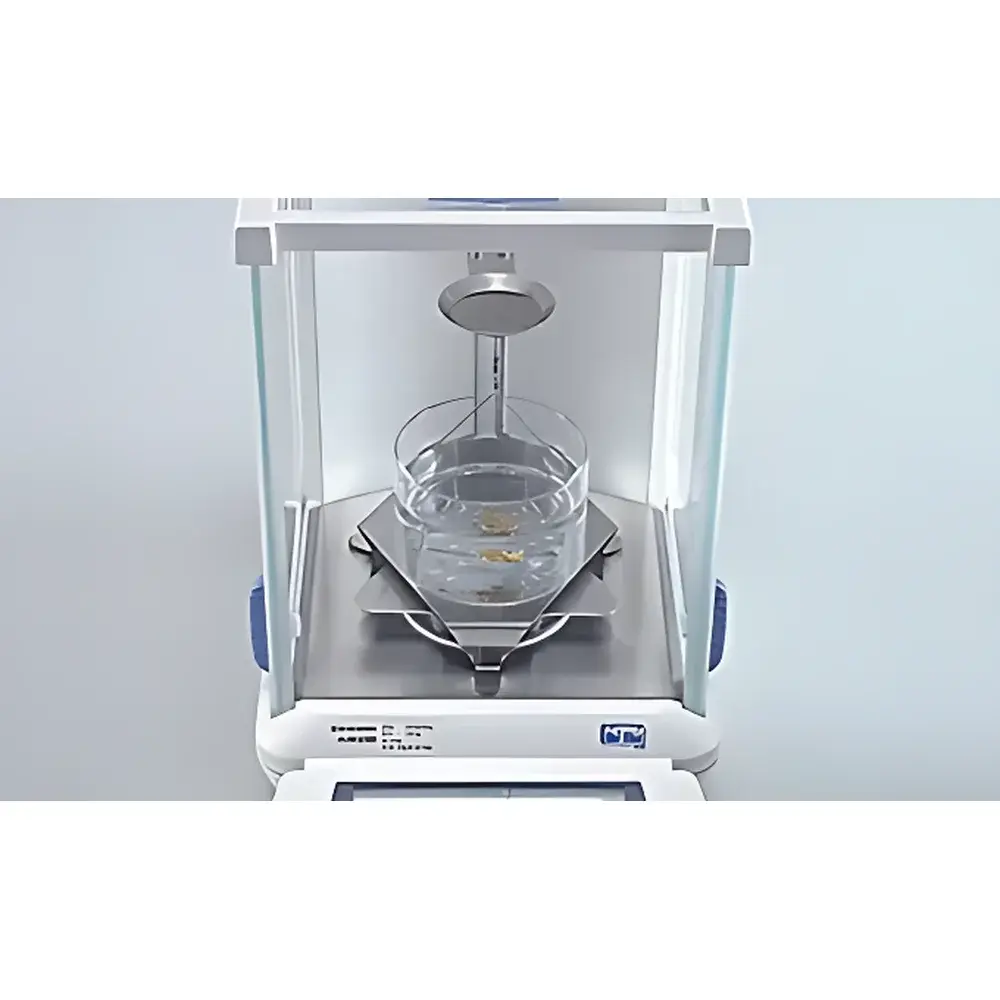
Shimadzu AU-SGM Density Balance
| Key | Brand: Shimadzu |
|---|---|
| Origin | Japan |
| Model | AU-SGM |
| Type | Analytical Density Balance |
| Maximum Capacity | 200 g |
| Readability | 0.1 mg (0.0001 g) |
| Density Resolution | 0.0001 g/cm³ |
| Repeatability | 0.0001 g/cm³ |
| Calibration | Manual or Automatic (Selectable) |
| Principle | Archimedean Buoyancy Method (Liquid Immersion) |
| Compliance | Designed for ISO/IEC 17025-compliant laboratories, compatible with GLP/GMP documentation workflows |
Overview
The Shimadzu AU-SGM Density Balance is a high-precision analytical instrument engineered for accurate, repeatable solid and liquid density determination based on the Archimedean buoyancy principle. Unlike conventional mass-only balances, the AU-SGM integrates a dedicated density measurement module with a precision analytical balance core—featuring Shimadzu’s proprietary Uni Bloc monolithic sensor architecture. This single-crystal load cell design eliminates mechanical hysteresis and thermal drift, delivering long-term stability and metrological integrity essential for regulated environments. The system performs fully automated density calculations by sequentially measuring sample mass in air and submerged mass in a calibration fluid (typically distilled water or ethanol), then applying standardized buoyancy correction formulas per ASTM D792, ISO 1183-1, and USP <642>. Its compact, integrated design houses both balance and immersion assembly within a streamlined draft shield—minimizing footprint without compromising environmental isolation.
Key Features
- Uni Bloc monolithic load cell technology ensures exceptional linearity, creep resistance, and temperature stability across ambient fluctuations (15–30 °C).
- Dual-mode operation: supports both solid-density measurement (via sinker immersion) and liquid-density measurement (using optional pendant sinker accessory).
- Intuitive guided workflow: built-in display prompts users through each step—tare, air weighing, immersion, and auto-calculation—reducing operator dependency and procedural error.
- Selectable calibration protocol: internal automatic calibration (with motorized weight deployment) or external manual calibration using certified mass standards traceable to NIST or JCSS.
- High-resolution readout: 0.1 mg readability (0.0001 g) at full 200 g capacity, enabling precise mass differentials critical for sub-0.0001 g/cm³ density resolution.
- Integrated draft shield with optimized airflow management minimizes convective disturbances during immersion steps—critical for low-buoyancy-force measurements.
Sample Compatibility & Compliance
The AU-SGM accommodates solid specimens ranging from 0.1 g to 200 g, including powders, granules, molded plastics, ceramics, metals, and porous materials (with surface-sealing protocols). For liquids, the optional sinker kit enables direct measurement of samples with viscosities up to 500 mPa·s. All density computations adhere to internationally recognized standards: ASTM D792 (plastics), ISO 1183-1 (general solids), ISO 1675 (liquids), and pharmacopeial methods (USP <642>, EP 2.2.5). The balance supports audit-ready operation under GLP and GMP frameworks—data output includes timestamped measurement records, operator ID fields, and calibration event logs. While not inherently 21 CFR Part 11 compliant, its RS-232/USB interface enables secure data export to validated LIMS or ELN systems with electronic signature integration.
Software & Data Management
The AU-SGM operates autonomously via its front-panel interface but also supports bidirectional communication with Shimadzu’s optional LabSolutions DA software (Windows-based). This platform enables method storage, batch reporting, statistical analysis (mean, SD, RSD), and PDF/CSV export compliant with ISO/IEC 17025 record retention requirements. All raw mass values (air and immersed), calculated density, temperature input (manual or via optional Pt100 probe), and calibration metadata are logged with immutable timestamps. Audit trails capture user actions—including parameter changes, calibration executions, and result overrides—facilitating internal quality audits and regulatory inspections.
Applications
- Quality control of polymer blends and composites where density correlates directly with filler content and crystallinity.
- Pharmaceutical excipient verification per USP monographs requiring density tolerances (e.g., microcrystalline cellulose, lactose monohydrate).
- Metallurgical QC of sintered parts to detect porosity deviations impacting mechanical performance.
- Geological sample characterization (minerals, ores) in research labs requiring reproducible bulk density profiling.
- Food science applications—e.g., fat content estimation in dairy products via density deviation from reference standards.
- Educational use in materials science curricula for teaching fundamental principles of buoyancy, specific gravity, and metrological uncertainty.
FAQ
What density standards does the AU-SGM support?
It implements calculation algorithms aligned with ASTM D792, ISO 1183-1, ISO 1675, and USP <642>—allowing direct comparison against published reference values.
Can it measure the density of irregularly shaped objects?
Yes—its immersion method eliminates geometric dependency; only sample mass and displaced fluid volume matter.
Is temperature compensation built-in?
The unit accepts manual temperature input for fluid density correction; optional Pt100 sensor integration enables real-time thermal compensation.
Does it require external PC software for routine operation?
No—full functionality is available standalone; software is optional for advanced reporting and data archival.
How often should calibration be performed?
Per ISO/IEC 17025, calibration frequency depends on usage intensity and risk assessment—but daily zero check and weekly calibration with traceable weights are recommended for QC labs.