
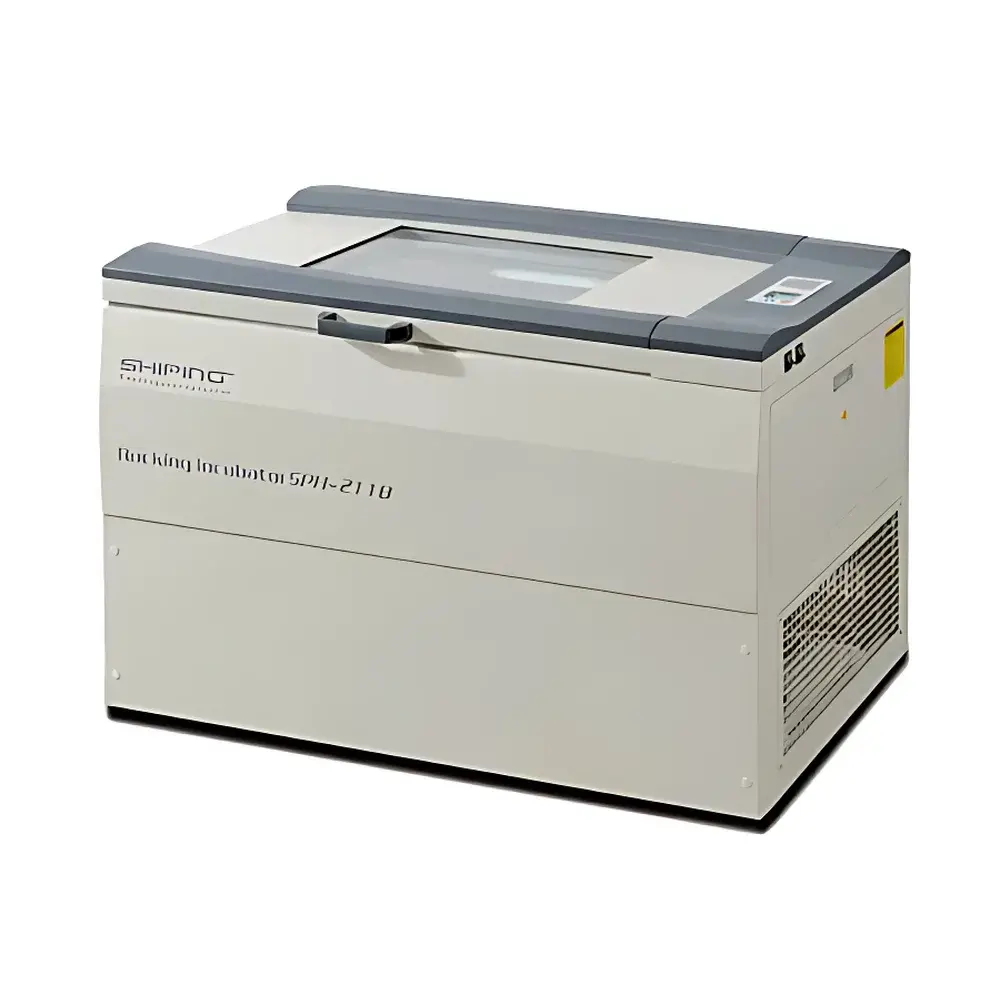
ShiPing SPH-211B Horizontal Constant-Temperature Orbital Shaker
| Brand | ShiPing |
|---|---|
| Origin | Shanghai, China |
| Model | SPH-211B |
| Timer Range | 0–500 h |
| Oscillation Speed | 50–300 rpm |
| Orbit Diameter | 25 mm |
| Temperature Range | Ambient +5°C to 60°C |
| Shelf Quantity | 1 |
| Chamber Dimensions (W×D×H) | 970 × 550 × 350 mm |
| Tray Dimensions | 920 × 500 mm |
| Max Load Capacity | 2000 mL × 10 or 500 mL × 28 |
| Power Consumption | 1120 W |
| Motor | 120 W AC induction motor, brushless, variable-frequency |
| Cooling System | CFC-free R134a refrigerant |
| Control System | PID microprocessor with LCD dual-display (setpoint & real-time) |
| Safety Features | Over-temperature/over-speed audio-visual alarm, independent thermal cutoff, door-open stop, leakage current protection, auto-restart after power recovery |
| Compliance | Designed for GLP-compliant lab environments |
Overview
The ShiPing SPH-211B Horizontal Constant-Temperature Orbital Shaker is an engineered platform for precise, reproducible incubation and mixing of biological and biochemical samples under controlled thermal and mechanical conditions. It operates on the principle of orbital shaking—generating uniform circular motion at a defined amplitude and frequency—to ensure homogeneous suspension of cells, microbes, or particulates without shear-induced damage. Integrated P.I.D. temperature control, forced-air convection, and a high-stability single-axis drive mechanism enable tight regulation across the full operating range (ambient +5°C to 60°C), making it suitable for applications requiring both physiological warmth and stable agitation—such as mammalian cell culture, microbial growth kinetics, and immunoassay plate preparation. Its horizontal orientation minimizes vertical displacement, reducing splashing and foam formation in large-volume vessels while maximizing workspace compatibility in standard biosafety cabinets and cold rooms.
Key Features
- Single-axis balanced drive system (Chinese patent No. ZL2018XXXXXXX)—ensures low-vibration operation, extended motor service life (>20,000 h), and noise reduction to ≤52 dB(A) at 1 m distance.
- Large-capacity stainless-steel chamber (970 × 550 × 350 mm) with electrostatically coated steel frame and tempered glass observation window with integrated LED illumination for real-time visual monitoring.
- Dual-parameter LCD display showing simultaneous setpoints and real-time values for temperature, speed, and elapsed time—with adjustable backlight intensity and contrast.
- CFC-free R134a refrigeration system (200 W cooling capacity) combined with 800 W heating element enables rapid thermal stabilization and ±0.1°C temperature accuracy with ±0.5°C uniformity across the chamber.
- Programmable timer (0–500 h) with memory retention and automatic restart function following power interruption—critical for unattended overnight or multi-day experiments.
- Comprehensive safety architecture: independent over-temperature cut-off, motor overheat protection, door-interlocked shutdown, earth-leakage circuit breaker (30 mA), and fail-safe power isolation upon fault detection.
Sample Compatibility & Compliance
The SPH-211B accommodates standard laboratory vessels including Erlenmeyer flasks (up to 2 L × 10 or 5 L × 4 with optional elevated tray), culture bottles, deep-well plates, and hybridization tubes. Its 25 mm orbit diameter and 50–300 rpm speed range support protocols compliant with ASTM D5295 (microbial suspension homogeneity), ISO 8573-1 (compressed air contamination testing sample agitation), and USP / (microbial enumeration method validation). The unit’s construction adheres to IEC 61010-1:2010 for electrical safety in laboratory instruments and incorporates materials certified per RoHS Directive 2011/65/EU. All firmware and hardware design elements align with GLP documentation requirements—including audit-trail-capable parameter logging (via optional RS485/USB interface) and traceable calibration points for temperature and speed verification.
Software & Data Management
While the base model operates via embedded microcontroller with non-volatile parameter memory, optional communication modules support integration into centralized lab management systems. The RS485 interface enables connection to SCADA platforms or custom LabVIEW-based data acquisition scripts for time-synchronized logging of temperature, RPM, and runtime. Firmware supports user-defined calibration offsets for temperature and speed sensors—facilitating periodic metrological verification against NIST-traceable references. All operational events (e.g., alarm triggers, door openings, power cycles) are timestamped and stored in internal EEPROM for up to 30 days—satisfying FDA 21 CFR Part 11 requirements when paired with validated third-party software for electronic signature and audit trail generation.
Applications
- Mammalian and insect cell culture in serum-containing or serum-free media, particularly where low-shear suspension is required for bioreactor seed train development.
- Microbial growth curve analysis (E. coli, yeast, Bacillus spp.) under controlled thermal gradients for metabolic profiling and antibiotic susceptibility testing.
- Solid-phase extraction (SPE) and liquid–liquid extraction (LLE) workflows involving solvent-based phase separation and analyte partitioning.
- Western blot membrane blocking, antibody incubation, and wash steps—leveraging uniform motion to reduce background and improve signal-to-noise ratio.
- Diagnostic assay development, including ELISA plate agitation, nucleic acid hybridization, and antigen–antibody binding kinetics studies.
- Environmental microbiology: soil slurry resuspension, waterborne pathogen enrichment, and biofilm dispersion assays.
FAQ
What is the maximum flask size supported on the SPH-211B standard tray?
The standard tray (920 × 500 mm) accommodates up to ten 2 L Erlenmeyer flasks or twenty-eight 500 mL flasks. For larger volumes, the SPH-211C variant features an extended-height chamber compatible with 5 L vessels.
Does the shaker support remote monitoring or network connectivity?
Yes—optional RS485 or USB-to-serial adapters enable integration with lab information management systems (LIMS) or custom Python/Node-RED scripts for real-time telemetry and event-triggered notifications.
Is the unit suitable for use in CO₂ incubator environments?
No—the SPH-211B is not rated for humidified or CO₂-enriched atmospheres. It is intended for ambient-air or dry incubation applications only. For CO₂-compatible shaking, consult the SPH-211B-CO₂ series with sealed chamber and gas-tight gasketing.
How is temperature uniformity verified during qualification?
Per IQ/OQ protocols, nine-point mapping using calibrated PT100 probes (±0.05°C accuracy) is recommended across the chamber volume at three representative setpoints (25°C, 37°C, 55°C); results must demonstrate ≤±0.5°C deviation per ISO/IEC 17025 guidelines.
Can the oscillation mode be switched between orbital and reciprocating?
No—the SPH-211B is configured exclusively for orbital motion. Reciprocating functionality is available only on the SPH-211F model, which uses a separate cam-driven actuation system.




