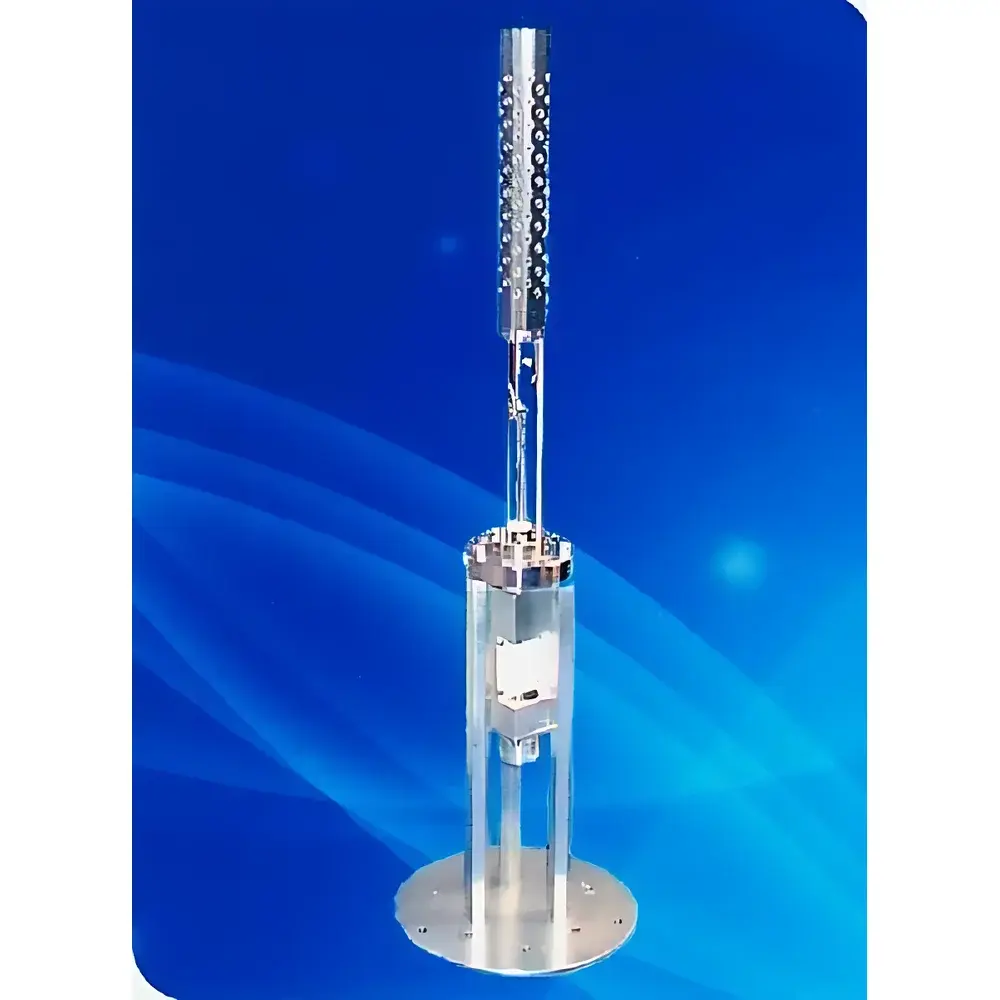
SVT Associates SVT-Excel Organic Material Evaporation Source for MBE Systems
| Brand | SVT Associates |
|---|---|
| Origin | USA |
| Model | SVT-Excel |
| Temperature Range | 0–600 °C |
| Power Rating | 600–1000 W |
| Temperature Stability | ±0.1 °C |
| Temperature Repeatability | ±0.1 °C |
| Thermocouple Type | K-type |
| Crucible Capacities | 16, 20, 22, 40, 60, and 150 cm³ (including conical-walled and PBN crucibles) |
| Standard Length | 12 in (304.8 mm) |
| Flange Options | 2.75 in or 4.5 in OD ConFlat (CF) |
| Filament | Amphenol annular heater |
| Thermocouple Connector | Omega subminiature |
Overview
The SVT Associates SVT-Excel Organic Material Evaporation Source is a precision-engineered thermal effusion cell designed specifically for molecular beam epitaxy (MBE) systems operating under high vacuum (HV) or ultra-high vacuum (UHV) conditions. It enables controlled, repeatable thermal evaporation of organic semiconductors—such as small-molecule emitters (e.g., Alq₃, TPD, NPB), host materials (e.g., CBP, mCP), and dopants—as well as inorganic compounds with exceptionally high vapor pressure at moderate temperatures (e.g., alkali halides, metal acetylacetonates). Unlike conventional resistive sources optimized for refractory metals, the SVT-Excel integrates a thermally isolated “hot lip” design to minimize thermal gradients across the effusion orifice, thereby enhancing flux stability and spatial uniformity during deposition. Its operational envelope spans 0–600 °C with ±0.1 °C stability and repeatability—critical for stoichiometric control in multilayer OLED, OPV, and perovskite precursor stacks. The source is fully compatible with standard UHV-compatible feedthroughs and integrates seamlessly into existing MBE chambers via ConFlat flanges.
Key Features
- Hot-lip geometry with integrated K-type thermocouple for real-time, localized temperature monitoring at the crucible throat—reducing axial thermal lag and improving dynamic response.
- Annular Amphenol filament heater ensures symmetrical radial heating and minimizes hot-spot formation, extending crucible lifetime and improving flux homogeneity.
- Selectable crucible volumes (16–150 cm³) including conical-walled variants for enhanced material utilization efficiency and improved angular flux distribution; PBN (pyrolytic boron nitride) crucibles available for high-purity, chemically inert containment of aggressive organics.
- Optional water-cooled outer shroud and motorized or manual integrated shutter for precise temporal control of deposition initiation/termination—essential for layer-by-layer growth and interface engineering.
- Standard 12-inch (304.8 mm) body length accommodates typical UHV chamber port spacing; flange options include 2.75-inch and 4.5-inch OD ConFlat for compatibility with major MBE platform vendors (e.g., Riber, Veeco, DCA Instruments).
- Robust mechanical architecture rated for continuous operation under ≤1×10⁻⁸ Torr base pressure; all internal wetted surfaces are electropolished stainless steel or PBN-lined to prevent outgassing and cross-contamination.
Sample Compatibility & Compliance
The SVT-Excel supports a broad spectrum of thermally labile and volatile precursors commonly employed in organic electronics fabrication, including but not limited to: tris(8-hydroxyquinolinato)aluminum (Alq₃), 4,4′-bis(N-carbazolyl)-1,1′-biphenyl (CBP), 2,2′,2″-(1,3,5-benzenetriyl)tris(1-phenyl-1-H-benzimidazole) (TPBi), and methylammonium lead iodide (MAPbI₃) precursors. Crucible material selection (e.g., PBN vs. graphite) is guided by chemical compatibility, thermal shock resistance, and required purity class—PBN being preferred for halogen-rich or reducing environments. The system conforms to standard UHV material compatibility protocols per ASTM F1494 and ISO 14644-1 Class 4 cleanroom assembly practices. All electrical feedthroughs meet IEC 61000-6-3 EMC requirements for laboratory instrumentation.
Software & Data Management
While the SVT-Excel operates as a standalone analog-controlled source, it is fully compatible with industry-standard MBE process controllers—including those from INFICON, MKS Instruments, and custom LabVIEW-based DAQ systems—via 0–10 V analog input for power setpoint and thermocouple output signal (mV). Optional digital interface modules support RS-485 Modbus RTU or Ethernet/IP communication for integration into centralized process logs. Temperature ramp profiles, dwell times, and interlock status (e.g., cooling water flow, overtemperature cutoff) can be archived with timestamped metadata compliant with GLP/GMP audit trails. When paired with mass spectrometry or quartz crystal microbalance (QCM) feedback, closed-loop flux regulation is achievable within ±2% relative standard deviation over multi-hour runs.
Applications
- Growth of high-efficiency OLED emissive layers, electron/hole transport layers, and interfacial dipole layers with sub-monolayer thickness control.
- Co-evaporation of donor–acceptor blends for bulk heterojunction organic photovoltaics (OPV), where independent flux tuning of two or more organics is required.
- Sequential deposition of perovskite precursor stacks (e.g., PbI₂ + MAI) under UHV to suppress ambient degradation and enable defect-engineered crystallization.
- Fabrication of organic spintronic devices requiring ultrathin (<5 nm), pinhole-free buffer layers (e.g., LiF, MgAg) with precise stoichiometry.
- Research-scale synthesis of novel organic–inorganic hybrid thin films where vapor-phase reactivity must be decoupled from substrate temperature effects.
FAQ
What vacuum level is required for optimal operation of the SVT-Excel source?
The source is rated for continuous use under base pressures ≤1×10⁻⁸ Torr; stable operation above 1×10⁻⁶ Torr is possible but may reduce crucible lifetime and increase background contamination risk.
Can the SVT-Excel be used for reactive evaporation (e.g., with oxygen or nitrogen co-feeding)?
Yes—when equipped with appropriate gas injection nozzles upstream of the effusion orifice and operated with inert carrier gas purging, the source supports reactive thermal evaporation of oxides and nitrides; however, direct exposure of hot filaments to oxidizing atmospheres is not recommended.
Is calibration traceable to NIST standards?
K-type thermocouples are supplied with individual calibration certificates traceable to NIST via accredited third-party labs; users may perform in-situ verification using fixed-point cells (e.g., zinc freeze point at 419.527 °C).
What maintenance intervals are recommended for long-term reliability?
Filament inspection and crucible cleaning are advised after every 50–100 hours of cumulative operation; water-cooling lines should be flushed quarterly with deionized water to prevent mineral buildup.
Does SVT Associates provide OEM integration support for custom MBE platforms?
Yes—engineering consultation, mechanical interface drawings (STEP/IGES), and electrical interface schematics are available under NDA for system integrators developing turnkey organic MBE solutions.