
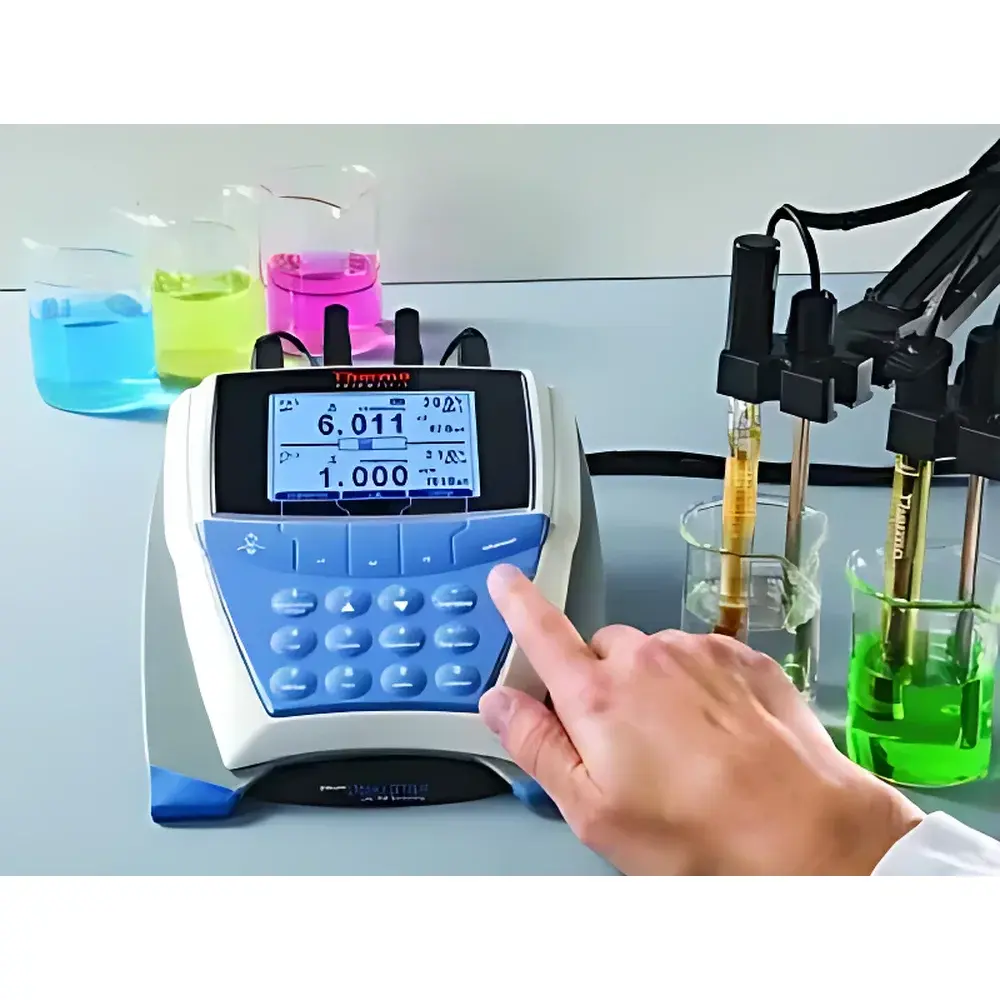
Thermo Fisher Orion Dual Star D10P-19 Potassium Ion Analyzer
| Brand | Thermo Fisher |
|---|---|
| Origin | USA |
| Manufacturer | Thermo Fisher Scientific |
| Product Type | Imported |
| Model | D10P-19 |
| Instrument Category | Multi-Ion Analyzer |
| Electrode | 9719BNWP Potassium Composite Electrode |
| Measurement Range (K⁺) | 0.04–39,000 ppm |
| pH Compatibility | 2.5–11 |
| Temperature Range | 0–40 °C |
| Repeatability | ±2% |
| Electrode Dimensions | 110 mm length × 13 mm body diameter × 16 mm cap diameter |
| Cable Length | 1 m |
| Main Unit Ion Range | 0–19,999 (units: ppm, mg/L, M, %, or unitless) |
| Ion Resolution | 1–3 significant digits |
| Ion Accuracy | ±0.1 mV or ±0.05% (whichever is greater) |
| pH Range | −2.000 to 19.999 |
| pH Resolution | 0.1 / 0.01 / 0.001 |
| pH Accuracy | ±0.001 |
| ORP Range | ±1999.9 mV |
| ORP Resolution | 0.1 mV |
| Temperature Range (instrument) | −5 to 105 °C |
| Temperature Accuracy | ±0.1 °C |
| Display | Dual-channel LCD |
| Interfaces | Dual BNC, dual reference electrode ports, dual MiniDIN (for ATC probes) |
| Method Storage | 20 methods |
| Data Storage | 1,000 entries with timestamp |
| GLP Compliance | Yes (audit trail, user passwords, method-level access control) |
| Connectivity | RS232 (bidirectional), optional USB cable |
| Enclosure Rating | IP54 |
| Certifications | CE, CSA, UL, TÜV, FCC Class A |
| Power | 4×AA batteries or universal AC adapter |
| Dimensions | 9.4 cm H × 17.0 cm W × 22.4 cm D |
Overview
The Thermo Fisher Orion Dual Star D10P-19 Potassium Ion Analyzer is a benchtop dual-channel electrochemical measurement system engineered for high-reproducibility quantification of potassium ion activity in aqueous environmental, industrial, and regulatory-compliant water quality applications. It operates on the principle of potentiometric detection using ion-selective electrodes (ISEs), where the 9719BNWP potassium composite electrode generates a Nernstian response proportional to the logarithm of free K⁺ activity in solution. Unlike optical or chromatographic techniques, this method delivers direct, real-time, non-destructive measurement without sample derivatization or reagent consumption—making it ideal for routine monitoring of surface water, wastewater effluents, drinking water sources, and agricultural runoff. The instrument’s dual-channel architecture enables simultaneous, independent measurement of potassium concentration and pH—or two distinct ionic species—thereby eliminating sequential analysis errors and reducing total assay time. Its design conforms to fundamental electrochemical metrology standards, ensuring traceable, repeatable results under field-deployable conditions.
Key Features
- Dual-channel architecture with independent BNC inputs, reference electrode ports, and ATC (Automatic Temperature Compensation) MiniDIN interfaces—supports concurrent K⁺ and pH measurement or parallel analysis of two different ISEs (e.g., K⁺ and NO₃⁻).
- Integrated 9719BNWP potassium-selective composite electrode featuring a solid-state polymeric membrane optimized for selectivity over Na⁺, NH₄⁺, and Ca²⁺ across pH 2.5–11; includes built-in reference system and low-drift junction design.
- Advanced calibration protocols: 2–6 point standardization with automatic buffer recognition (US, NIST, DIN), known-addition/subtraction, sample-addition/subtraction, and automated blank compensation.
- GLP-compliant data management: password-protected method storage (up to 20 customizable protocols), per-method access control, full audit trail with operator ID, date/time stamping, and electronic signature support.
- Graphical calibration curve display with residual error analysis and slope evaluation (mV/decade) to verify electrode performance prior to sample analysis.
- Robust physical design: IP54-rated enclosure for dust and splash resistance; CE, UL, CSA, TÜV, and FCC Class A certified; operable at 5–45 °C ambient with 5–85% RH (non-condensing).
- Flexible output: supports ppm, mg/L, mol/L, %, or unitless reporting; resolution configurable to 1–3 significant digits; accuracy specified as ±0.1 mV or ±0.05% (whichever dominates).
Sample Compatibility & Compliance
The D10P-19 is validated for use with natural and treated aqueous matrices—including freshwater, seawater dilutions, wastewater, soil leachates, and nutrient solutions—provided samples fall within the operational pH (2.5–11) and temperature (0–40 °C) limits of the 9719BNWP electrode. Low-concentration measurements (<1 ppm K⁺) require strict control of ionic strength via addition of 931911 ISA (Ionic Strength Adjuster) to minimize interference from H⁺ and OH⁻ activity. The system meets ASTM D6919-22 (Standard Test Method for Determination of Dissolved Alkali and Alkaline Earth Cations by Ion Chromatography) for comparative validation and supports method development aligned with EPA Methods 300.0 and 300.1 for ion-specific analysis. All firmware and data handling comply with FDA 21 CFR Part 11 requirements for electronic records and signatures when configured with password enforcement and audit logging enabled.
Software & Data Management
Data acquisition and reporting are managed through the instrument’s embedded firmware, supporting bidirectional RS232 communication for integration with LIMS or custom SCADA platforms. Up to 1,000 measurement records—including ion concentration, mV potential, temperature, electrode slope, calibration status, and operator ID—are stored with ISO 8601 timestamps. USB firmware updates ensure long-term compatibility with evolving regulatory software validation requirements. Exported CSV files include metadata headers compliant with ISO/IEC 17025 documentation standards. No proprietary desktop software is required; raw data export is protocol-transparent and interoperable with Python-based analytics pipelines or Microsoft Excel for statistical process control (SPC) charting.
Applications
- Regulatory compliance monitoring of potassium in municipal drinking water per WHO guideline values (20 mg/L as interim target).
- Industrial process control in fertilizer manufacturing, where K⁺ concentration directly correlates with product grade consistency.
- Environmental assessment of potassium leaching from agricultural soils into groundwater systems.
- Research-grade ion activity profiling in hydroponic nutrient solutions and plant physiology studies.
- Verification of ion exchange resin efficiency in water softening and demineralization units.
- Calibration verification of laboratory-grade ISEs against primary standard solutions traceable to NIST SRM 3199 (Potassium Chloride).
FAQ
What is the minimum detectable potassium concentration with the 9719BNWP electrode?
The lower limit of quantitation is 0.04 ppm K⁺ under optimal conditions (i.e., with ISA addition, stable temperature, and calibrated electrode). Below this level, H⁺/OH⁻ interference increases significantly.
Can the D10P-19 measure potassium in high-salinity samples such as seawater?
Yes—when diluted appropriately and compensated with ISA—but note that the 9719BNWP exhibits measurable cross-sensitivity to Na⁺ above 10,000 ppm; validation against spike recovery is recommended for salinities >35 g/kg.
Does the system support automatic temperature compensation during K⁺ measurement?
Yes—via the included 927007MD temperature probe connected to either MiniDIN port; ATC applies the Nernst equation correction in real time using the measured solution temperature.
How is GLP compliance implemented in daily operation?
Each measurement record logs operator ID, method name, calibration history, electrode serial number, and timestamp; password-protected method editing prevents unauthorized parameter changes; all actions are retained in non-volatile memory for audit review.
Is the 9719BNWP electrode compatible with other Orion meters?
Yes—it is fully compatible with all Orion Star series benchtop and portable meters equipped with BNC input and ISE measurement capability, including the A215, A329, and Versa Star platforms.
Related Products







