
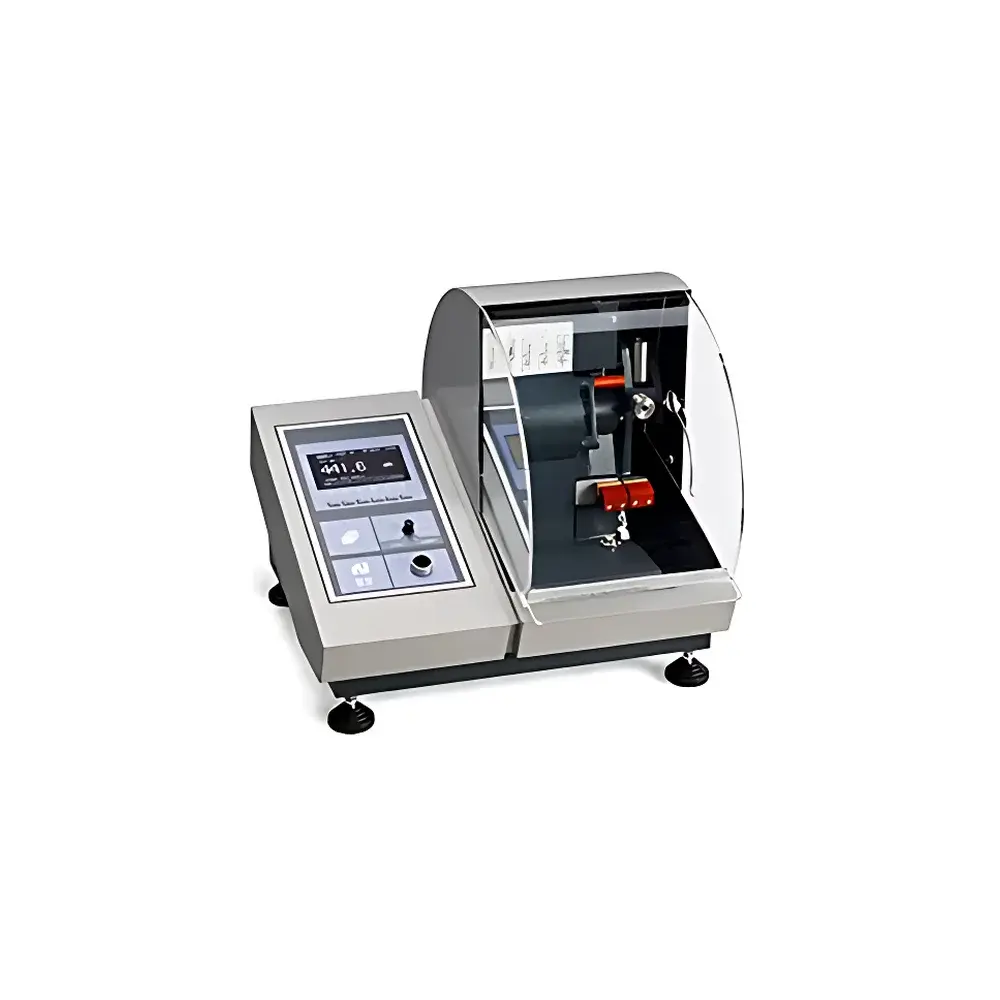
TMI Elmendorf Tear Tester Model 83-20 Automatic
| Brand | TMI |
|---|---|
| Origin | USA |
| Type | Automatic Elmendorf Tear Tester |
| Model | 83-20 |
| Pendulum Capacity | 0–6400 g |
| Pendulum Ranges | 400, 800, 1600, 3200, 6400 g |
| Accuracy | ±1.0% of full-scale pendulum capacity |
| Calibration Weights | 20%, 50%, and 90% of selected range |
| Measurement Range | 0–64 N |
| Measurement Principle | High-resolution digital encoder |
| Display | Digital force readout |
| Data Interface | RS-232 |
| Safety | Integrated transparent safety guard |
| Sample Notching | Automated notch cutter |
| Clamping | Pneumatic mechanical clamps |
| Language Support | English, German, French, Dutch, Italian, Spanish, Finnish |
| Statistical Output | Mean, Max, Min, Standard Deviation, Coefficient of Variation, Tear Index |
Overview
The TMI Elmendorf Tear Tester Model 83-20 is a precision-engineered, benchtop instrument designed to quantify the tearing resistance of planar materials using the classical Elmendorf principle—a pendulum-based method grounded in conservation of energy. As the pendulum swings through a pre-notched specimen, the energy loss due to tear propagation is measured and converted into tear force (in newtons), enabling standardized evaluation of intrinsic material toughness under controlled dynamic conditions. This method is widely accepted for quality control and R&D across paper, board, plastic films, nonwovens, and woven/nonwoven textiles where directional tear strength and consistency are critical performance indicators. The Model 83-20 implements fully automated sample notching and pneumatic clamping to eliminate manual variability, ensuring high reproducibility across operators and shifts—essential for laboratories operating under ISO/IEC 17025, GLP, or GMP frameworks.
Key Features
- Integrated automatic notch cutter ensures consistent 20 mm slit geometry per ASTM D1922 and ISO 1974 requirements, minimizing operator-induced deviation.
- Pneumatic mechanical clamping system delivers uniform pressure distribution across the specimen width, preventing edge slippage and preserving measurement fidelity—particularly critical for low-modulus or highly anisotropic substrates.
- Motor-driven pendulum lift-and-release mechanism guarantees repeatable starting position and eliminates manual release inconsistencies that affect kinetic energy input.
- Digital force transduction via high-resolution optical encoder provides direct N-scale output with resolution better than 0.01 N, traceable to NIST-certified calibration weights.
- Full RS-232 serial interface supports bidirectional communication with LIMS or custom QA software; data export includes timestamp, test ID, raw encoder counts, and calculated statistics.
- Transparent polycarbonate safety guard interlocked with pendulum motion—halts operation if opened mid-cycle—compliant with IEC 61000-6-2 and ANSI B11.19 machine safeguarding standards.
- Multi-language UI (English, German, French, Dutch, Italian, Spanish, Finnish) enables seamless integration into multinational manufacturing sites and contract testing labs.
Sample Compatibility & Compliance
The Model 83-20 accommodates specimens up to 75 mm wide × 100 mm long, supporting standard test geometries for single-ply and multi-ply configurations. It is validated for use with grammage ranges from 20 g/m² (lightweight tissue) to 500 g/m² (heavy-duty packaging board), as well as thin polyethylene, PET, PP, and laminated films (≥12 µm thickness). Regulatory alignment includes full conformance with TAPPI T 414, ISO 1974:2022, ASTM D689 (paper), ASTM D1922 (plastics), ASTM D1424 (fabrics), ISO 13937-1 (textiles), and NF T54-141. All firmware and calibration protocols adhere to ISO/IEC 17025:2017 clause 6.5 (equipment verification) and support audit-ready documentation for FDA 21 CFR Part 11-compliant environments when paired with validated data acquisition software.
Software & Data Management
The embedded microcontroller stores up to 1,000 test records locally, each containing full metadata: operator ID, sample ID, environmental conditions (optional external hygrothermometer input), pendulum range, notch depth verification flag, and six statistical parameters (mean, max, min, SD, CV%, tear index). Exported CSV files include ISO 8601 timestamps and SI-unit labeling for unambiguous interpretation. Optional TMI TestLink™ PC software enables automated report generation (PDF/Excel), SPC charting (X̄–R, Cpk), trend analysis across batches, and electronic signature workflows compliant with 21 CFR Part 11 Annex 11 requirements. Audit trails log all user actions—including calibration events, parameter changes, and data deletions—with immutable timestamps.
Applications
- Quality assurance of kraft linerboard and corrugating medium in packaging mills, verifying compliance with FBA and ISTA transport simulation tear thresholds.
- Routine testing of medical-grade Tyvek® and SMS nonwovens per ISO 13937-1 to validate barrier integrity during sterilization pouch fabrication.
- Development of biodegradable film blends (PLA, PHA, starch composites), where tear anisotropy correlates directly with molecular orientation and processing history.
- Supplier qualification of textile reinforcements used in automotive airbags, where minimum tear initiation energy must exceed 35 N per FMVSS 208 specifications.
- Regulatory submission support for FDA 510(k) dossiers requiring mechanical property comparability between legacy and next-generation wound dressings.
FAQ
What is the recommended recalibration frequency for the Model 83-20?
Per ISO/IEC 17025, recalibration is required at least annually—or after any impact event, major maintenance, or observed drift exceeding ±0.5% of full scale during routine verification checks.
Can the instrument measure tear resistance of wet-strength papers?
Yes—provided specimens are conditioned per TAPPI T 402 and tested within 30 seconds of removal from the humidity chamber to minimize moisture loss-induced error.
Is third-party certification available for GMP validation?
TMI provides IQ/OQ documentation packages and supports PQ execution with qualified users; full 21 CFR Part 11 validation requires site-specific risk assessment and electronic record controls.
Does the automatic notch cutter accommodate variable slit lengths?
No—the cutter is fixed at 20.0 ± 0.2 mm per ISO 1974; alternative slit lengths require manual preparation using certified gauge templates.
How is traceability maintained for calibration weights?
Each set includes NIST-traceable certificate of calibration with uncertainty budget; weight values are verified quarterly using Class E2 reference standards in climate-controlled metrology labs.



