
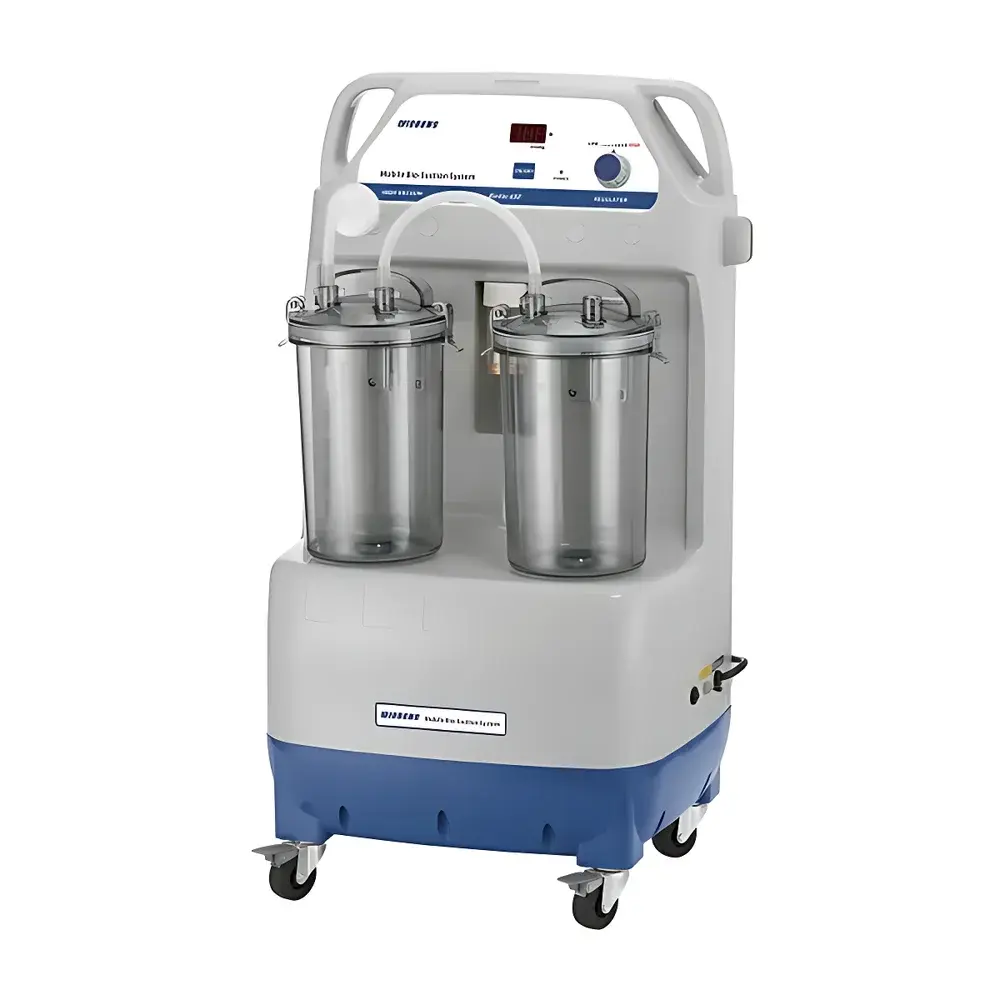
WIGGENS Biovac 650A Mobile Biomedical Vacuum Liquid Aspiration System
| Brand | WIGGENS |
|---|---|
| Origin | Germany |
| Model | Biovac 650A |
| Ultimate Vacuum | ≥60 mbar |
| Maximum Flow Rate | ≤80 L/min |
| Dimensions | 45 × 35 × 84 cm |
| Weight | 19.5 kg |
| Collection Bottle Capacity | 2 × 3000 mL (PC) |
| Filtration | 0.2 µm PTFE disc filter |
| Sterilization Compatibility | Autoclavable (121 °C, 20 min) |
| Pump Type | Oil-free diaphragm vacuum pump |
Overview
The WIGGENS Biovac 650A Mobile Biomedical Vacuum Liquid Aspiration System is an engineered solution for safe, efficient, and aseptic removal of culture supernatants, spent media, and biological fluids in cell culture laboratories, biosafety cabinets, and cleanroom environments. Designed around a maintenance-free oil-free diaphragm vacuum pump, the system eliminates risks associated with oil contamination, hydrocarbon backstreaming, or lubricant degradation—critical considerations in GLP-compliant and ISO 13485-aligned workflows. Its stable vacuum output (≥60 mbar) and high volumetric flow rate (≤80 L/min) ensure rapid aspiration across variable viscosity ranges—from low-viscosity PBS washes to moderately viscous conditioned media—without compromising sterility integrity or operator ergonomics. The fully mobile chassis enables seamless repositioning between laminar flow hoods, incubators, and biosafety level 2 (BSL-2) workstations, supporting decentralized liquid handling without reliance on fixed central vacuum infrastructure.
Key Features
- Oil-free diaphragm vacuum pump: No lubrication required; eliminates oil vapor carryover and reduces long-term maintenance overhead.
- Dual-stage overflow protection: Integrated float valve in polycarbonate (PC) collection bottles + upstream 0.2 µm hydrophobic PTFE disc filter prevent liquid ingress into the pump head under overfill or sudden pressure fluctuation.
- Autoclavable components: Both 3000 mL PC waste bottles and the PTFE filter disc are rated for repeated steam sterilization at 121 °C for 20 minutes (EN 285 compliant), ensuring full compatibility with aseptic processing validation protocols.
- Ergonomic operation: Includes a foot-operated switch for hands-free activation and a modular suction wand assembly with interchangeable tips (e.g., wide-bore for bulk aspiration, narrow-tip for precision removal).
- Low-noise design: Acoustic emission <55 dB(A) at 1 m distance—optimized for shared lab environments where acoustic disturbance must be minimized during sensitive procedures such as live-cell imaging or electrophysiology setup.
- Robust mobile platform: Reinforced polymer frame with lockable casters (two swivel, two rigid), integrated cable management, and sealed electronics housing rated IP42 for incidental liquid exposure resistance.
Sample Compatibility & Compliance
The Biovac 650A supports aspiration of aqueous biological liquids including cell culture media, trypsin-EDTA solutions, centrifugation supernatants, and buffered saline washes. It is not intended for organic solvents, strong acids/bases, or highly particulate suspensions without pre-filtration. All wetted materials—including tubing, bottle gaskets, and filter housings—meet USP Class VI biocompatibility requirements. The system conforms to IEC 61010-1:2010 for laboratory electrical safety and carries CE marking under the EU Machinery Directive 2006/42/EC. Its autoclavable configuration supports adherence to ISO 14644-1 cleanroom classification standards when deployed inside ISO Class 5 laminar flow cabinets.
Software & Data Management
The Biovac 650A operates as a standalone analog-controlled device with no embedded firmware or digital interface. This architecture ensures deterministic response time, immunity to software failure modes, and compliance with FDA 21 CFR Part 11 requirements for systems where electronic records are not generated. Vacuum pressure and flow remain mechanically regulated; no calibration certificates or firmware updates are required. For labs implementing electronic lab notebooks (ELN) or LIMS integration, optional analog-to-digital signal adapters (0–10 V output) can be installed to log operational timestamps and runtime duration via external data acquisition modules—enabling traceability in GMP environments where equipment usage logs are auditable.
Applications
- Removal of spent culture media from adherent and suspension cell cultures prior to passaging or harvesting.
- Aspiration of supernatants during immunoprecipitation, ELISA plate washing, and flow cytometry sample preparation.
- Drainage of excess buffer during histological tissue processing and cryosectioning workflows.
- Decontamination fluid evacuation in BSL-2 containment hoods following biohazard spill response protocols.
- Supporting high-throughput screening (HTS) platforms where modular, mobile aspiration minimizes cross-contamination risk between assay plates.
FAQ
Can the Biovac 650A be used with corrosive or organic solvents?
No. The system is designed exclusively for aqueous biological fluids. Exposure to acetone, ethanol (>70 % v/v), chloroform, or acidic/basic solutions will degrade PC bottles and compromise PTFE filter integrity.
Is the vacuum level adjustable?
No. The diaphragm pump delivers a fixed vacuum output of ≥60 mbar, optimized for consistent aspiration performance across standard lab conditions (20–25 °C, 40–60 % RH).
How often should the PTFE filter be replaced?
Under normal use (≤4 hrs/day, sterile media only), replacement is recommended every 6 months or after 50 autoclave cycles—whichever occurs first—to maintain hydrophobic integrity and filtration efficiency.
Does the unit require annual calibration?
Not applicable. As a non-measuring, non-recording mechanical aspiration device, it falls outside ISO/IEC 17025 calibration scope. Functional verification (vacuum hold test, audible pump operation, float valve actuation) is sufficient per internal SOP.
Can the collection bottles be substituted with third-party alternatives?
Only WIGGENS-certified 3000 mL PC bottles are validated for autoclave compatibility, dimensional fit, and seal integrity. Non-OEM bottles may cause vacuum leaks or float valve misalignment.



