
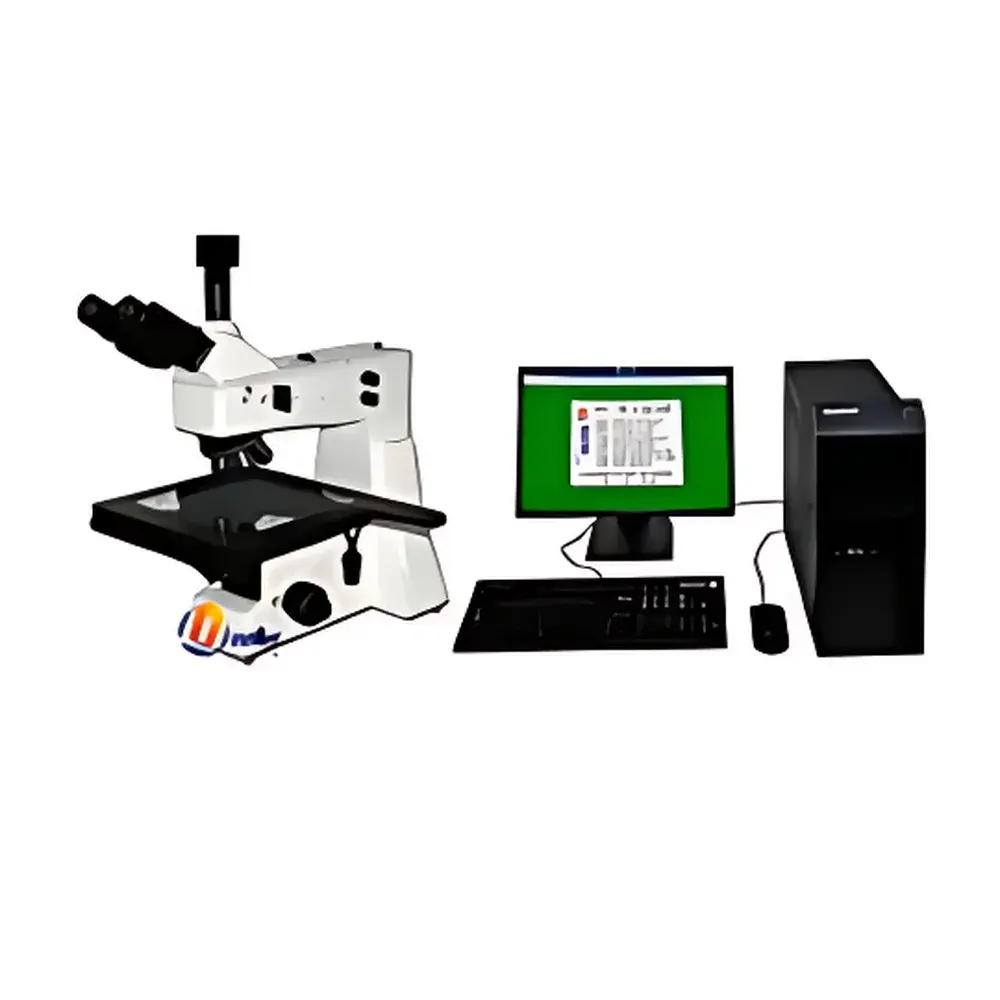
YANRUN MMAS-15 Infinity-Corrected Metallurgical Microscope with Integrated Image Analysis System
| Brand | YANRUN |
|---|---|
| Origin | Shanghai, China |
| Manufacturer Type | Direct Manufacturer |
| Product Type | Upright Metallurgical Microscope |
| Image Analysis System Included | Yes |
| Total Magnification Range | 50× to 800× |
| Eyepieces | Wide-Field WF10X (Φ22 mm) |
| Objective Lenses | 5X, 10X, 20X, 50X, 80X (Infinity-Corrected Plan Achromatic) |
Overview
The YANRUN MMAS-15 is an upright, infinity-corrected metallurgical microscope engineered for high-fidelity observation and quantitative analysis of opaque specimens—including polished metallographic sections, ceramic fracture surfaces, semiconductor wafers, and mineral thin sections. Its optical architecture is based on a fully corrected infinite-conjugate pathway, enabling consistent wavefront fidelity across the entire field of view and compatibility with modular contrast enhancement accessories such as polarized light, darkfield, and brightfield illumination. The system integrates a rigid T-shaped mechanical frame with ultra-low-position coaxial coarse/fine focusing, optimized to minimize vibration transmission during precision measurement tasks. Designed in accordance with ergonomic principles, the 30° inclined trinocular head supports seamless transition between direct ocular viewing and digital imaging—ensuring operator comfort during extended inspection sessions typical in QC laboratories, failure analysis centers, and academic metallurgy departments.
Key Features
- Trinocular optical tube with 30° inclination and 100% beam-splitting capability for simultaneous eyepiece viewing and camera coupling
- Wide-field WF10X eyepieces (Φ22 mm field number) paired with plan achromatic infinity-corrected objectives (5X/0.12, 10X/0.25, 20X/0.40, 50X/0.70, 80X/0.80), delivering flat, color-corrected images with working distances from 26.1 mm down to 1.25 mm
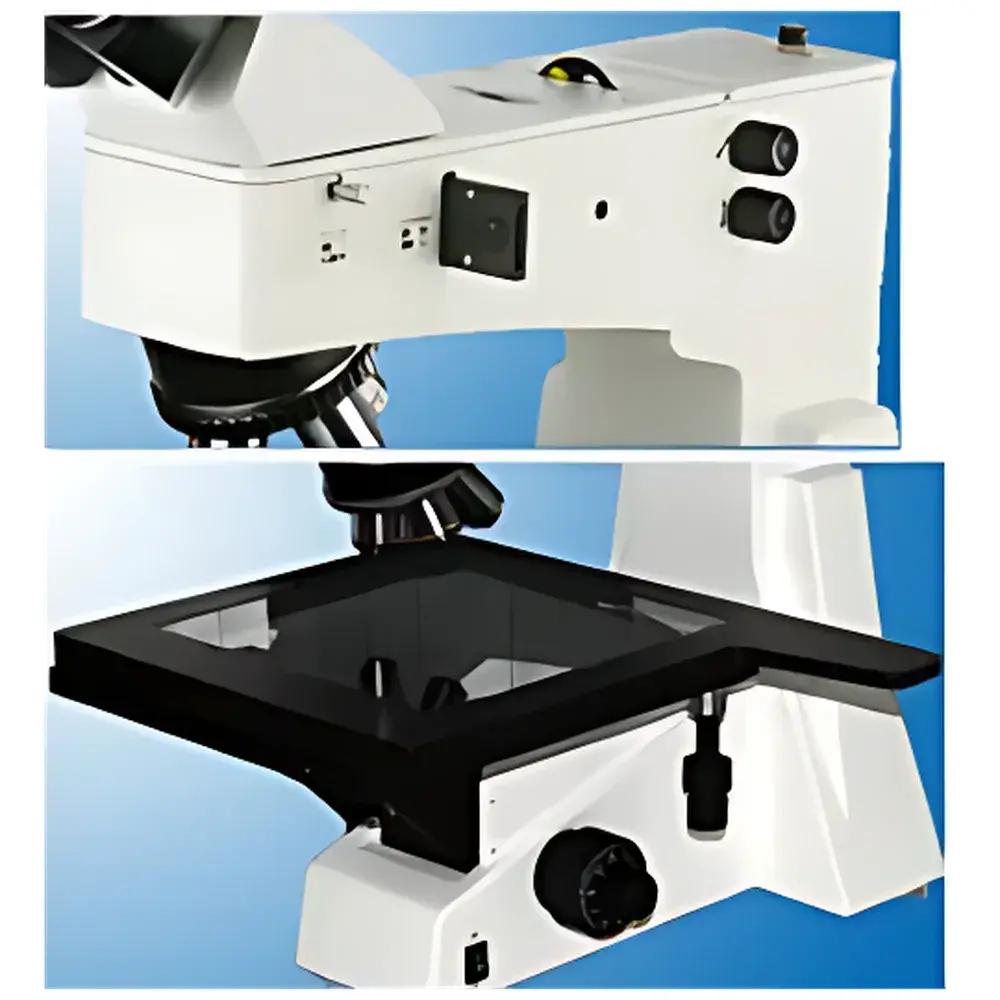
- Three-layer mechanical stage (280 × 270 mm footprint; 204 × 204 mm travel range) with dual-speed translation control for rapid positioning and fine-tuned specimen navigation
- Dedicated epi-illumination system featuring a 6 V / 30 W halogen lamp with continuous intensity adjustment, integrated field and aperture diaphragms, and rotating filter turret accommodating yellow, blue, green, and ground-glass filters
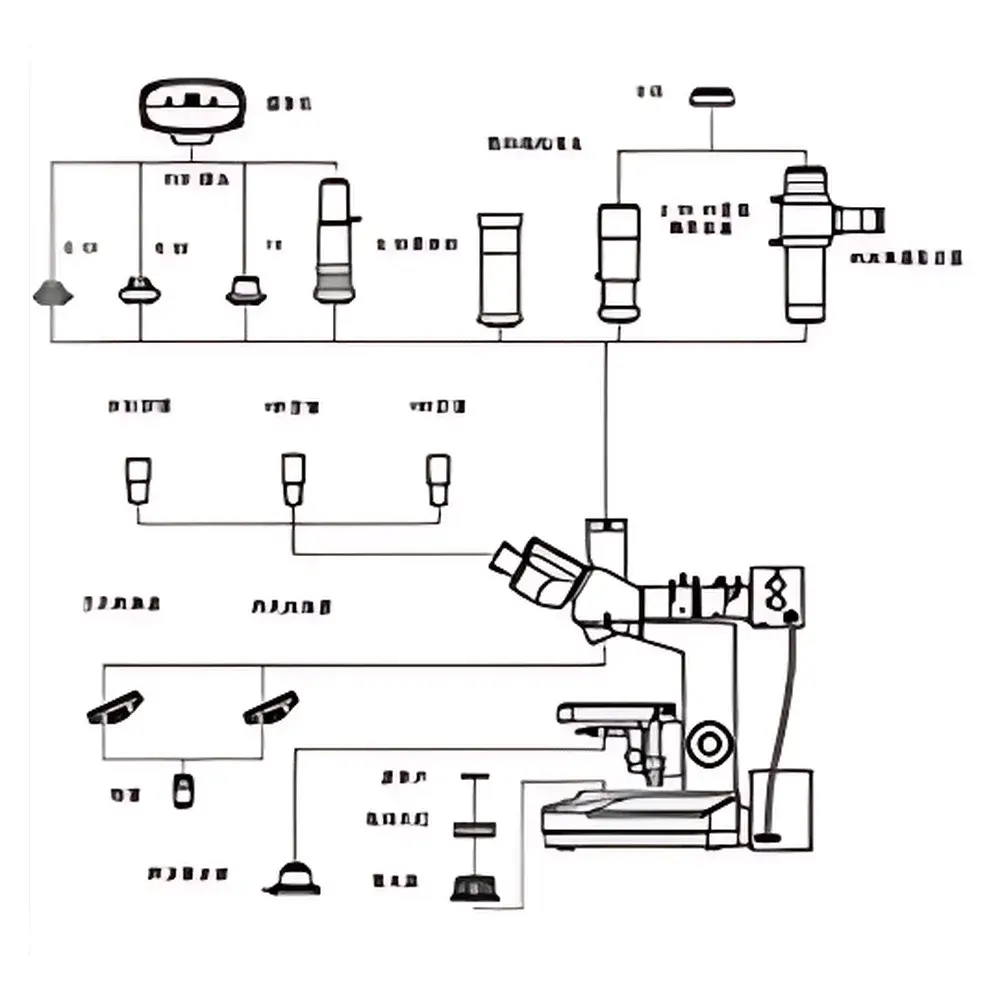
- Optional darkfield module with 12 V / 50 W halogen source and dedicated darkfield condenser/objective set, eliminating stray light and enhancing edge contrast on reflective surfaces
- Coaxial coarse/fine focusing mechanism with adjustable coarse-focus tension, locking lever, upper/lower limit stops, and fine-focus graduation of 0.7 µm per division
- Five-position objective revolver with inward-rolling ball-bearing positioning for repeatable, backlash-free lens switching
Sample Compatibility & Compliance
The MMAS-15 accommodates standard 25 mm and 32 mm diameter metallographic mounts, as well as custom-sized specimens up to 204 × 204 mm within its stage travel envelope. Its epi-illumination geometry ensures uniform illumination of non-transmissive samples without requiring section thinning or staining—making it suitable for ASTM E3, ISO 643, GB/T 13298, and other standardized metallographic evaluation protocols. While the base system does not carry CE or FDA 510(k) certification, its hardware architecture and software output structure support integration into GLP/GMP-regulated environments when deployed with audit-trail-enabled configurations (e.g., timestamped image metadata, user-access logs, and version-controlled report templates). All optical components comply with ISO 10110 surface quality standards for transmitted and reflected light applications.
Software & Data Management
The bundled MMAS Image Analysis Software is a Windows-based application designed specifically for quantitative metallography and microstructural assessment. It provides over 400 preconfigured analysis modules aligned with national and industrial standards—including ASTM E112 (grain size), ASTM E1245 (inclusion rating), ISO 4497 (porosity), and GB/T 6394 (average grain diameter). Core capabilities include automated phase segmentation, linear intercept grain counting, inclusion classification per ASTM E45, multi-point hardness correlation mapping (when interfaced with compatible hardness testers), and geometric measurement tools (line, polygon, circle, angle, area). Reports are exportable in PDF, TIFF, and CSV formats, with configurable templates supporting institutional branding and regulatory documentation requirements. Optional advanced modules—such as focus stacking (z-stack synthesis), panoramic image stitching, and pseudo-3D topographic rendering via multi-height intensity profiling—are available under custom deployment agreements.
Applications
The MMAS-15 serves as a primary tool in materials science laboratories for routine and investigative metallography, including heat treatment verification, weld integrity assessment, corrosion morphology analysis, and additive manufacturing microstructure characterization. Its stable platform and calibrated magnification range make it appropriate for ISO/IEC 17025-accredited testing facilities performing interlaboratory round-robin studies. In R&D settings, the system supports comparative studies of alloy phase evolution under thermal cycling, fatigue crack propagation tracking, and ceramic grain boundary analysis. Industrial users apply it for incoming material inspection, process validation, and root cause failure analysis—particularly where traceability, repeatability, and compliance with AS9100, IATF 16949, or ISO 9001 documentation requirements are mandated.
FAQ
Does the MMAS-15 support DIC or phase contrast?
No—the system is configured for brightfield, darkfield, and polarized light observation only. Differential interference contrast (DIC) and phase contrast require additional Nomarski prisms and specialized condensers not included in the standard configuration.
Can the MMAS software generate compliant audit trails for regulated industries?
Out-of-the-box functionality includes user login tracking, image acquisition timestamps, and version-stamped reports. Full 21 CFR Part 11 compliance requires optional server-side deployment with electronic signature modules and centralized log archiving—available upon request.
What camera interfaces are supported?
The system accepts C-mount cameras with USB 3.0 or HDMI video output. Recommended sensor resolution is ≥5 MP with global shutter capability for motion artifact suppression during stage scanning.
Is motorized stage or autofocus available?
These are not factory-integrated options but can be retrofitted via third-party OEM partnerships under engineering consultation.
How is calibration maintained across magnifications?
Calibration is performed using NIST-traceable stage micrometers and certified graticules. The software stores scale factors per objective, automatically applying corrections during measurement and reporting workflows.




