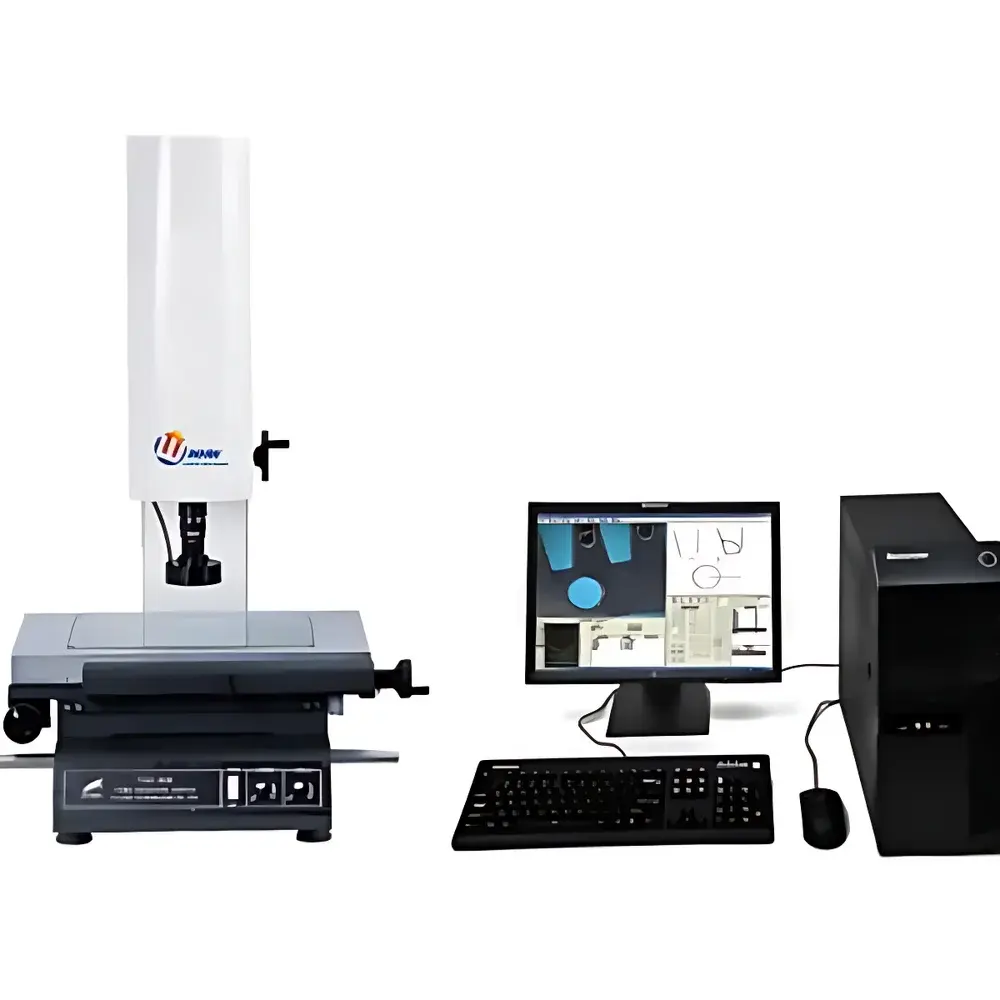
YANRUN YR-T4030 Economical Vision Measuring Machine
| Brand | YANRUN |
|---|---|
| Origin | Shanghai, China |
| Manufacturer Type | Direct Manufacturer |
| Region of Origin | Domestic (China) |
| Model | YR-T4030 |
| Price | USD 1 (Base Unit Quotation) |
| Table Load Capacity | ≥450 kg |
| Table Dimensions (L×W×H) | 1250 × 900 × 780 mm |
| Metal Stage Size | 606 × 466 mm |
| Glass Stage Size | 450 × 350 mm |
| X-Y Travel Range | 400 × 300 mm |
| Z-Axis Vertical Travel | 200 mm |
| Working Distance | 92 mm |
| Digital Readout Resolution (X/Y/Z) | 0.0005 mm |
| Positioning Accuracy (X/Y) | ≤(3 + L/200) µm |
| Imaging System | 1/3" Color CCD Camera |
| Zoom Objective Magnification | 0.7× to 4.5× |
| Total Video Magnification | 30× to 230× |
| Field of View (Object Side) | 7.0 mm to 1.1 mm |
| Illumination | Dual LED Sources (Top Surface & Bottom Transmitted), Continuously Adjustable Brightness |
| Power Supply | AC 180–260 V, 50 Hz |
| Standard Software Features | Auto-edge detection, deburring algorithm, geometric element measurement (point, line, circle, center-to-center distance), coordinate system alignment (part registration) |
Overview
The YANRUN YR-T4030 Economical Vision Measuring Machine is a benchtop optical coordinate measuring system engineered for high-reproducibility 2D geometric metrology in quality control laboratories, precision machining workshops, and R&D environments. It operates on the principle of non-contact optical imaging metrology—capturing high-contrast silhouette or surface-reflected images via a telecentric zoom lens and 1/3″ progressive-scan CCD sensor, then performing sub-pixel edge detection and coordinate transformation within a calibrated Cartesian reference frame. Designed for dimensional verification of machined parts, stamped components, PCBs, and micro-fabricated features, the YR-T4030 delivers traceable measurements compliant with ISO 10360-7 (acceptance and reverification of vision measuring systems) and supports implementation under ISO/IEC 17025-accredited quality management systems. Its rigid granite base, precision ground linear guideways, and thermally stable mechanical architecture ensure long-term repeatability across ambient workshop conditions (20 ± 2 °C, 40–70% RH).
Key Features
- High-stability mechanical platform with ≥450 kg load capacity and 1250 × 900 × 780 mm dedicated support table—optimized for large or heavy workpieces requiring minimal vibration-induced uncertainty.
- 400 mm × 300 mm motorized X-Y travel range with 0.0005 mm digital encoder resolution and bidirectional positioning accuracy certified to ≤(3 + L/200) µm per ISO 10360-2.
- 200 mm Z-axis vertical clearance enables measurement of stepped or multi-level features without manual stage repositioning; fixed 92 mm working distance ensures consistent depth-of-field across magnification ranges.
- Dual independent LED illumination modules—top coaxial and bottom transmitted—with analog brightness control allow adaptive contrast enhancement for opaque, translucent, or reflective surfaces.
- 0.7×–4.5× parfocal zoom objective paired with real-time video processing yields 30×–230× total magnification, supporting measurement of features from ~10 µm to several centimeters with scalable pixel calibration.
- Integrated auto-edge detection algorithm employs gradient-based thresholding and morphological filtering to suppress noise and mitigate operator-dependent interpretation errors during contour extraction.
Sample Compatibility & Compliance
The YR-T4030 accommodates flat, planar, or low-relief specimens up to 450 kg, including metal stampings, injection-molded housings, ceramic substrates, and flex circuits. Its 450 × 350 mm optical glass stage permits transmission-based measurement of transparent or semi-transparent parts (e.g., glass wafers, polymer films), while the 606 × 466 mm metal stage provides thermal mass and rigidity for metallic components subject to thermal drift. The system meets CE electromagnetic compatibility (EMC) directives and conforms to IEC 61000-6-2/6-3 standards. Measurement data integrity aligns with ISO 9001:2015 clause 7.1.5.2 (monitoring and measuring resources) and supports audit readiness for FDA-regulated manufacturing under 21 CFR Part 820.72 (inspection, measuring, and test equipment).
Software & Data Management
The standard YANRUN Vision Measurement Suite includes calibrated coordinate geometry (CG) engine supporting point, line, circle, arc, slot, distance, angle, and concentricity calculations. All measurements are timestamped and stored with full metadata—including lens magnification, illumination mode, user ID, and environmental log (optional external sensor integration). Raw image files (BMP/TIFF) and measurement reports (PDF/CSV/XLSX) are exportable with configurable templates. Audit trail functionality records parameter changes, software updates, and calibration events—enabling compliance with GLP/GMP documentation requirements. Optional network deployment allows centralized license management and remote validation report generation.
Applications
- Dimensional inspection of automotive sheet-metal flanges, brackets, and gaskets against GD&T callouts (e.g., position, profile, symmetry).
- PCB solder paste deposit verification and pad registration accuracy assessment prior to SMT assembly.
- Geometric tolerance validation of medical device components (e.g., catheter hubs, syringe barrels) per ISO 13485 and USP analytical instrument qualification protocols.
- Tooling verification for injection molds and die-cast dies—measuring cavity dimensions, gate locations, and ejection pin positions.
- Educational use in metrology training labs for teaching fundamental concepts of optical magnification, pixel calibration, uncertainty budgeting, and measurement traceability.
FAQ
What calibration standards are recommended for routine verification of the YR-T4030?
A NIST-traceable step gauge or ceramic scale with certified line-pair spacing (e.g., 10 µm, 50 µm, 100 µm) should be used biweekly; annual third-party calibration against ISO 10360-7 is advised.
Can the system measure features with surface texture or burrs?
Yes—the deburring algorithm applies morphological opening/closing operations to suppress edge artifacts; however, physically sharp burrs exceeding 20 µm height may require pre-measurement mechanical removal per ISO 14289-1.
Is USB or Ethernet connectivity supported for data export?
Standard configuration includes USB 2.0 host port for direct flash drive reporting; optional Gigabit Ethernet module enables integration into factory MES/SPC platforms.
Does the software support custom report generation for ISO/TS 16949 PPAP submissions?
Yes—template editor allows inclusion of part number, revision level, Cpk/Ppk statistics, and operator signature fields aligned with AIAG PPAP Level 3 requirements.
What environmental conditions must be maintained for optimal performance?
Ambient temperature stability within ±2 °C over 24 hours, relative humidity 40–70% non-condensing, and vibration isolation (ISO 23828 Class 2) are required to maintain stated accuracy specifications.