
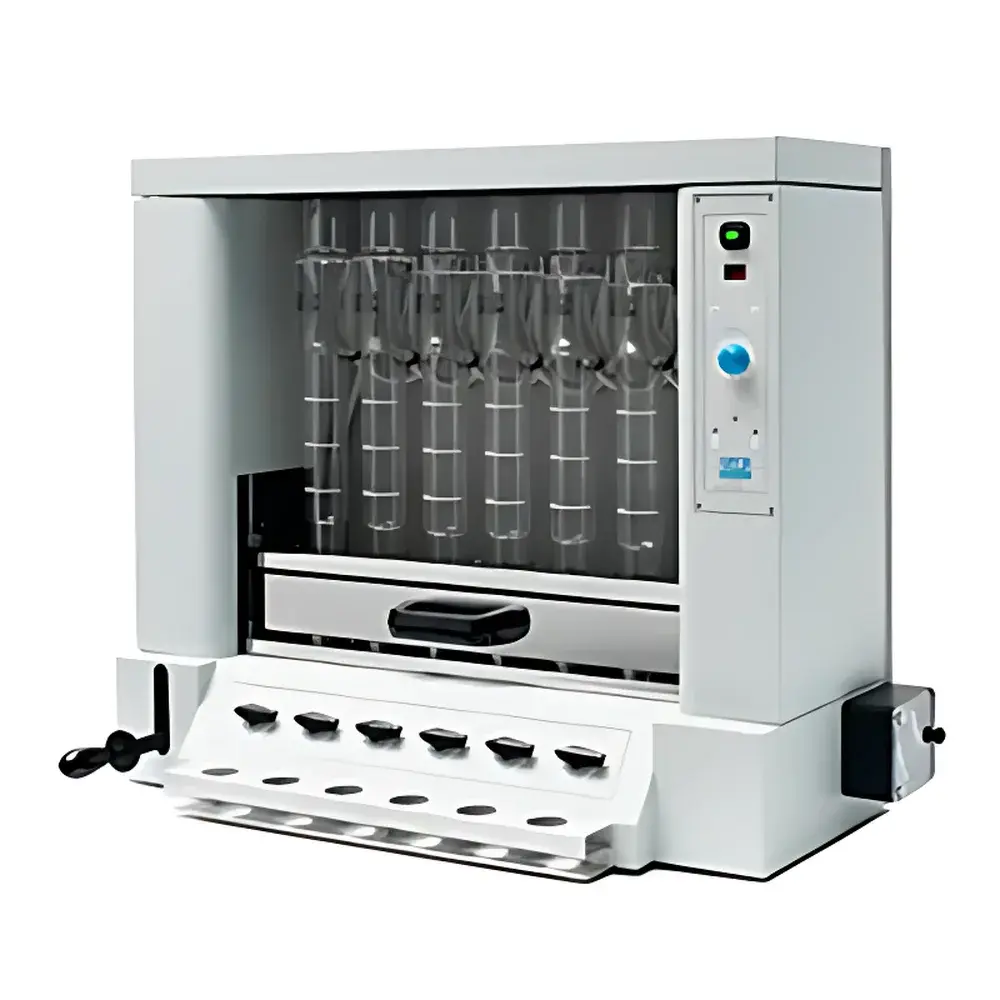
VELP FIWE Fiber Analyzer
| Brand | VELP |
|---|---|
| Origin | Italy |
| Model | FIWE |
| Sample Capacity | 6 positions (independent operation per sample) |
| Measurement Principle | Gravimetric difference method after sequential acid/alkali digestion (AOAC 978.10, ISO 5498, ISO 6865, EN ISO 13906) |
| Repeatability (RSD) | ±1% |
| Sample Mass Range | 0.5–3 g |
| Reagent Preheating Units | Dual independent RC2 heaters (RT to 370 °C) |
| Filtration & Backflush | Integrated air pump with three-way valve control |
| Waste Handling | Precision peristaltic pump for residue collection and effluent evacuation |
| Safety System | Self-diagnostic routine with audible/visual alarm timer |
| Construction | Stainless steel housing with chemical-resistant coating |
| Display | LCD interface with programmable time (0–99 min) and temperature settings |
| Power | 1200 W |
| Ambient Operating Temperature Control | Electronic PID regulation |
Overview
The VELP FIWE Fiber Analyzer is a fully automated, gravimetric-based analytical system engineered for precise determination of dietary fiber fractions in animal feed, foodstuffs, botanicals, and agricultural commodities. It implements the standardized sequential digestion methodology—first acidic hydrolysis (using sulfuric acid), followed by alkaline hydrolysis (using sodium hydroxide)—to isolate and quantify crude fiber, neutral detergent fiber (NDF), acid detergent fiber (ADF), acid detergent lignin (ADL), cellulose, and hemicellulose. The instrument operates in strict compliance with internationally recognized reference methods including AOAC Official Method 978.10, ISO 5498 (crude fiber), ISO 6865 (NDF/ADF), and EN ISO 13906 (for feed analysis). Its design reflects over four decades of VELP’s expertise in wet-chemistry instrumentation, integrating robust thermal management, controlled fluid handling, and fail-safe operational logic to ensure method fidelity across high-throughput laboratory environments.
Key Features
- Dual Independent Reagent Preheating (RC2 System): Two thermally isolated heating modules enable simultaneous, programmable preheating of acid and alkali reagents up to 370 °C—minimizing thermal lag and improving digestion kinetics without cross-contamination.
- Intelligent Three-Way Valve & Air-Backflush Technology: Automated pneumatic control precisely directs reagent flow, filtration vacuum, and reverse-air pulses during washing cycles—preventing filter clogging and ensuring complete removal of soluble matrix components from fibrous residues.
- Peristaltic Waste Management System: A calibrated, chemically resistant peristaltic pump evacuates spent reagents and collects undigested residues separately—enabling traceable mass recovery and reducing manual handling errors.
- Independent Sample Processing Architecture: Six parallel digestion vessels operate autonomously; each position supports individual timing, temperature, and reagent sequence programming—critical for heterogeneous sample batches or method development workflows.
- Chemical-Resistant Stainless Steel Construction: All wetted surfaces feature electropolished AISI 316 stainless steel with proprietary anti-corrosion coating—validated for long-term exposure to concentrated H2SO4, NaOH, and acetone used in lignin extraction protocols.
- Integrated Safety & Diagnostics: Real-time self-check at startup verifies pressure integrity, heater response, valve actuation, and pump function; an alarm timer triggers visual and acoustic alerts if any step exceeds user-defined tolerance thresholds.
Sample Compatibility & Compliance
The FIWE accommodates solid and semi-solid matrices ranging from ground cereal grains and hay pellets to processed pet foods and algae biomass. Sample masses between 0.5 g and 3.0 g are supported, with reproducibility validated at ≤±1% RSD across replicate analyses (n≥6) under GLP-compliant conditions. Instrument validation documentation aligns with ISO/IEC 17025 requirements for testing laboratories. Method outputs satisfy regulatory reporting needs for EU Regulation (EC) No 152/2009 (feed hygiene), FDA Title 21 CFR Part 11 (electronic records), and AOAC International’s Performance Tested Methods (PTM) framework. All reagent delivery, temperature ramping, and filtration durations are logged with timestamped audit trails—supporting full traceability during internal audits or regulatory inspections.
Software & Data Management
The FIWE operates via an embedded LCD interface with intuitive menu navigation—no external PC required for routine operation. All method parameters (digestion time, preheat setpoint, backflush duration, vacuum level) are stored as named protocols and recalled with one-touch activation. For laboratories requiring extended data governance, optional VELP LabLink™ software (Windows-compatible) enables remote monitoring, export of raw mass values (tare, post-acid, post-alkali, ash-corrected), and automated calculation of NDF, ADF, ADL, cellulose, and hemicellulose according to AOAC equations. Data files comply with CSV and PDF report formats suitable for LIMS integration and 21 CFR Part 11–compliant electronic signatures when paired with validated user access controls.
Applications
- Quality control of compound feeds and raw materials in commercial animal nutrition facilities
- Nutritional labeling compliance for human food products under EU Regulation 1169/2011 and FDA Nutrition Facts panel requirements
- Research on forage digestibility and rumen fermentation kinetics in veterinary and agricultural science
- Validation of enzymatic fiber assays (e.g., AOAC 2009.01, 2011.25) via gravimetric benchmarking
- Supporting ISO 16630-compliant fiber characterization in bioenergy feedstock evaluation (e.g., switchgrass, miscanthus)
FAQ
What fiber fractions can the FIWE directly quantify?
The FIWE delivers gravimetric results for crude fiber, neutral detergent fiber (NDF), acid detergent fiber (ADF), acid detergent lignin (ADL), and—by calculation—cellulose (ADF – ADL) and hemicellulose (NDF – ADF).
Is method validation support available from VELP?
Yes—VELP provides IQ/OQ documentation templates, certified reference material (CRM) test reports (e.g., NIST SRM 1846), and on-site installation qualification services upon request.
Can the FIWE be integrated into a centralized lab network?
While standalone operation is standard, Ethernet-enabled LabLink™ software permits centralized protocol deployment, real-time status dashboards, and secure data aggregation across multiple FIWE units in multi-instrument labs.
What maintenance intervals are recommended?
Daily: Visual inspection of tubing, valves, and filter crucibles; weekly: calibration of reagent volume delivery using supplied volumetric standards; annual: verification of thermal uniformity across RC2 heaters and pressure transducer accuracy per ISO 17025 calibration schedules.
Does the instrument meet environmental safety standards for fume hood installation?
The FIWE is designed for benchtop use inside certified chemical fume hoods; its sealed reagent reservoirs, leak-detection circuitry, and automatic shut-off on overpressure ensure compliance with EN 14175-3 and OSHA 1910.1200 hazard communication requirements.






