
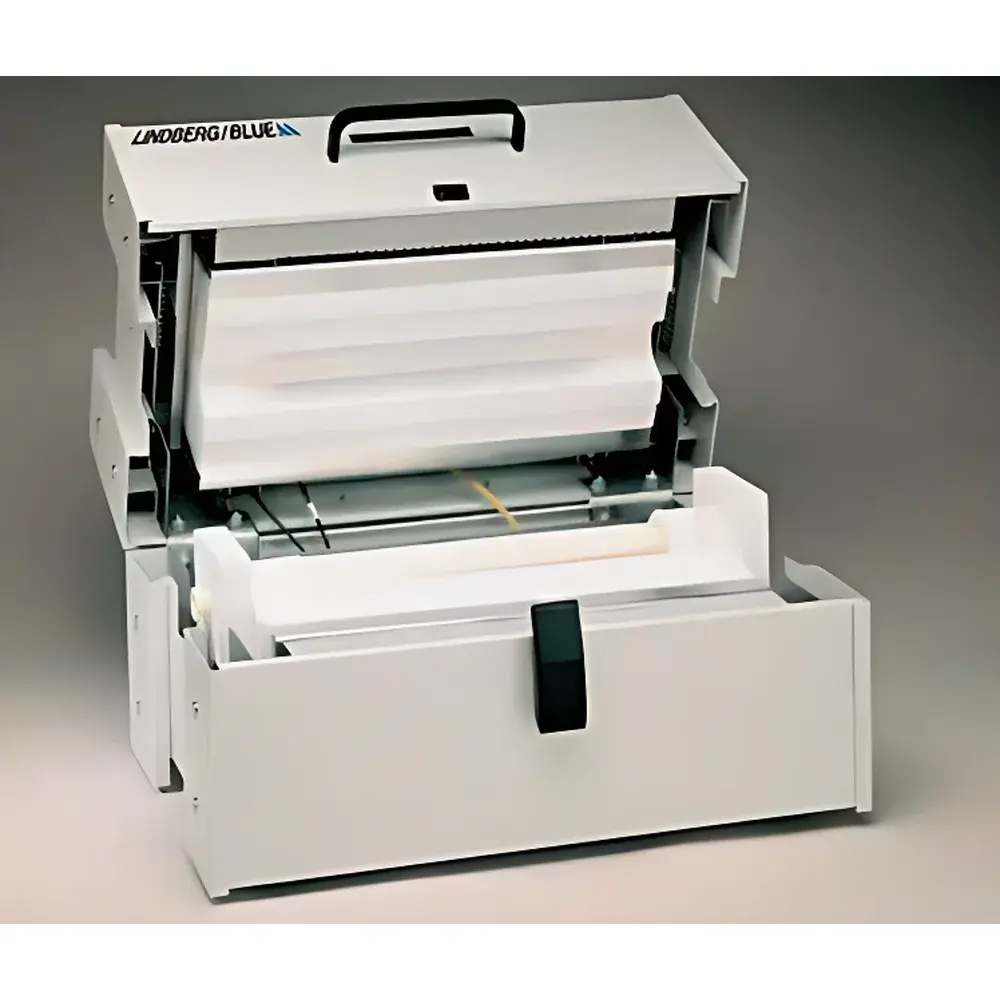
Thermo Fisher Lindberg/Blue M HTF55322C-1 Horizontal/Vertical Split-Tube Furnace (1200°C)
| Brand | Thermo Fisher |
|---|---|
| Origin | USA |
| Manufacturer | Thermo Fisher Scientific |
| Product Type | Split-Tube Furnace |
| Max Temperature | 1200°C |
| Temperature Control Accuracy | ±2–4°C |
| Max Power | 2675 W |
| Ramp Rate (to Max Temp) | 6–12°C/min |
| Heating Method | Resistive Wire Heating |
| Internal Chamber Dimensions | 406.4 × 431.8 × 584.2 mm |
| Voltage/Frequency | 208/240 V, 50/60 Hz |
| Controller Model | CC58114C-1 |
| Tube Diameter Range | 25.4–76.2 mm |
| Heated Zone Length | 304.8 mm |
| External Dimensions (H×D×W) | 406.4 × 431.8 × 584.2 mm |
| Net Weight | 55 kg |
| Compliance | CE, UL Listed (per ANSI/UL 61010-1), RoHS Compliant |
Overview
The Thermo Fisher Lindberg/Blue M HTF55322C-1 is a precision-engineered split-tube furnace designed for high-reliability thermal processing in research laboratories, materials science facilities, and quality control environments. Its patented LGO (Low-Glare Oxide) heating elements deliver uniform radiant heat distribution across the furnace chamber, enabling stable thermal profiles and rapid ramping without thermal overshoot. Unlike conventional muffle furnaces, this horizontal/vertical configurable tube furnace employs a dual-hinged, front-opening clamshell design that provides full access to the working tube—facilitating easy sample loading, in-situ monitoring, and integration with gas delivery or vacuum systems. The furnace operates within a calibrated temperature range of 100–1200°C and is engineered for long-term stability under continuous duty cycles. Its thermally optimized cavity geometry, combined with high-efficiency reflective insulation layers, minimizes external surface temperatures (<60°C at ambient conditions), reducing lab safety hazards and energy loss.
Key Features
- Split-tube architecture with independent horizontal or vertical orientation capability—enabling flexible integration into gloveboxes, fume hoods, or custom process lines.
- Three-zone temperature control system (available on multi-zone variants; HTF55322C-1 is single-zone with optional CC58114C-1 controller) featuring independent Platinel II thermocouples per zone for spatially resolved thermal profiling.
- LGO resistive heating elements—ceramic-encapsulated Ni-Cr alloy wires offering >15,000 hours service life, zero maintenance, and consistent emissivity across operating range.
- Dual-layer insulation: inner alumina fiber board + outer high-density ceramic fiber blanket—reducing standby power consumption by up to 35% versus legacy designs.
- Integrated Moldatherm® work tube adapter kit (2-inch nominal) compatible with quartz, alumina, and silicon carbide tubes; includes O-ring-sealed flange interfaces for inert/vacuum applications.
- Controller with PID algorithm, programmable ramp-soak profiles (up to 16 segments), and real-time data logging via RS-232/USB interface.
- Surface finish: high-temperature silicone-based coating rated to 650°C—resistant to oxidation, chipping, and chemical splatter.
Sample Compatibility & Compliance
This furnace supports a broad spectrum of sample configurations—including crucibles, boats, catalyst beds, thin-film substrates, and wire specimens—within standard 25.4–76.2 mm OD tubular reactors. It complies with international safety and electromagnetic compatibility standards including UL 61010-1 (2nd Ed.), IEC 61000-6-3 (EMI), and RoHS Directive 2011/65/EU. For regulated environments, the CC58114C-1 controller supports audit-trail-capable operation when paired with optional Thermo Fisher LabTrack™ software—meeting core requirements of FDA 21 CFR Part 11 for electronic records and signatures. All thermal calibrations are traceable to NIST standards, and validation documentation (IQ/OQ protocols) is available upon request for GLP/GMP-compliant installations.
Software & Data Management
The CC58114C-1 digital controller features a backlit LCD interface with intuitive menu navigation, real-time temperature display, and alarm thresholds for overtemperature, sensor failure, or power interruption. Data export is supported via ASCII-formatted CSV files through USB or RS-232 serial connection. When integrated with Thermo Fisher’s optional LabTrack™ Suite, users gain access to automated calibration reporting, trend analysis, deviation alerts, and secure user-role management (administrator/operator/reviewer). All logged temperature data include timestamps, controller ID, and thermocouple identification—ensuring full traceability for ISO/IEC 17025-accredited testing labs.
Applications
- Controlled-atmosphere annealing of semiconductor wafers and thin-film devices (N₂, Ar, forming gas).
- Thermal gravimetric analysis (TGA) pre-conditioning and sample stabilization prior to mass spectrometry coupling.
- Catalyst activation, regeneration, and deactivation studies under dynamic gas flow conditions.
- Heat treatment of metallic alloys, ceramics, and battery electrode materials (e.g., LiCoO₂, NMC cathodes).
- Sintering of metal-organic frameworks (MOFs) and porous coordination polymers under low-oxygen environments.
- Calibration reference source for infrared pyrometer validation (in accordance with ASTM E2847).
FAQ
Can this furnace be operated vertically?
Yes—the HTF55322C-1 is mechanically certified for both horizontal and vertical mounting orientations. Structural support brackets and leveling feet are included for stable upright installation.
What tube materials are recommended for 1200°C operation?
High-purity fused quartz (up to 1100°C), recrystallized alumina (1200°C continuous), or reaction-bonded silicon carbide (1350°C) are validated options. Avoid borosilicate glass above 550°C.
Is vacuum compatibility supported out-of-the-box?
The furnace itself is not vacuum-rated; however, the Moldatherm adapter flanges accept standard KF-25 or CF-35 vacuum fittings when used with compatible end caps and sealing gaskets (sold separately).
Does the controller support remote monitoring via Ethernet?
No—CC58114C-1 offers only RS-232 and USB ports. For Ethernet or Wi-Fi connectivity, integrate via third-party industrial gateways compliant with Modbus RTU protocol.
What is the recommended recalibration interval?
Annual calibration is advised for routine QC use. In GLP/GMP settings, calibration frequency must align with internal SOPs and risk assessment—typically every 6 months or after 200 operational cycles.



