
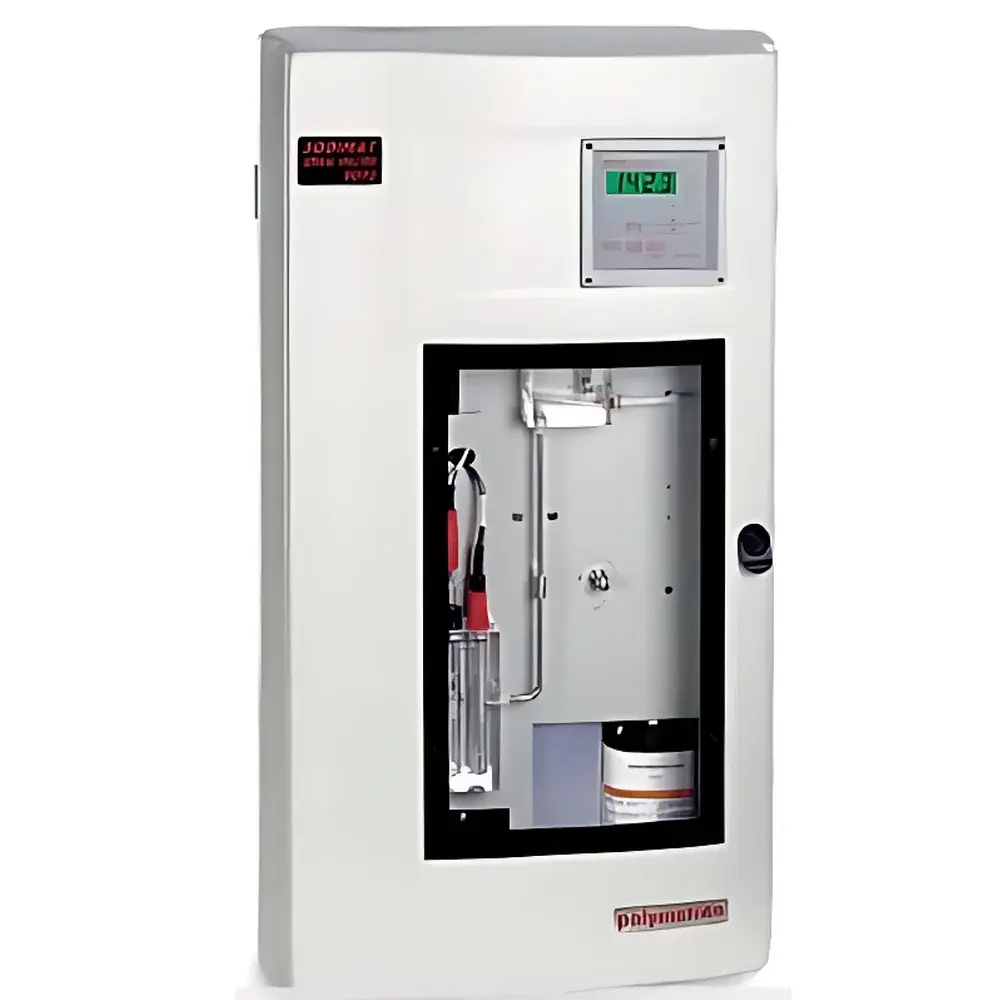
HACH 9073 Online Sodium Analyzer
| Brand | HACH |
|---|---|
| Origin | Imported |
| Manufacturer Type | Manufacturer |
| Model | 9073 |
| Ion Type | Sodium |
| Measurement Range | 0–0.01 ppb and 0–10,000 ppm (user-selectable) |
| Repeatability | <5% of reading or ±0.05 ppb (whichever is greater) |
| Response Time (T90) | <2 min |
| Analog Outputs | Two 4–20 mA outputs (max. load: 900 Ω) |
| Operating Temperature | 5–45 °C |
| Power Supply | 220 VAC, 50/60 Hz |
| pH Conditioning Required | Yes (pH >10) |
| Electrode Type | Sodium-selective glass electrode |
| Calibration Method | AUTOCAL (automated 1- or 2-point standard addition) |
| Sample Handling | Integrated pH adjustment and acid-tolerant configuration available |
Overview
The HACH 9073 Online Sodium Analyzer is a high-precision, industrial-grade instrument engineered for continuous, real-time quantification of sodium ion concentration in ultra-pure water streams. It operates on the potentiometric principle using a sodium-selective glass membrane electrode, which generates a Nernstian potential proportional to the logarithm of sodium activity in solution. To ensure thermodynamic validity and minimize hydrogen ion interference, the analyzer incorporates an integrated sample conditioning system that elevates sample pH to >10 via controlled addition of a reagent (typically diisopropylamine or similar amine-based buffer). This electrochemical measurement architecture delivers trace-level sensitivity essential for critical applications where sodium contamination directly impacts equipment integrity and process reliability—particularly in thermal power generation and microelectronics manufacturing.
Key Features
- Ultra-low detection capability down to 0.01 ppb, validated per ASTM D4192 and ISO 10523 for trace cation analysis in high-resistivity water
- AUTOCAL calibration protocol: fully automated single- or dual-point standard addition with programmable volume delivery, eliminating manual pipetting and reducing operator-induced variability
- Dedicated pH conditioning module with closed-loop reagent dosing and real-time pH monitoring, ensuring consistent alkalinity prior to electrode measurement
- Acid-tolerant configuration option for direct analysis of low-pH condensate or steam cycle samples without external neutralization pre-treatment
- Microprocessor-controlled temperature compensation using integrated Pt100 sensor, correcting for thermal drift across the full 5–45 °C operating range
- Dual isolated 4–20 mA analog outputs configurable for sodium concentration and auxiliary parameters (e.g., pH, temperature, or system status)
- Robust industrial enclosure rated IP65, suitable for deployment in turbine halls, control rooms, and cleanroom utility corridors
Sample Compatibility & Compliance
The 9073 is optimized for aqueous matrices with conductivity <1 µS/cm and total dissolved solids (TDS) <10 ppb. It accommodates feedwater, boiler drum water, saturated/unsaturated steam condensate, and ultrapure rinse water used in semiconductor wafer fabrication. The system complies with key regulatory and industry frameworks including USP for purified water testing, EP 2.2.38 for conductivity and ion monitoring, and ANSI/ISA-84.00.01 for safety instrumented systems when configured with optional alarm relays. Data integrity meets FDA 21 CFR Part 11 requirements when paired with HACH’s INTELLIGENT™ software suite, supporting electronic signatures, audit trails, and secure user access controls aligned with GLP/GMP laboratory practices.
Software & Data Management
The analyzer interfaces seamlessly with HACH’s SCADA-integrated DataStream™ firmware, enabling Modbus TCP/IP and Ethernet/IP communications for integration into plant-wide DCS environments. Local display provides real-time concentration, calibration history, electrode slope diagnostics, and maintenance alerts. All measurement data—including raw mV signals, compensated values, and calibration event logs—are timestamped and stored onboard for ≥30 days. Export functionality supports CSV and XML formats compatible with LIMS platforms such as Thermo Fisher SampleManager and LabVantage. Firmware updates are performed via secure HTTPS connection, maintaining cryptographic validation throughout the update chain.
Applications
- Power generation: Continuous monitoring of sodium in makeup water, economizer inlet, boiler drum, and turbine exhaust condensate to prevent caustic stress corrosion cracking (CSCC) in superheater tubes
- Semiconductor manufacturing: Verification of sodium levels <0.1 ppb in DI water loops supplying photolithography tools and wet benches, where alkali metal contamination induces gate oxide defects
- Pharmaceutical water systems: Support for PW and WFI distribution loop surveillance per EU GMP Annex 1 and WHO TRS 970 guidelines
- Nuclear reactor coolant chemistry: Sodium tracking in primary and secondary circuits to detect steam generator tube leakage
- Research laboratories: Reference-grade sodium quantification in calibration standards preparation and method validation studies
FAQ
What sample flow rate is required for stable operation?
A minimum continuous flow of 100 mL/min at 1–3 bar pressure is recommended; the integrated flow cell maintains laminar flow conditions optimal for electrode response stability.
Can the 9073 measure sodium in seawater or brackish water?
No—the instrument is designed exclusively for ultrapure water applications; high ionic strength matrices cause severe electrode poisoning and non-Nernstian behavior.
Is manual pH adjustment ever necessary during routine operation?
No—pH conditioning is fully automated via the built-in reagent pump and feedback-controlled dosing logic; no operator intervention is required between scheduled calibrations.
How frequently should the sodium electrode be replaced?
Under typical power plant conditions, electrode service life exceeds 18 months; performance degradation is monitored continuously via slope tracking and offset diagnostics.
Does the system support remote diagnostics and predictive maintenance?
Yes—embedded SNMP and OPC UA protocols enable integration with enterprise asset management (EAM) systems for condition-based maintenance scheduling and failure mode analytics.







