
PIE Scientific Tergeo EM Plasma Surface Treater for TEM/SEM Sample and Holder Cleaning
| Brand | PIE Scientific |
|---|---|
| Model | Tergeo EM |
| Origin | USA |
| RF Frequency | 13.56 MHz |
| RF Power | 75 W (optional 150 W) |
| Chamber Dimensions | Ø110 mm × Depth 280 mm |
| Chamber Volume | 2.6 L |
| Chamber Material | High-Purity Fused Quartz |
| Gas Inlets | 2 standard, optional 3rd inlet |
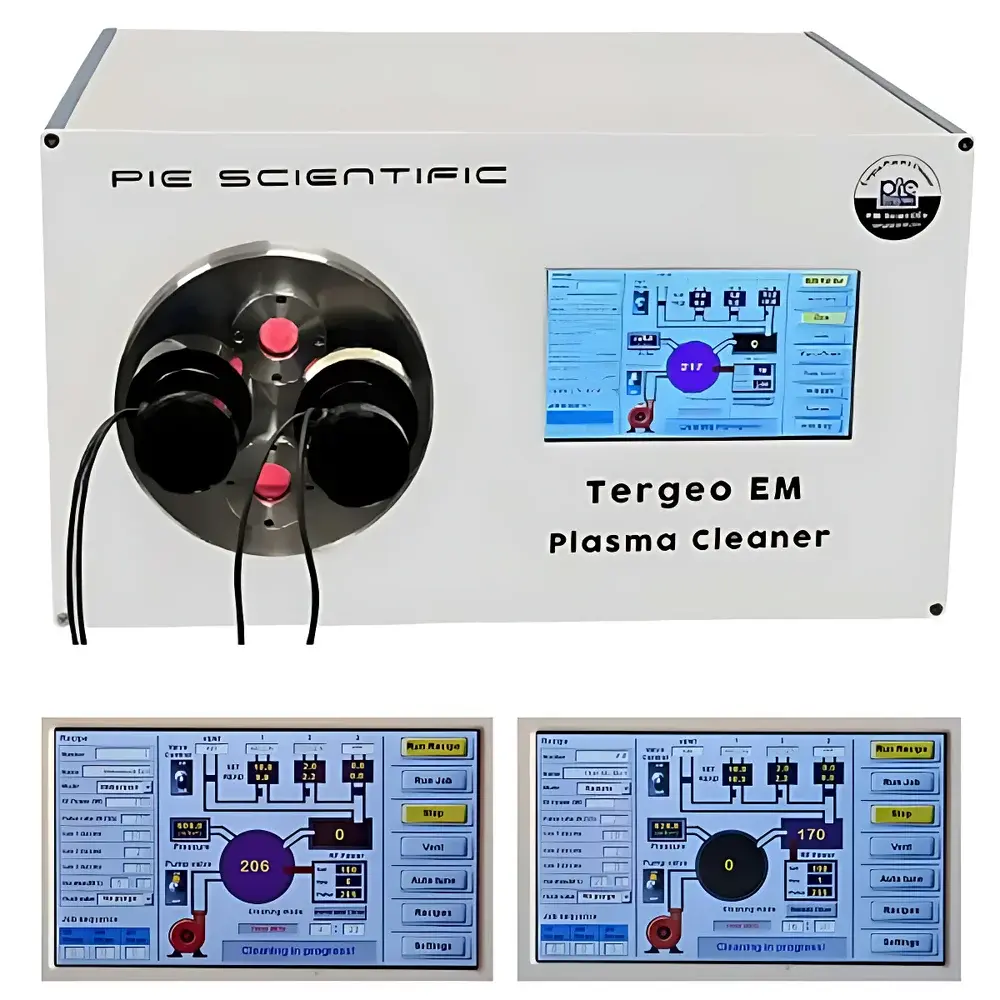
| Control Interface | 7-inch full-color touchscreen, fully automated |
| Plasma Type | Capacitively Coupled RF Plasma (CCP), no microwave, no downstream-only, no wafer-specific configuration |
| Compliance | Designed for GLP-compliant lab environments |
Overview
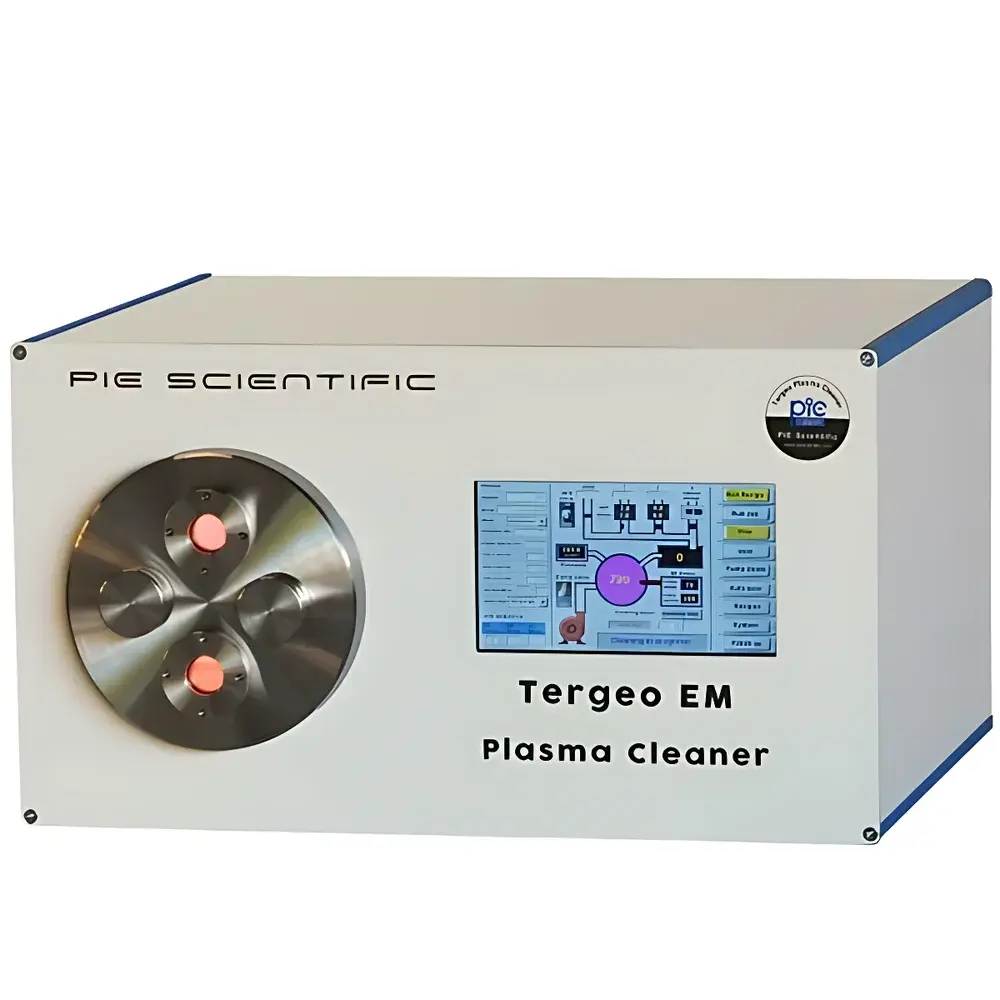
The PIE Scientific Tergeo EM is a benchtop capacitive-coupled radiofrequency (RF) plasma surface treater engineered specifically for high-precision cleaning, surface activation, and contamination removal in electron microscopy laboratories. Operating at the industrial standard 13.56 MHz frequency, it generates stable, low-pressure RF plasma within a high-purity fused quartz chamber—enabling reproducible, non-destructive treatment of sensitive electron-optical components and nanoscale specimens. Unlike microwave or remote plasma systems, the Tergeo EM employs a dual-mode RF plasma architecture: immersion mode delivers direct, energetic ion bombardment for aggressive carbonaceous residue removal from apertures and grids; downstream mode provides gentle, radical-dominated exposure ideal for graphene, carbon nanotubes, ultrathin carbon films, and porous support membranes without structural damage. Its design bridges semiconductor-grade plasma process control with practical laboratory usability—making it a critical tool for TEM/SEM sample preparation workflows requiring sub-nanometer surface cleanliness and consistent interfacial chemistry.
Key Features
- Dual-mode RF plasma operation: switchable between immersion (direct plasma contact) and downstream (radical-rich, low-ion-energy) configurations for application-specific optimization
- 7-inch capacitive touchscreen interface with pre-programmed, user-editable protocols—including ramped power profiles, multi-step gas sequences, and timed plasma cycles
- Modular gas delivery system supporting two standard mass-flow-controlled inlets (e.g., O₂, Ar, H₂, air); third inlet available as factory option for advanced chemistries (e.g., CF₄/O₂ for selective etching)
- Quartz chamber (Ø110 mm × 280 mm depth, 2.6 L volume) ensures optical transparency, thermal stability, and ultra-low metallic impurity leaching—critical for UHV-compatible sample handling
- Dedicated TEM holder adapters compatible with FEI (now Thermo Fisher), JEOL, and Hitachi series—enabling in-situ cleaning of single-tilt, double-tilt, and cryo-transfer holders without disassembly
- Universal AC input (110–230 V, 50/60 Hz) with internal RF matching network and real-time impedance monitoring for stable plasma ignition across global lab infrastructures
Sample Compatibility & Compliance
The Tergeo EM accommodates a broad spectrum of electron microscopy substrates: standard 12.7 mm and 3.05 mm SEM stubs (via perforated quartz stage), 3.05 mm TEM copper grids (including lacey carbon, holey carbon, and graphene oxide supports), and TEM specimen holders up to 3 mm diameter. Its low-power RF plasma minimizes charging effects on insulating samples and avoids thermal degradation of beam-sensitive organics. The system complies with ISO 14644-1 Class 5 cleanroom compatibility standards when operated under laminar flow hoods. While not certified as medical device hardware, its operational parameters align with ASTM E2975-22 (Standard Practice for Plasma Cleaning of Surfaces Prior to Electron Microscopy) and supports traceable process documentation required under GLP and GMP frameworks—particularly when paired with external logging software meeting FDA 21 CFR Part 11 electronic record integrity requirements.
Software & Data Management
The embedded firmware supports full protocol logging: timestamped records of RF power, pressure, gas composition, cycle duration, and plasma ignition status are stored internally and exportable via USB to CSV. Optional Ethernet connectivity enables integration into centralized lab information management systems (LIMS). No proprietary cloud service is required; all data remains on-device unless explicitly transferred. Audit trails include operator ID fields (via alphanumeric login), version-controlled method files, and immutable session logs—facilitating internal QA reviews and regulatory inspections. Firmware updates are delivered via signed firmware packages verified through SHA-256 checksum validation.
Applications
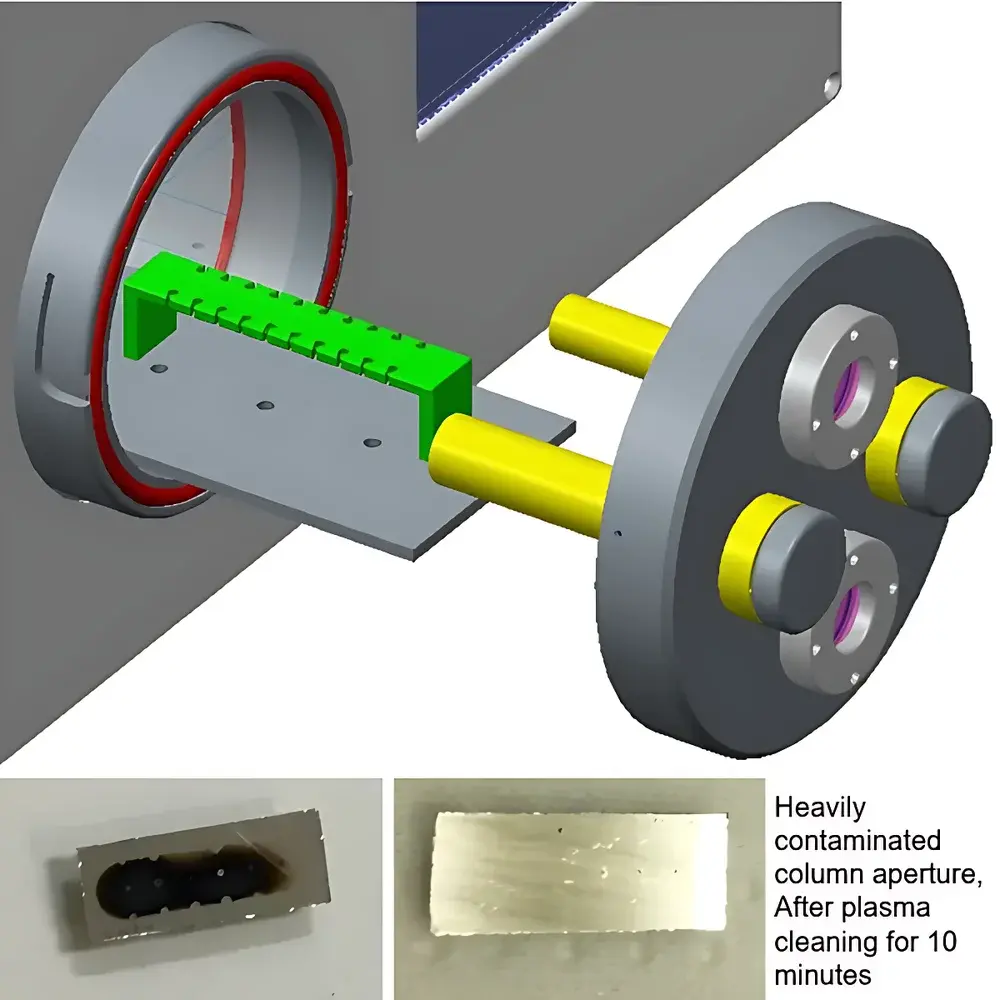
- Removal of hydrocarbon contamination from TEM apertures, objective lenses, and condenser diaphragms
- Surface activation of carbon support films prior to biological macromolecule adsorption
- Hydrophilization of silicon nitride windows for cryo-EM grid preparation
- Low-damage ashing of residual PMMA or HSQ resist after electron-beam lithography
- Inert-gas plasma reduction of native oxides on metal-coated SEM samples
- Controlled surface functionalization (e.g., amine or carboxyl group introduction) using NH₃ or CO₂ plasmas
- Coal ashing for mineralogical analysis—per ASTM D3174-21 standard methodology
FAQ
What plasma modes does the Tergeo EM support, and how do they differ physically?
It operates in two distinct RF-coupled modes: immersion mode applies bias directly to the sample stage, generating higher ion energy for sputter-assisted cleaning; downstream mode positions the sample outside the main plasma glow region, relying primarily on neutral reactive species for gentler surface modification.
Can the Tergeo EM be used for plasma-enhanced chemical vapor deposition (PECVD)?
No—it lacks precursor injection manifolds, substrate heating capability, and pressure control below 10 mTorr required for PECVD. It is optimized for surface treatment, not thin-film growth.
Is ozone generation a concern during O₂ plasma operation?
Yes—O₂ plasma produces ozone as a byproduct. Operation requires connection to an external exhaust line vented to a fume hood or dedicated ozone destruct system per OSHA PEL guidelines (0.1 ppm TWA).
Does the system require liquid cooling or external water supply?
No—all thermal management is passive via aluminum chassis heat sinks and convection airflow; no plumbing or chiller integration is needed.
How is process repeatability ensured across different operators and labs?
By enforcing parameter lockout in administrator mode, storing calibrated gas flow profiles, and recording full environmental metadata (ambient temperature, chamber base pressure, RF forward/reflected power) with every run.



