
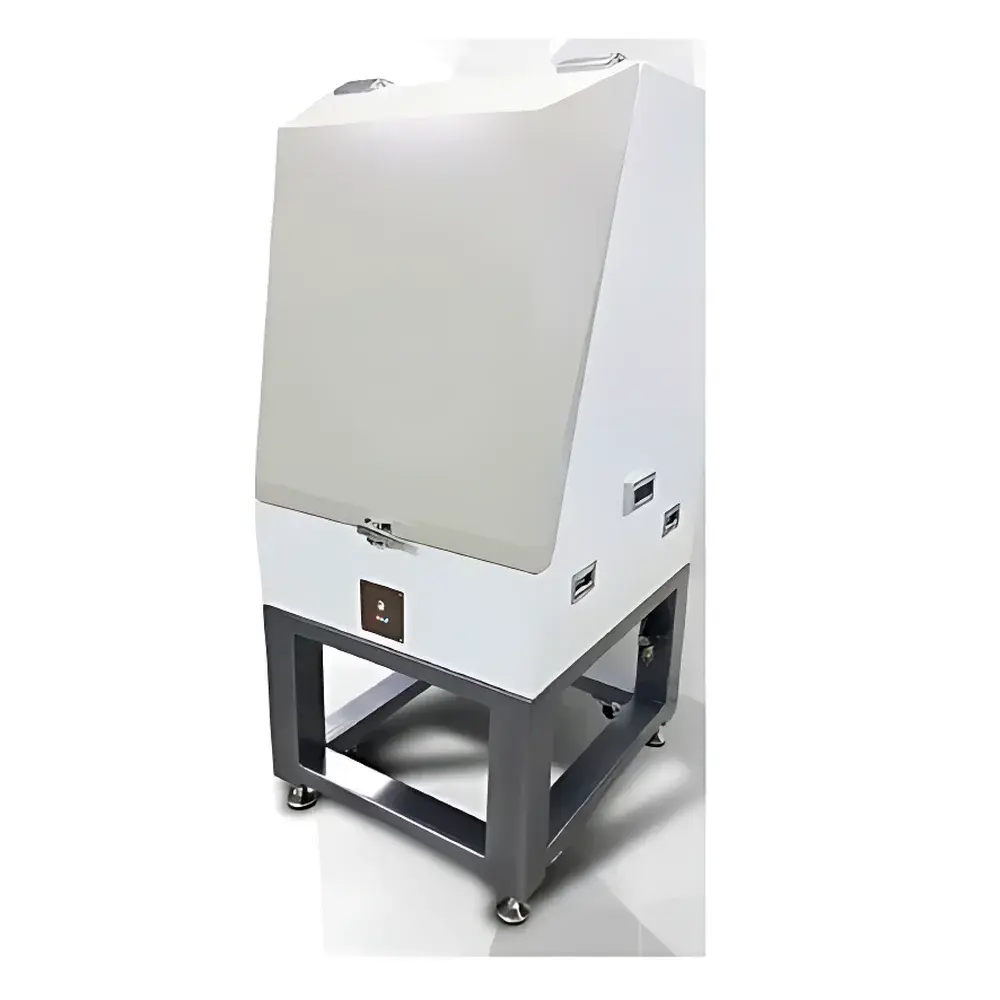
PMT Active Vibration Isolation Table
| Brand | SHNTI |
|---|---|
| Origin | Shanghai, China |
| Model | PMT |
| Load Capacity | Up to 300 kg |
| Vibration Control Principle | Real-time active force cancellation via triaxial inertial sensing and pneumatic actuation |
| Noise Attenuation | Broadband airborne noise isolation via multilayer acoustic barrier construction |
| Magnetic Shielding | Integrated mu-metal and conductive layer shielding |
| Control Architecture | Hybrid feedforward + feedback control |
| Compliance | Designed for GLP-compliant environments |
| Software Interface | Embedded LED status display |
Overview
The PMT Active Vibration Isolation Table is an integrated precision support platform engineered for laboratories requiring simultaneous suppression of mechanical vibration, airborne acoustic noise, and ambient magnetic fields. Unlike conventional passive optical tables or air-spring isolators, the PMT employs a hybrid isolation architecture: a high-stiffness pneumatic passive base provides initial low-frequency attenuation (typically below 5 Hz), while an active control subsystem—comprising triaxial accelerometers, real-time signal processing unit, and fast-response pneumatic actuators—generates counteracting forces to nullify residual motion in the 0.5–100 Hz band. This dual-stage approach enables stable operation for instruments sensitive to sub-micron displacement, such as scanning probe microscopes (SPM), electron beam lithography systems, interferometric metrology tools, and ultra-low-noise optical cavities. The system’s structural design accommodates floor-mounted installation and integrates seamlessly with acoustic enclosures—making it the first commercially deployed solution combining full-spectrum vibration mitigation with standardized acoustic and magnetic shielding in a single platform.
Key Features
- Triaxial active vibration cancellation: Real-time detection and compensation of translational motion along X, Y, and Z axes using high-bandwidth inertial sensors and proportional-integral-derivative (PID)-optimized control algorithms.
- Hybrid feedforward + feedback control architecture: Feedforward inputs (e.g., from building HVAC or nearby machinery) can be integrated via analog voltage signals to preemptively suppress known disturbance sources; feedback loop ensures closed-loop stability and robustness against unmodeled dynamics.
- Integrated broadband acoustic enclosure compatibility: Multilayer composite barrier—comprising mass-loaded vinyl, constrained-layer damping sheets, and sealed acoustic gaskets—achieves ≥35 dB insertion loss across 100 Hz–10 kHz, meeting requirements for acoustic-sensitive applications such as laser Doppler vibrometry or microphonics testing.
- DC–1 MHz magnetic field attenuation: Internal shielding combines high-permeability mu-metal layers (for static and low-frequency fields) with aluminum RF containment (for >1 kHz interference), verified per ASTM A753 Type IV specifications.
- Dedicated LED status panel: Front-mounted visual indicators display operational mode (standby/active/isolation active), sensor health, actuator pressure status, and real-time RMS acceleration values—enabling rapid verification without external software.
- Modular footprint scalability: Available in standard surface dimensions (1.0 × 1.2 m, 1.2 × 1.5 m, 1.5 × 2.0 m), with customizable mounting hole patterns and optional through-table cabling conduits for vacuum, fluid, or fiber-optic integration.
Sample Compatibility & Compliance
The PMT supports payloads ranging from 50 kg to 300 kg with center-of-gravity height ≤0.4 m above the table surface. Its rigid steel-reinforced honeycomb core and kinematic leveling feet ensure uniform load distribution and long-term geometric stability (<±1 µm flatness deviation over 24 h under thermal equilibrium). The system complies with mechanical safety standards per ISO 14122-3 (permanent means of access) and is rated for continuous operation in ambient conditions of 15–30 °C and 30–70% RH (non-condensing). While not certified to IEC 61000-4-x immunity standards out-of-the-box, its internal EMI-shielded electronics compartment meets Class B emissions limits per CISPR 32. Documentation packages include calibration certificates traceable to NIM (National Institute of Metrology, China) for sensor gain and actuator response linearity.
Software & Data Management
The PMT operates autonomously via embedded firmware but offers optional digital connectivity through RS-232 or USB-C ports for configuration and diagnostics. A vendor-provided Windows-compatible utility enables parameter tuning (e.g., loop gain, filter cutoffs), real-time waveform logging (up to 1 kHz sampling), and spectral analysis (FFT-based). All configuration changes are timestamped and stored in non-volatile memory with audit-trail capability—supporting basic GLP/GMP data integrity requirements. For regulated environments, the system can be configured to generate CSV-formatted reports compliant with FDA 21 CFR Part 11 when paired with validated third-party data acquisition software.
Applications
- Atomic force microscopy (AFM) and scanning tunneling microscopy (STM) in nanoscale surface characterization labs.
- High-resolution transmission electron microscopy (HRTEM) sample stages requiring sub-nanometer positional stability.
- Laser interferometry systems used in gravitational wave detector R&D or industrial precision length metrology.
- Quantum optics experiments involving trapped ions or cold atom clouds where magnetic field fluctuations degrade coherence times.
- Micro-acoustic testing of MEMS devices under controlled vibrational and acoustic boundary conditions.
- Calibration laboratories performing ISO/IEC 17025-accredited measurements on vibration-sensitive transducers and accelerometers.
FAQ
What is the lowest frequency at which active cancellation begins to operate?
Active control engages continuously from 0.5 Hz upward; below this threshold, isolation relies solely on the pneumatic passive stage.
Can the PMT be integrated into an existing acoustic chamber?
Yes—the table’s modular mounting interface and low-profile pneumatic supply connections allow direct integration with standard ISO 3744-compliant test enclosures.
Is magnetic shielding performance validated with external instrumentation?
Yes—SHNTI provides third-party test reports from SGS Shanghai, measuring DC field attenuation ≥60 dB and AC field attenuation ≥40 dB (1 kHz) using calibrated fluxgate magnetometers.
Does the system require compressed air? What are the supply specifications?
Yes—requires clean, dry, oil-free air at 0.5–0.7 MPa, with flow rate ≤15 L/min during transient correction events; a dedicated membrane dryer and 5-µm particulate filter are recommended upstream.
How is long-term drift compensated in the active control loop?
The system performs automatic zero-point recalibration every 24 hours during idle periods, using internal reference accelerometers and temperature-compensated bias correction algorithms.



