
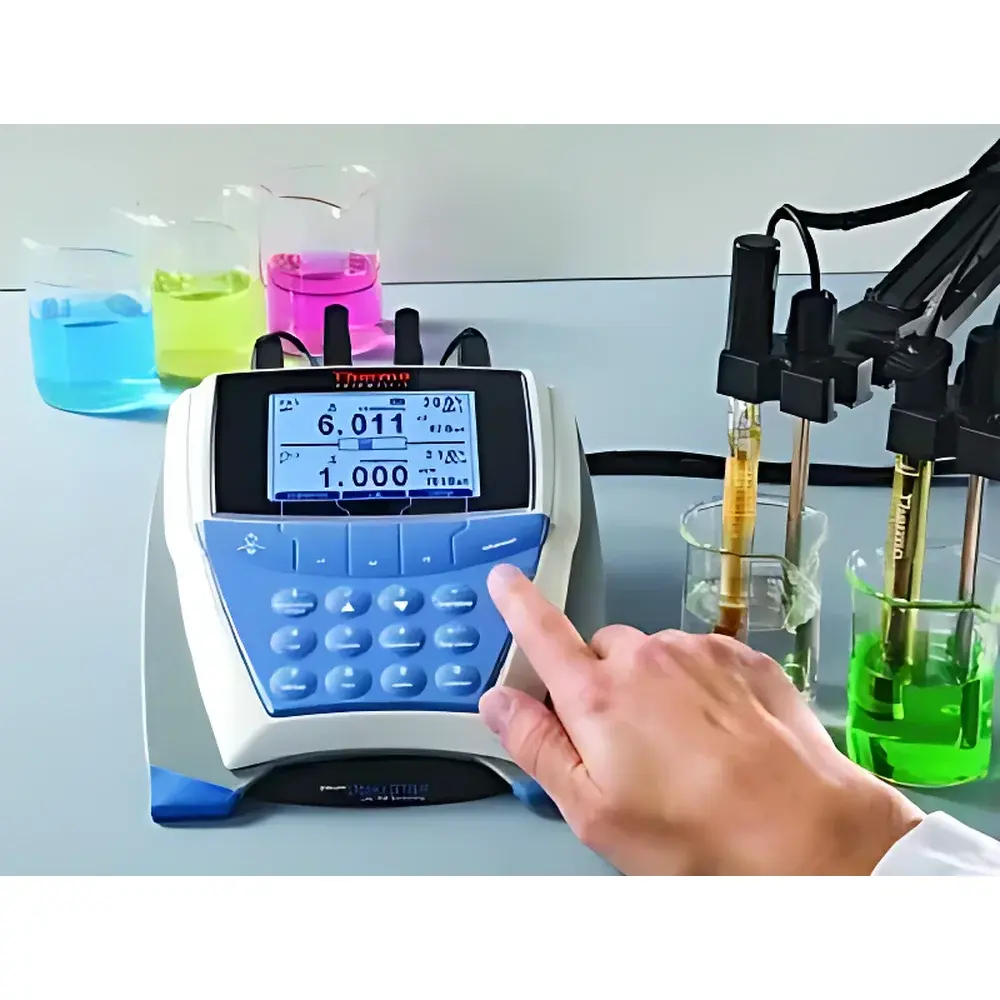
Thermo Fisher Orion Dual Star D10P-48 Cadmium Ion Analyzer
| Brand | Thermo Fisher |
|---|---|
| Origin | USA |
| Manufacturer | Thermo Fisher Scientific |
| Product Type | Imported Instrument |
| Model | D10P-48 |
| Price | Upon Request |
| Electrode | 9648BNWP Cd²⁺ Composite Electrode |
| Cd²⁺ Measurement Range | 0.01–11,200 ppm |
| pH Range | 2–12 |
| Temp. Range (Continuous) | 0–80°C |
| Temp. Range (Intermittent) | 80–100°C |
| Reproducibility | ±4% |
| Electrode Dimensions | 110 mm (L) × 13 mm (body Ø) × 16 mm (cap Ø) |
| Cable Length | 1 m |
| Ion Concentration Resolution | 1–3 significant digits |
| Relative Accuracy | ±0.1 mV or ±0.05% (whichever is greater) |
| pH Range | −2.000 to 19.999 |
| pH Accuracy | ±0.001 |
| ORP Range | ±1999.9 mV |
| Temp. Accuracy | ±0.1°C |
| Data Storage | 1000 entries with timestamp |
| GLP Compliance | Yes |
| Communication | RS232 (bidirectional), optional USB |
| Enclosure Rating | IP54 |
| Certifications | CE, CSA, UL, TÜV, FCC Class A |
Overview
The Thermo Fisher Orion Dual Star D10P-48 Cadmium Ion Analyzer is a laboratory-grade, dual-channel potentiometric measurement system engineered for precise, trace-level quantification of cadmium ions (Cd²⁺) in aqueous environmental and regulatory compliance samples. It operates on the principle of ion-selective electrode (ISE) potentiometry—measuring the potential difference between a cadmium-specific sensing membrane (9648BNWP composite electrode) and a stable reference electrode under controlled ionic strength conditions. This Nernstian response enables direct, interference-minimized determination of free Cd²⁺ activity across a wide dynamic range (0.01–11,200 ppm), critical for wastewater effluent monitoring, drinking water safety verification, soil leachate analysis, and EPA Method 6010D/7000B-compliant testing. The instrument integrates rigorous electrochemical metrology with robust hardware architecture—including dual BNC inputs, dual ATC (Automatic Temperature Compensation) ports, and dual reference electrode interfaces—to support simultaneous pH and Cd²⁺ measurement or dual-ion analysis, ensuring data integrity and method flexibility required in certified environmental laboratories.
Key Features
- Dual-channel architecture enables concurrent measurement of Cd²⁺ concentration and pH—or two independent ISE parameters—on a single platform, reducing analysis time and cross-contamination risk.
- Orion 9648BNWP cadmium-selective composite electrode features a solid-state, polymeric membrane optimized for high selectivity against common interferents including Pb²⁺, Zn²⁺, Cu²⁺, and Ca²⁺ under regulated ionic strength conditions (using included 940011 ISA).
- Advanced calibration protocols: supports 2–6 point calibration, single/dual standard addition/subtraction methods, and automatic blank correction—essential for complex matrices such as industrial wastewater or sediment pore water.
- Full GLP compliance: password-protected method storage (up to 10 per channel), audit-trail-enabled data logging (1000 entries with date/time stamp), and electronic signature-ready reporting aligned with ISO/IEC 17025 and EPA-approved QA/QC workflows.
- Intuitive dual-line LCD display shows real-time Cd²⁺ concentration (ppm, mg/L, M, or %), corresponding mV potential, sample temperature, and ion name—eliminating manual unit conversion errors.
- Temperature compensation via integrated 927007MD thermistor probe (±0.1°C accuracy) ensures Nernst slope correction across 0–105°C, with configurable isothermal point settings for method reproducibility.
- RS232 bidirectional interface supports direct connection to LIMS or spreadsheet software; optional USB adapter enables firmware updates and secure data export compliant with FDA 21 CFR Part 11 requirements.
Sample Compatibility & Compliance
The D10P-48 is validated for use with natural waters, treated effluents, groundwater, surface runoff, and digested soil extracts—provided samples are filtered (≤0.45 µm), adjusted to pH 2–12, and stabilized with Orion Ionic Strength Adjuster (ISA). It meets performance criteria specified in U.S. EPA Methods 6010D (ICP-OES confirmation) and 7000B (potentiometric ISE screening), and supports ISO 10523 (pH) and ISO 10304-1 (ion chromatography cross-validation). All measurements adhere to ASTM D3590 and EN ISO 11885 guidelines for metal speciation in environmental matrices. The instrument’s CE, CSA, UL, and TÜV certifications confirm conformance with IEC 61010-1 safety standards for laboratory electrical equipment.
Software & Data Management
Data acquisition and method execution are governed by embedded firmware supporting 20 user-defined analytical methods—each configurable with unique calibration curves, units, temperature coefficients, and ISA volume corrections. Stored results include raw mV, calculated concentration, electrode slope (%Nernst), temperature, operator ID (via password entry), and method version. Exported CSV files retain full metadata for traceability. The graphical calibration curve display allows visual verification of linearity (R² ≥ 0.999 typical) and outlier detection prior to reporting. Firmware updates preserve historical calibration data and comply with change control documentation requirements under GLP and GMP frameworks.
Applications
- Regulatory compliance testing for Cd²⁺ in municipal and industrial wastewater discharges (e.g., NPDES permits).
- Drinking water source monitoring per WHO Guideline Values (3 µg/L) and U.S. EPA MCL (5 µg/L).
- Leaching studies (TCLP, SPLP) evaluating cadmium mobility from contaminated soils and construction materials.
- Process control in electroplating, battery recycling, and pigment manufacturing facilities.
- Research applications in aquatic toxicology, where free Cd²⁺ activity—not total metal—is the biologically relevant parameter.
- Field-deployable verification when paired with portable power supplies and ruggedized electrode holders (IP54-rated enclosure).
FAQ
What electrode is required for cadmium measurement on the D10P-48?
The Orion 9648BNWP cadmium-selective composite electrode is mandatory; it incorporates a proprietary PVC-based ionophore membrane with optimized selectivity coefficients (log KCd,Zn = −2.1, log KCd,Pb = −1.8) per IUPAC recommendations.
Can the instrument measure other ions without hardware modification?
Yes—the D10P-48 accepts any Orion or third-party BNC-compatible ISE (e.g., fluoride, nitrate, ammonia) or pH electrode; method parameters and calibration curves are software-configurable per channel.
Is temperature compensation mandatory for accurate Cd²⁺ readings?
Yes—Nernst slope varies with temperature (−1.98 mV/°C per decade at 25°C); the 927007MD ATC probe must be used for all quantitative analyses to meet ±4% reproducibility specifications.
How does the instrument handle high-ionic-strength samples?
The included 940011 Ionic Strength Adjuster (ISA) maintains constant background electrolyte concentration (typically 0.1 M NaNO₃), minimizing activity coefficient drift and ensuring linear response across the full 0.01–11,200 ppm range.
Does the D10P-48 support automated sampling?
Yes—it is compatible with Orion Auto-Sampler AS-50 and third-party XYZ robotic platforms via RS232 command protocol, enabling unattended batch analysis of up to 96 samples with programmable rinse cycles.
Related Products







