
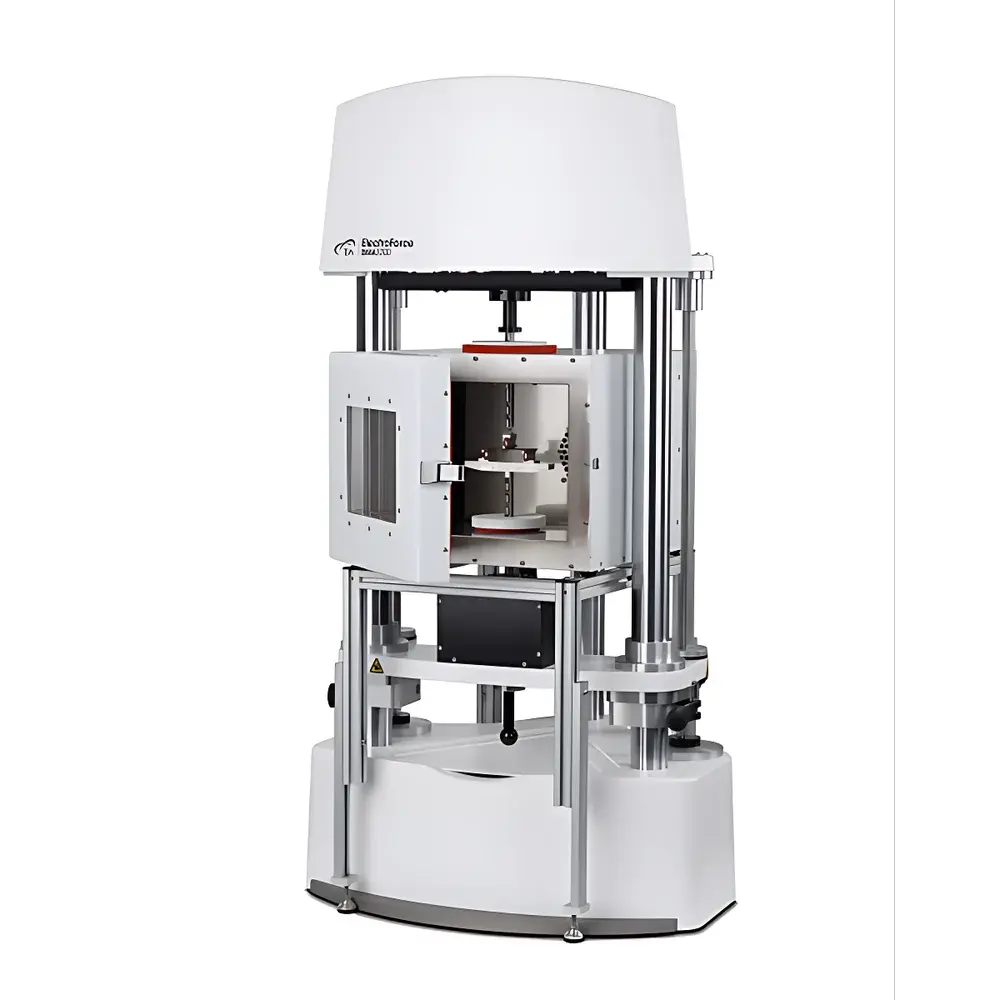
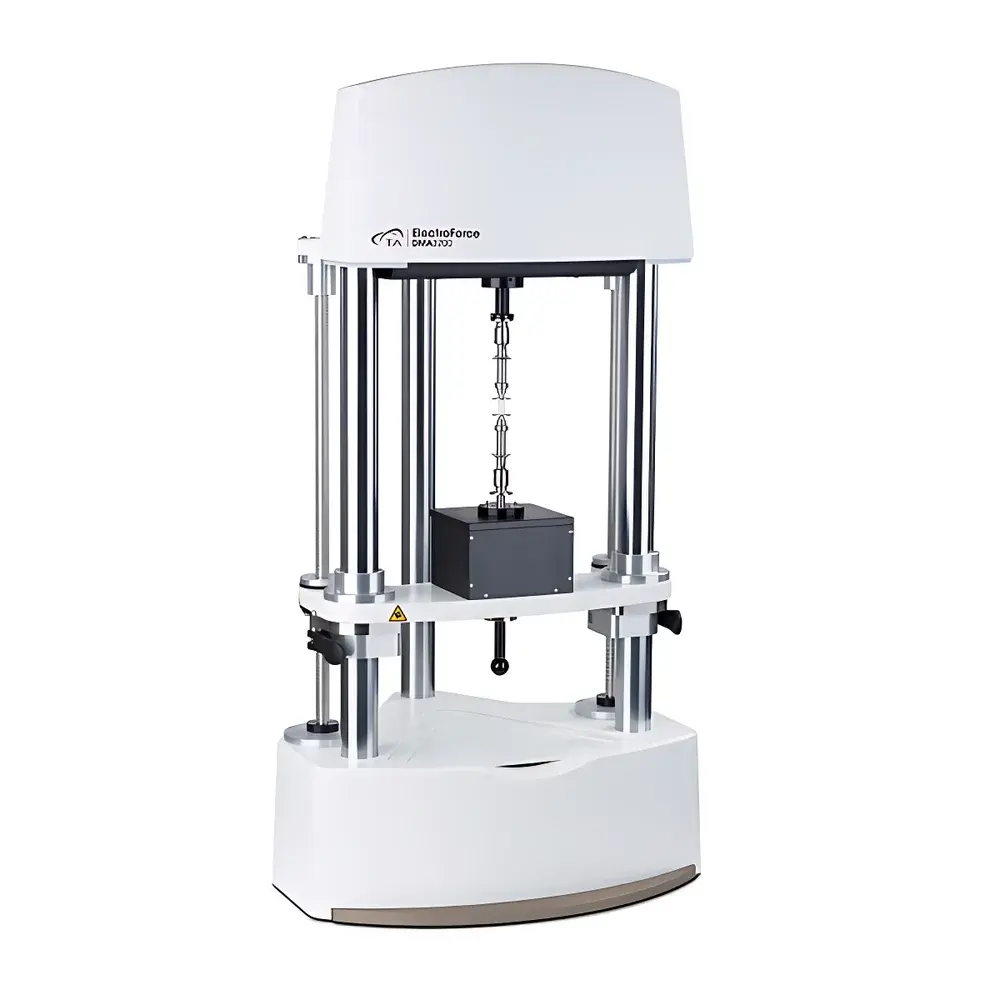
ElectroForce® 3200 Series Electromechanical Testing System
| Brand | TA Instruments |
|---|---|
| Origin | USA |
| Model | ElectroForce® 3200 Series |
| Frequency Range | 0.0001 – 300 Hz |
| Force Capacity Options | ±225 N or ±450 N (standard) |
| Optional Torsion Motor | 14 N·m or 25 N·m |
| Optional Linear Extension | +150 mm stroke |
| Encoder Resolution | High-resolution optical encoder (torsion mode, up to 62 revolutions) |
| Environmental Compatibility | Integrated with temperature chambers, saline baths, and bioreactors |
| Sensor Range | ±0.002 N to ±450 N (interchangeable load cells) |
| Drive Type | Direct-drive linear electromagnetic motor |
Overview
The ElectroForce® 3200 Series is a high-precision, electromechanical testing system engineered for dynamic mechanical characterization under controlled force, displacement, strain, and frequency conditions. Based on closed-loop electromagnetic actuation—free of hydraulic fluid, gear backlash, or servo-valve hysteresis—the system delivers exceptional waveform fidelity, phase accuracy, and long-term repeatability across a broad operational spectrum (0.0001–300 Hz). Its modular architecture supports axial, axial-torsional, and axial-extension configurations, enabling rigorous evaluation of viscoelastic, fatigue, creep, stress-relaxation, and cyclic deformation behavior in polymeric, metallic, composite, biomaterial, and soft tissue specimens. Designed for compliance with GLP/GMP environments and aligned with ASTM E4, E8, E21, D638, D790, ISO 527, ISO 178, and USP mechanical testing guidelines, the 3200 Series serves as a reference-grade platform for R&D laboratories, quality control facilities, and regulatory submission studies.
Key Features
- Direct-drive electromagnetic actuator with zero-maintenance operation, eliminating oil contamination, thermal drift, and nonlinear flow dynamics inherent in hydraulic systems
- Interchangeable high-accuracy load cells spanning ±0.002 N to ±450 N, calibrated traceably to NIST standards; optional upgrade paths to ±1000 N or ±3000 N axial capacity
- High-resolution optical rotary encoder integrated into torsional motor modules (14 N·m or 25 N·m), supporting precise torque control and angular displacement measurement up to 62 full revolutions
- Optional 150 mm stroke extension motor for high-elongation testing of elastomers, hydrogels, and fiber-reinforced composites without mechanical linkage compromise
- Quiet, compact desktop frame (< 72 dB(A)) constructed from vibration-damped aluminum alloy—certified for Class 1000 cleanroom use and compatible with ISO 14644-1 compliant environments
- Fully programmable control architecture supporting simultaneous multi-axis waveforms (e.g., superimposed axial tension + torsional oscillation), dwell steps, ramp profiles, and user-defined spectral loading
Sample Compatibility & Compliance
The 3200 Series accommodates diverse specimen geometries—from microtensile coupons (0.5 mm wide) to orthopedic implant components—via standardized ISO/ASTM-compliant grips, pneumatic clamps, cryogenic fixtures, and custom-engineered holders. Environmental integration includes thermostatic chambers (−70 °C to +300 °C), corrosion-resistant saline immersion baths, and sterile bioreactor modules with pH/O2 monitoring ports. All hardware and firmware comply with FDA 21 CFR Part 11 requirements for electronic records and signatures when paired with TA Instruments’ TRIOS software configured for audit-trail-enabled operation. System validation documentation—including IQ/OQ/PQ protocols, uncertainty budgets per ISO/IEC 17025, and metrological traceability statements—is provided upon request.
Software & Data Management
TRIOS software (v10.x or later) provides full instrument control, real-time data acquisition at up to 10 kHz sampling rate, and automated test method execution per ASTM D7028 (DMA), D3410 (compressive properties), or ISO 10365 (fatigue life mapping). Built-in analysis modules support time–temperature superposition (TTS), master curve generation, hysteresis loop quantification, and Weibull-based fatigue life prediction. Data export conforms to ASTM E1447 (ASCII), HDF5, and .tdms formats; metadata embedding includes operator ID, environmental logs, calibration timestamps, and sensor serial numbers. Secure role-based access controls, encrypted database storage, and configurable electronic signature workflows ensure alignment with GxP and ISO 9001 quality management systems.
Applications
- High-cycle and low-cycle fatigue testing of cardiovascular stents, suture anchors, and spinal fusion devices under physiological loading waveforms
- Mechanical spectroscopy of thermoplastic elastomers and shape-memory polymers across glass transition regions
- Creep-recovery profiling of pressure-sensitive adhesives and soft robotics actuators
- Dynamic shear modulus determination in hydrogel-based wound dressings and cartilage mimetics
- Multi-axial fatigue simulation of aerospace composite laminates using synchronized axial–torsional loading
- Regulatory-compliant mechanical validation of ISO 13485-certified medical device packaging under accelerated aging protocols
FAQ
What is the minimum resolvable force in the lowest-range configuration?
The ±0.002 N load cell provides sub-micron resolution with noise floor < 0.0001 N RMS under ambient conditions.
Can the system perform tests under submerged or humidified conditions?
Yes—integrated saline bath modules and humidity-controlled environmental chambers are available with IP54-rated motor enclosures and corrosion-resistant stainless-steel load train components.
Is the system compatible with third-party DAQ or control platforms?
The 3200 Series supports IEEE 488.2 (GPIB), Ethernet TCP/IP, and USB 2.0 interfaces with SCPI command set; LabVIEW, MATLAB, and Python API libraries are provided for custom automation.
How is calibration maintained over extended service intervals?
Load cells feature internal shunt calibration verification; system-level verification uses NIST-traceable deadweight standards and dynamic calibration rigs per ISO 376 Annex C.
Does the software support automated pass/fail criteria for QC release testing?
Yes—TRIOS allows definition of statistical tolerance bands, slope thresholds, and area-under-curve limits with automatic flagging and PDF report generation per ISO/IEC 17025 clause 7.8.
Related Products



